
Category: Uncategorized
-
How Mathematical Reasoning Changes From G3 Additional Mathematics to H2 Mathematics | K341 → 9758
A first-principles mega guide to how mathematical reasoning changes from SEC G3 Additional Mathematics K341 to H2 Mathematics 9758: premises, deduction, proof, method justification, multi-step arguments, counterexamples, modelling, verification and reasoning under mixed-topic load.
-
How to Diagnose H2 Mathematics Readiness Before JC Begins | A Pre-JC Mathematical Systems Audit
A first-principles mega guide to diagnosing H2 Mathematics readiness before JC begins: algebraic stability, functions, graphs, trigonometry, calculus, mixed-topic transfer, graphing-calculator judgement, retrieval, endurance, probability-and-statistics readiness and subject-planning evidence.
-

How Probability and Statistics Change the H2 Mathematics Workload | Why H2 Is Not Just More Pure Mathematics
A first-principles mega guide to how probability and statistics change H2 Mathematics 9758: Paper 2 load, probability models, random variables, binomial and normal distributions, sampling, hypothesis testing, correlation and regression, calculator use, interpretation and revision planning.
-

How Graphing Calculators Change Mathematics in H2 | From Calculation Tool to Mathematical Instrument
A first-principles mega guide to how approved graphing calculators change H2 Mathematics 9758: graphs, numerical solving, tables, intersections, calculus, statistics, verification, calculator state, exactness, working requirements and mathematical judgement.
-
How Calculus Changes From G3 Additional Mathematics to H2 Mathematics | K341 → 9758
A first-principles mega guide to how calculus changes from SEC G3 Additional Mathematics K341 to H2 Mathematics 9758: broader function families, implicit and parametric differentiation, connected rates, Maclaurin series, integration techniques, differential equations, modelling and mathematical endurance.
-

How Algebraic Fluency Changes From G3 Additional Mathematics to H2 Mathematics | K341 → 9758
A first-principles mega guide to how algebraic fluency changes from SEC G3 Additional Mathematics K341 to H2 Mathematics 9758: symbolic density, functions, logarithms, inequalities, exactness, rearrangement, graphing-calculator judgement, method selection and mathematical endurance.
-
How Mathematical Structure Works | Seeing the System Beneath the Surface
Mathematical structure is the hidden organisation beneath numbers, expressions, equations, graphs, geometry, functions, proof and models. This guide explains structural thinking, patterns and relationships, parts and wholes, properties, operations, representations, algebraic structure, functional reasoning, connections, invariants and transfer—and why seeing structure is one of the main ways mathematics becomes coherent rather than a collection of…
-
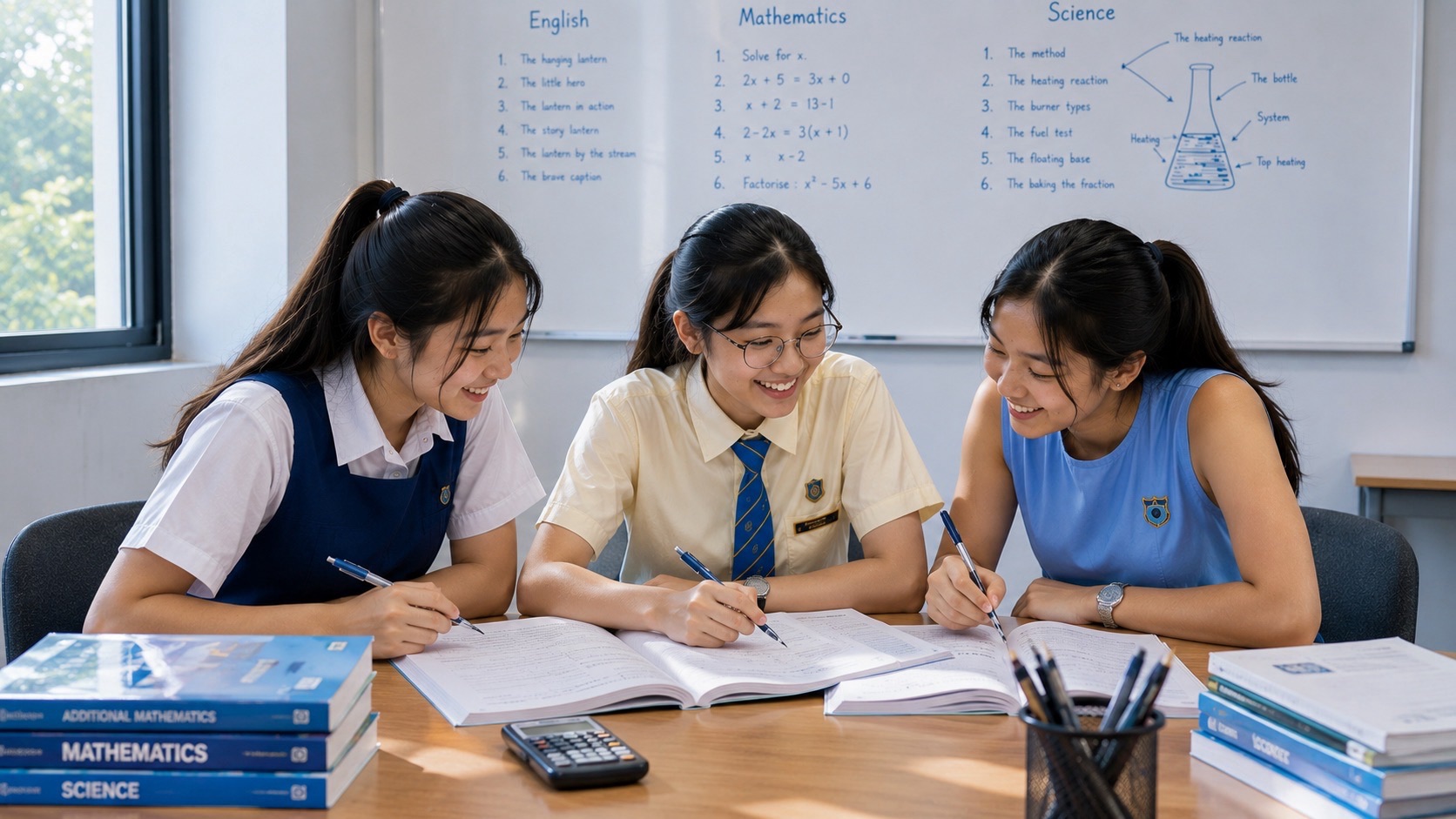
How Accuracy, Significant Figures, Rounding & Units Work in SEC Secondary Mathematics | G1, G2 & G3 (2027)
How answer accuracy works across Singapore’s 2027 SEC G1, G2 and G3 Mathematics: significant figures, decimal places, rounding, degree angles, intermediate precision, exact values, π and units.
-

How Functions Bridge Additional Mathematics to H2 Mathematics | From G3 A-Math to 9758
A first-principles mega guide to how functions bridge G3 Additional Mathematics and H2 Mathematics 9758: domain and range, one-one functions, inverse and composite functions, graphs and transformations, equations and inequalities, graphing-calculator use, calculus links and the transition from SEC to JC mathematics.