
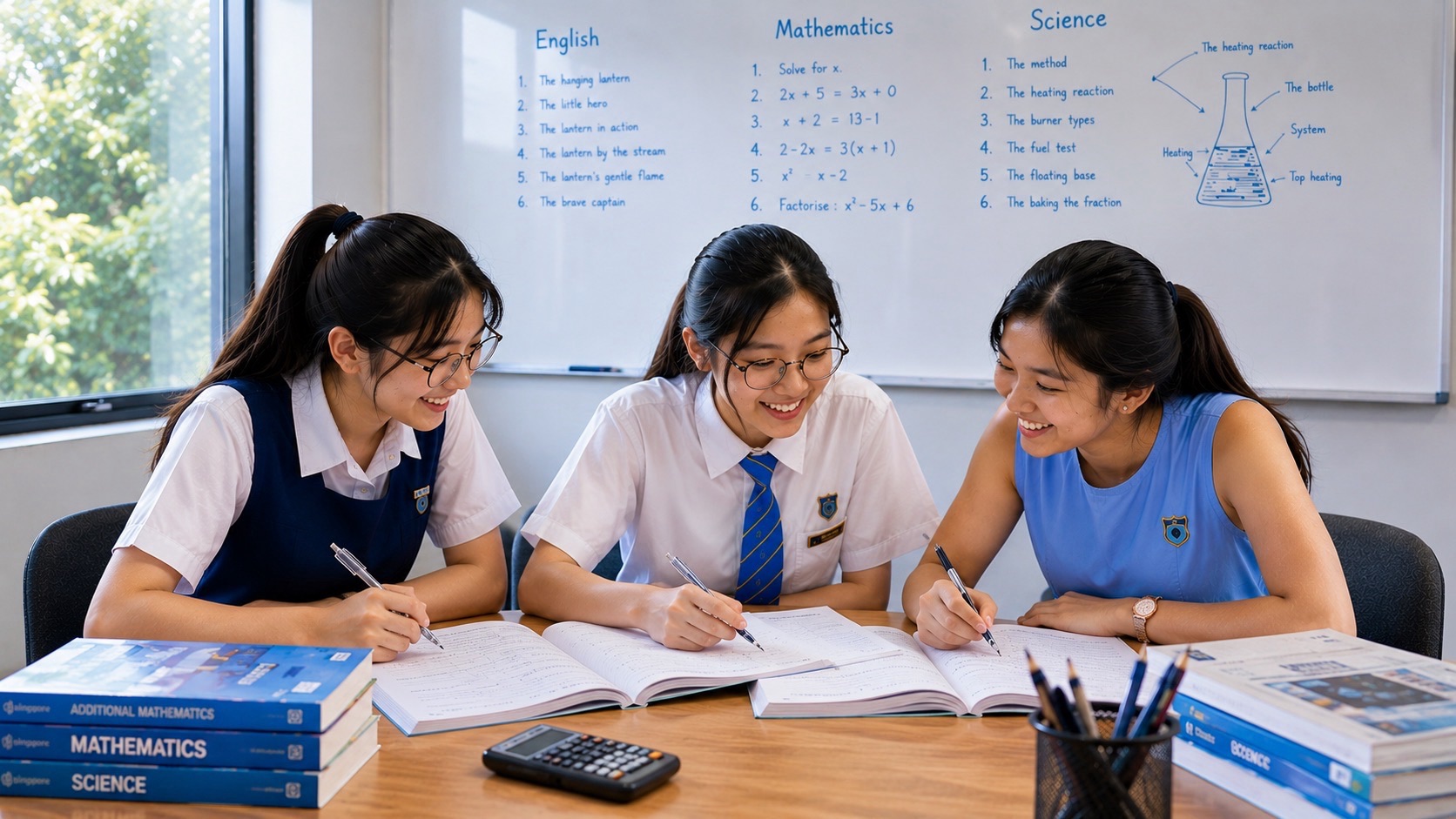
Secondary 4 Additional Mathematics past-year papers are most useful when they are treated as a training system rather than a pile of old examinations.
A past paper can test syllabus retrieval, paper strategy, question recognition, timing, working, checking and examination stamina. But the same paper can also be wasted if it is attempted too early, marked only by final answers, repeated immediately from memory or selected without regard to the student’s actual route and current weaknesses.
This guide explains how to select, sequence, attempt, mark, analyse and re-enter past-year paper work for Secondary 4 Additional Mathematics under the SEC G2 K232 and G3 K341 routes. It also explains why older papers can still be mathematically valuable while official current syllabus documents remain the authority for what is examinable now.
For school-based prelim use, read How Secondary 4 Additional Mathematics Prelim Papers Work. For full-paper conditions, use How Secondary 4 Additional Mathematics Full-Paper Simulation Works.
1. Past Papers Are Samples, Not the Syllabus
A past paper shows how mathematics was assessed in one examination sitting.
It does not define the complete set of mathematics that can be examined in a later sitting.
The current official syllabus remains the boundary owner.
2. Selection Should Begin With Syllabus Compatibility
Before using an older paper, check whether the content and paper structure align with the student’s current syllabus.
Where syllabus transitions have occurred, an older question can still be useful as mathematics even if the paper itself is no longer an exact examination simulation.
Separate mathematical value from structural fidelity.
3. A Current-Route Paper Has the Highest Simulation Value
The closer a paper is to the student’s actual syllabus, timing and assessment structure, the more useful it is for full-paper simulation.
Use current-route material when testing examination fidelity.
Use older compatible questions more flexibly for training individual mathematical demands.
4. Older Questions Can Still Be Excellent Practice
Quadratic reasoning, algebraic control, trigonometric structure and calculus do not lose educational value merely because the source paper is older.
The key is to know what job the question is performing now.
A question can be valuable as technique practice without being treated as a current-paper predictor.
5. Do Not Start With Full Papers Automatically
A student who still has major content gaps may learn more from carefully selected past-paper questions than from complete papers.
Full papers add timing, switching and endurance demands.
Add those layers when the component mathematics is ready to be tested together.
6. Use Past Papers in Several Modes
- Topical extraction
- Mixed untimed sections
- Timed partial papers
- Full-paper simulation
- Delayed re-entry after correction
The same source can serve different purposes at different stages.
7. Topical Extraction Builds Technique
Extract several questions sharing one mathematical structure.
This helps the learner compare variants and build fluency.
Topical extraction is especially useful early in repair.
8. Mixed Extraction Builds Recognition
Once technique is stable, combine questions from different chapters.
Remove topic labels and let the student decide what mathematics belongs.
This changes the task from execution to routing plus execution.
9. Partial Papers Build Paper Behaviour
A timed section can test pacing, switching and leaving without consuming the time of a full paper.
This is a high-value bridge between mixed practice and complete examination simulation.
Use partial papers when one paper-level mechanism needs repeated testing.
10. Full Papers Test the Assembled System
Full papers reveal whether all components continue to work together under sustained conditions.
They test endurance, switching, time allocation, checking and independent decision-making in one continuous run.
This makes them powerful but expensive diagnostic instruments.
11. Sequence From Learning to Release
A useful progression is learn → topical attempt → mixed attempt → timed section → full paper → analysis → repair → delayed re-entry.
The progression gradually removes supports and adds realistic performance demands.
Do not jump directly from worked examples to repeated full papers.
12. Paper Order Should Be Intentional
Random paper selection can create random information.
Choose the next paper because it tests a specific question: score stability, unfamiliar wording, endurance, AO2, linked parts or broad retrieval.
Every paper should have a reason for being next.
13. Save Some High-Fidelity Papers for Late Testing
If every recent paper is used early for untimed practice, the student may remember too much of the content when later simulation begins.
Reserve some fresh material for genuine late-stage release testing.
Novelty is part of examination fidelity.
14. Repeated Exposure Can Create False Improvement
A second attempt usually improves because the student remembers the question, method or correction.
That improvement is not useless, but it should not be interpreted as independent transfer automatically.
Use changed questions and delayed re-entry to test whether the learning generalised.
15. Immediate Re-attempt Tests Reconstruction
After correction, asking the student to reproduce the route can confirm that the explanation was understood.
This is useful, but it is only the first repair stage.
Durability must be tested later.
16. Delayed Re-entry Tests Memory
Return to the same or structurally similar question after time has passed.
Can the student still recognise and execute the method without the correction being active in short-term memory?
This is a stronger test of repair.
17. Changed Re-entry Tests Transfer
Change the numbers, representation, wording or topic surface while preserving the core structure.
If the student succeeds, the method has become more portable.
Transfer is more valuable than memory of one paper.
18. Marking Must Go Beyond the Final Answer
A correct final answer can hide weak reasoning. A wrong final answer can follow mostly correct method.
Use the available marking scheme to inspect method evidence and essential working.
Then use teaching analysis to understand the mechanism beneath the mark allocation.
19. Marking Schemes Are Compressed Assessment Documents
A scheme shows what evidence earns marks.
It is not always designed to teach the concept from first principles.
Students should not mistake a compressed scheme line for a complete model solution.
20. Record the First Wrong Event
Do not copy the entire correct solution before finding where the student’s route first became invalid.
The first wrong event tells us what should change next time.
Correction should target that event directly.
21. Record the Cost of Correct Questions
A question solved correctly but far too slowly remains a performance problem.
Record time cost separately from correctness.
Later practice can target recognition or method economy.
22. Record the Questions That Were Left
Strategic leaving can be good paper management.
But repeated abandonment of one question family reveals a gap.
Past-paper analysis should distinguish sensible leaving from avoidance.
23. Record Repeated Error Types
Sign errors, interval omissions, exactness failures and lost conditions often recur across years and topics.
These repeated mechanisms are more important than the paper year.
Build prevention rules from them.
24. Past Papers Reveal What the Student Cannot Yet Do Independently
During lessons, hints and context may conceal dependence.
A past paper removes that support.
The gap between supported and independent performance is valuable diagnostic evidence.
25. Past Papers Should Not Replace Concept Learning
Repeated exposure can teach pattern matching without deep understanding.
If the student cannot explain why the method works or transfer it to changed conditions, return to the concept.
Past papers test capability; they do not automatically build every missing capability.
26. Past Papers Should Not Replace Mixed Practice
Full papers are too expensive to isolate every weakness.
After a paper identifies a problem, targeted mixed sets can repair it more efficiently.
Then the next paper tests whether the repair survives.
27. Past Papers Should Not Become Prediction Engines
Counting how often a topic appeared in previous years does not guarantee future appearance or absence.
Use frequency only as historical description.
Prepare the current syllabus comprehensively.
28. Past Papers Can Train Command Words
Real examination wording exposes students to the language of find, show, prove, hence, sketch and interpret.
Record whether errors come from mathematics or from misunderstanding the task contract.
Question language is part of performance.
29. Past Papers Can Train Answer Forms
Exact form, rounded form, intervals, coordinates, equations and written conclusions each require different exits.
Past papers show these demands in authentic combinations.
Students should learn to finish the job requested, not merely finish a calculation.
30. Past Papers Can Train Linked Parts
Multi-part questions reveal whether the student reuses earlier results efficiently.
Track missed “hence” opportunities and unnecessary re-derivations.
Result handoffs are a recurring source of avoidable cost.
31. Past Papers Can Train Checking
After completing a paper, identify which errors could realistically have been caught before submission.
Develop a targeted checking map around those failure types.
The next paper tests whether the checking routine works at speed.
32. Past Papers Can Train Strategic Leaving
Students need experience deciding when a blocked question is no longer earning information.
Practise preserving a restart point and returning later.
This is a paper skill that worksheets rarely teach.
33. Past Papers Can Train Endurance
As the examination approaches, full papers test whether mathematical quality survives the official duration.
Compare early and late error rates.
Endurance means preserving quality, not merely remaining seated.
34. Build a Paper Bank by Job
Instead of storing papers only by year, label their training role.
- Baseline paper
- AO2-heavy paper
- Endurance simulation
- Mixed-topic repair source
- Late-stage fresh release paper
This makes selection purposeful.
35. Strong Students Need Freshness
For high-attaining students, repeated familiar papers can create inflated confidence.
Protect some unseen or less familiar material for later-stage testing.
Strong mathematics should survive novelty.
36. Recovering Students Need Selective Paper Use
A low-attaining student may learn little from repeated complete-paper failure.
Extract high-value questions, repair foundations and then return to longer sections.
Paper practice should be scaled to the student’s current operating level.
37. G2 K232 Papers Should Be Used as K232 Training
Use current G2 material when testing K232 paper fidelity and assessment balance.
Older compatible questions can supplement mathematics, but they should not overwrite the official K232 structure.
The current syllabus owns the route.
38. G3 K341 Papers Should Be Used as K341 Training
Use current G3 material when testing K341 timing, weighting and question demand.
Historical Additional Mathematics material can still train transferable content while being labelled appropriately.
Do not confuse useful mathematics with current structural equivalence.
39. A Useful Past-Paper Audit
- Why was this paper selected?
- Is it structurally current or mathematically supplementary?
- Was it attempted topically, partially or fully?
- Were method marks analysed?
- What was the first wrong event in major losses?
- Which error patterns recurred?
- What changed after marking?
- When and how will the repair be re-tested?
40. The BTT Mathematical Lab Can Change the Paper Mode
The BTT Mathematical Lab can take one past-paper question and change the conditions around it.
Add or remove the timer. Remove the topic label. Change the representation. Delay re-entry. Supply the method and isolate execution.
The paper becomes a source of experiments rather than a one-use worksheet.
41. Official SEC Reference
For current examination boundaries, use SEAB’s official 2027 school-candidate listings for G2 Additional Mathematics K232 and G3 Additional Mathematics K341. Past papers should be interpreted through the student’s present syllabus rather than treated as timeless structural templates.
42. The Deeper Idea
A past paper is not valuable because it came from the past.
It is valuable because it creates a controlled opportunity to test whether mathematics can be recognised, executed and recovered under unfamiliar examination conditions.
The best use of a past paper is not to finish it. It is to extract enough evidence from it that the next performance becomes more reliable than the last.