
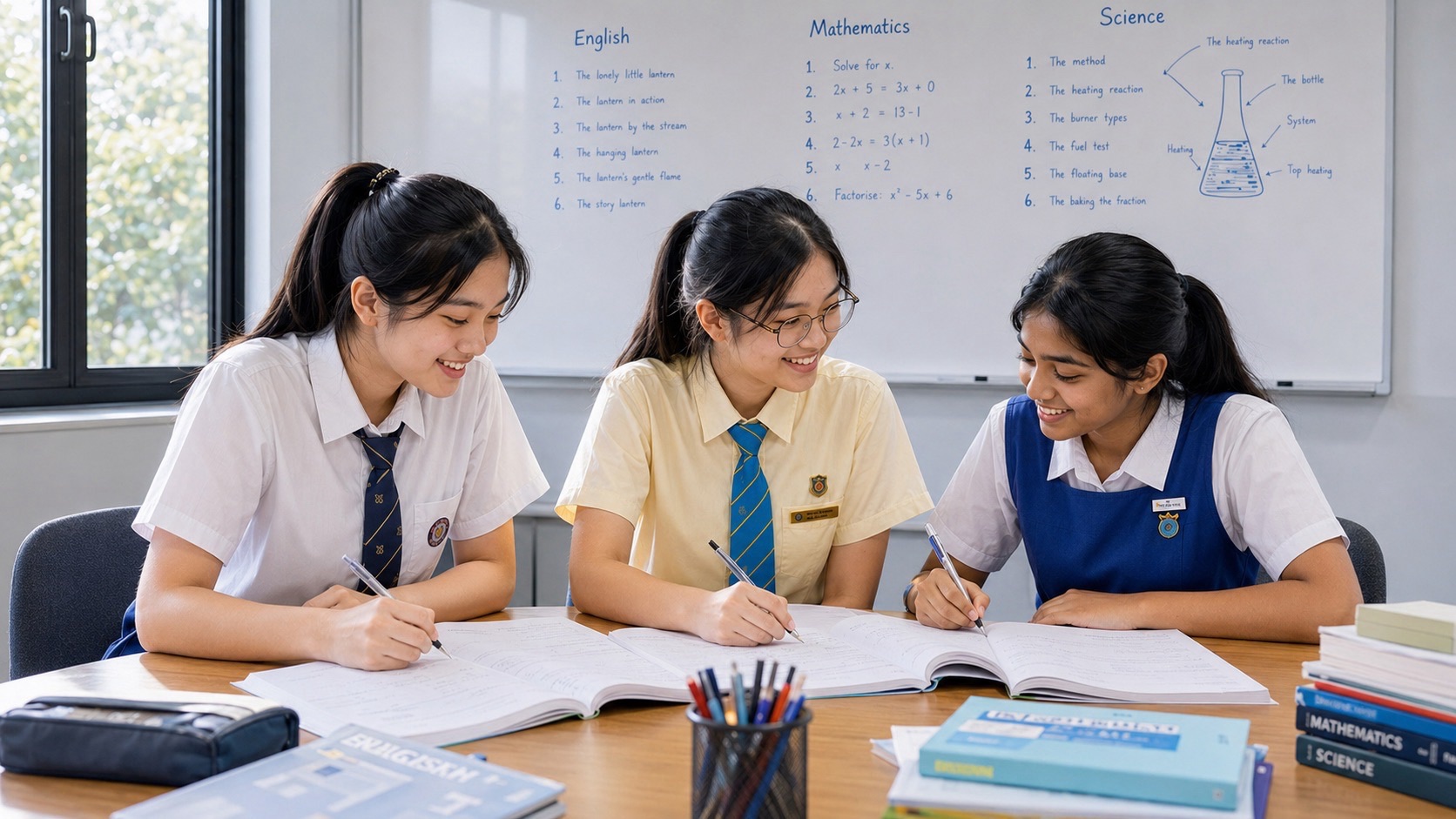
Secondary 4 Additional Mathematics independence means the student can increasingly run the mathematical process without waiting for another person to tell them what to notice, what to try, whether the step is right or when to stop.
This is one of the most important changes in the examination year. The tutor will not sit beside the student in the SEC paper. The chapter heading will not announce the method. An answer key will not confirm the first line. The learner has to read, choose, execute, check, recover and move on.
Independence does not mean working without teaching. It means teaching is gradually converted into student-owned control. This guide explains how metacognition, hint fading, self-correction, retrieval, calibration and paper management work together across the Secondary 4 SEC Additional Mathematics routes, where Additional Mathematics is offered at G2 as K232 and at G3 as K341.
For the wider subject system, begin with How Secondary 4 Additional Mathematics Works. For error repair, use How Secondary 4 Additional Mathematics Error Diagnosis Works.
1. Independence Is Not Silence
A student can work quietly for an hour and remain highly dependent.
The learner may still rely on chapter labels, worked examples, answer keys or invisible routines supplied by the environment.
Real independence is measured by who owns the decisions.
2. The Examination Removes the Tutor
This fact should shape the whole Secondary 4 programme.
The tutor cannot say “use the identity”, “differentiate now”, “check the interval” or “leave this question and return later”.
Those decisions must eventually become internalised by the student.
3. Metacognition Means Thinking About the State of Your Own Mathematics
Metacognition is the learner’s ability to monitor what they understand, what remains uncertain and what strategy is currently being used.
Instead of saying “I am bad at trigonometry”, a more metacognitive student may say, “I know the identities, but I fail to find all solutions when the interval changes.”
That precision makes self-correction possible.
4. Good Self-Knowledge Is Specific
Large labels such as weak, careless or slow are difficult to act on.
Specific descriptions are better: slow recognition, unstable algebra after differentiation, over-checking easy questions, calculator mode errors, or difficulty restarting after one wrong turn.
Independence grows when the student can identify the mechanism, not merely feel the symptom.
5. The Student Should Know What They Know
Secure knowledge should be distinguishable from recent familiarity.
A student may feel confident because the topic was just revised. Delayed retrieval and mixed practice provide a more honest test.
Accurate self-knowledge requires evidence under changing conditions.
6. The Student Should Know What They Do Not Yet Know
Independence is not pretending everything is understood.
A learner should be able to identify when a concept needs explanation rather than hiding the gap behind copied procedures.
Knowing when to seek help is itself a form of metacognitive control.
7. Help Should Reduce Over Time
Effective teaching often begins with substantial support.
The problem begins when the same level of support remains after the student is capable of carrying more of the decision load.
Secondary 4 should therefore include deliberate fading of help.
8. Hint Length Is Not Hint Size
A five-word hint can do most of the mathematical work.
“Try differentiation” names the method family. “Use the previous result” identifies the dependency. “Check radians” locates the failure layer.
Hints should therefore be measured by how much decision-making they remove from the student.
9. Hint Fading Should Remove Decision Content
A useful progression can move from full explanation to guided reconstruction, then to a general question, then to silence.
The tutor may begin by naming the method, later ask what feature of the question matters, and eventually wait for the student to identify the route independently.
The goal is transfer of ownership.
10. Productive Struggle Needs a Boundary
Independence is not built by abandoning the student indefinitely.
Struggle is useful while the learner is generating and testing plausible moves. It becomes less useful when the student is repeating random operations without information gain.
The tutor’s job is to preserve responsibility without allowing confusion to harden into habit.
11. The Student Should Learn a Starting Routine
Many dependent students wait for a hint because they do not have an internal starting process.
A useful routine is: identify the target, list the decisive givens, choose a representation, identify the likely mathematical family and attempt one defensible step.
This does not guarantee a solution. It replaces passive waiting with structured entry.
12. The Student Should Learn a Stuck Routine
Being stuck should trigger a process rather than panic.
- What is the target?
- What have I already established?
- Which condition have I not used?
- Is another representation possible?
- Can I verify whether the current route is still valid?
- Should I preserve the work and return later?
This is metacognition translated into action.
13. Self-Correction Begins With Detection
A student cannot correct an error they cannot detect.
Checking strategies therefore form part of independence: substitution, estimation, units, graph behaviour, calculator-state checks and comparison with boundary conditions.
The learner should increasingly generate these checks without being prompted.
14. Detection Is Not Yet Repair
Knowing that an answer is wrong is only the first stage.
The student must locate the first doubtful event, identify the failure layer and decide what to change.
Self-correction becomes powerful when it is diagnostic rather than merely repetitive.
15. The Student Should Learn to Trust Evidence Over Feeling
An unfamiliar question can feel impossible before it has been inspected.
A familiar question can feel safe even when the method is only weakly remembered.
Metacognition requires the student to calibrate feeling against actual mathematical evidence.
16. Confidence Should Be Calibrated
Underconfidence can stop a student from attempting accessible work. Overconfidence can reduce checking and revision.
The goal is not maximum confidence. It is accurate confidence.
Repeated performance under realistic conditions is the strongest calibration mechanism.
17. Retrieval Is an Independence Test
If a student can only solve a topic immediately after revision, the knowledge still depends on proximity.
Delayed retrieval asks whether the student can call the mathematics when the original lesson is no longer present.
This is closer to the examination demand.
18. Mixed Practice Is an Independence Test
Chapter headings route the learner toward a method.
Mixed practice removes that routing and forces the student to classify the problem independently.
A drop in performance can reveal hidden dependence on environmental cues.
19. Variation Is an Independence Test
Changing the numbers, representation or wording tests whether the learner possesses the underlying structure.
A memorised example often collapses when the surface changes.
Independent knowledge should travel.
20. Timed Work Is an Independence Test
Under time, the student cannot rely on unlimited reconsideration.
Recognition, retrieval and routine algebra need enough fluency to preserve attention for reasoning.
Timed work reveals whether the student’s internal system is efficient enough to operate without external pacing.
21. Paper Strategy Is Metacognition at Scale
A complete paper requires the student to monitor not only one question but the state of the entire examination.
How much time remains? Which questions are unfinished? Where is persistence productive? Which answers need checking?
Paper-level independence is the ability to make these decisions without external rescue.
22. Strategic Leaving Is a Form of Self-Regulation
Leaving a difficult question temporarily can be a mature decision.
The student recognises diminishing returns, preserves useful working, reallocates time and returns later if possible.
This requires metacognition because the learner must evaluate the state of their own progress.
23. Strong Students Can Be Dependent Too
A high-performing student may depend on confirmation even when the mathematics is correct.
They may repeatedly ask whether the first line is right, whether the method is allowed or whether the answer looks acceptable.
Secondary 4 should reduce reassurance dependence alongside content dependence.
24. Reassurance Can Become a Hidden Hint
A nod, “yes”, or immediate correction can tell the student more than intended.
If the learner knows the tutor will stop them at the first wrong step, they may never develop their own error-detection threshold.
Sometimes the tutor should allow a plausible error to continue long enough for the student to encounter evidence that challenges it.
25. The Tutor Should Sometimes Withhold the Verdict
Instead of saying whether an answer is correct, ask how the student could check it.
This transfers verification from teacher to learner.
The goal is not to frustrate the student but to build an internal checking system.
26. Corrections Should Become Student-Owned
A correction is more valuable when the learner identifies the first wrong line and explains the error before seeing the full solution.
Over time, the tutor should shift from providing corrections to supervising the student’s correction process.
That is the path from feedback dependence to self-correction.
27. Error Logs Should Shrink Into Rules
A large error log can become another archive the student never uses.
Recurring errors should be compressed into simple prevention rules: write the interval first, mark the negative sign, keep exact values, return to the command, check calculator mode.
Independent students carry a small library of high-value rules into the paper.
28. Planning Is Part of Metacognition
A student should increasingly know what to revise and why.
Revision planning should respond to evidence: inactive topics, recurring errors, slow question families and upcoming assessment demands.
This replaces undirected “study more” with purposeful allocation.
29. Monitoring Is Part of Metacognition
During work, the learner should know whether the current route is progressing.
Are new constraints being used? Is the target getting closer? Is the algebra becoming more complicated without revealing anything?
Monitoring prevents long periods of unproductive persistence.
30. Evaluation Is Part of Metacognition
After completing a question, the student should ask whether the answer is plausible and whether the method was efficient.
A correct answer can still reveal a fragile route that should be improved.
Evaluation turns practice into information about future behaviour.
31. Independence Should Not Mean Refusing Help
A mature learner knows when help is justified.
The important distinction is whether help replaces thinking or unlocks the next stage of thinking.
Strategic help-seeking is more independent than silently rehearsing confusion for an hour.
32. Ask Better Help Questions
“I don’t know this” is less useful than “I formed the derivative but I cannot solve the resulting equation.”
Specific help requests show that the student has already diagnosed part of the problem.
This makes teacher support more efficient and preserves student ownership.
33. Independence Is Built Through Repeated Release Tests
A student should periodically attempt work with fewer supports.
No chapter label. No notes. No immediate hints. Mixed topics. Delayed retrieval. Then timed conditions.
Each test reveals which supports have become unnecessary and which are still carrying the performance.
34. Independence Can Fail Under Pressure
A student who works independently at home may become dependent again under examination stress.
They may mentally search for the tutor’s voice, freeze on unfamiliar wording or abandon checking.
This is why release testing must eventually include realistic timed conditions.
35. Recovery Is the Final Independence Skill
No student can guarantee that every first attempt will work.
Independent performance therefore depends on recovery: detect failure, preserve what remains valid, change representation, try another route or leave strategically.
Robust students are not students who never get stuck. They are students who know what to do when they get stuck.
36. Strong Students Need Independence From Perfection
High-attaining students can become trapped by the need to produce the perfect solution.
They may over-check, over-explain or spend too long seeking an elegant route.
Independence includes trusting a sufficiently verified solution and moving on.
37. Recovering Students Need Small Ownership Transfers
A struggling learner may not be ready for complete withdrawal of support.
Transfer one decision at a time: first choose the formula, then the first step, then the checking method, then the whole question.
Independence can be engineered gradually.
38. G2 Independence Builds the Bridge
G2 Additional Mathematics K232 is designed to prepare students adequately for G3 Additional Mathematics.
Progression requires more than content exposure. The student needs increasing independence in recognition, algebra, checking and mixed problem-solving.
These are the capabilities that make a higher level sustainable.
39. G3 Independence Protects the H2 Runway
G3 Additional Mathematics K341 supports further mathematical study including H2 Mathematics.
Future mathematics expects students to manage larger bodies of knowledge, longer reasoning chains and less immediate scaffolding.
Secondary 4 independence is therefore part of future mathematical readiness.
40. A Useful Independence Audit
- Can the student start without a hint?
- Can the method be selected without a chapter label?
- Can the learner identify what is uncertain?
- Can the first wrong line be found independently?
- Can the student choose a checking method?
- Can help be requested specifically rather than globally?
- Can the learner decide when to persist and when to move?
- Can performance survive delayed, mixed and timed conditions?
41. The BTT Mathematical Lab Can Probe Independence
The BTT Mathematical Lab can vary support deliberately.
Remove the topic label. Delay the hint. Ask the student to verify before receiving feedback. Change one surface feature. Retest after a week. Add timing only after the mathematics is stable.
The experiment reveals what the student can truly operate alone.
42. Official SEC Reference
SEAB’s 2027 school-candidate listings show Additional Mathematics as K232 at G2 and K341 at G3. The published syllabuses emphasise problem-solving, reasoning, communication and metacognitive development alongside mathematical knowledge. Use the official G2 and G3 listings for current syllabus truth.
43. The Deeper Idea
Secondary 4 independence works when the student’s internal control system begins replacing the supports that originally made learning possible.
The learner can notice, choose, monitor, check, correct and recover with less external routing.
The tutor’s success is not measured by how necessary the tutor remains. It is measured by how much of the mathematical decision-making the student can carry into the examination room alone.