
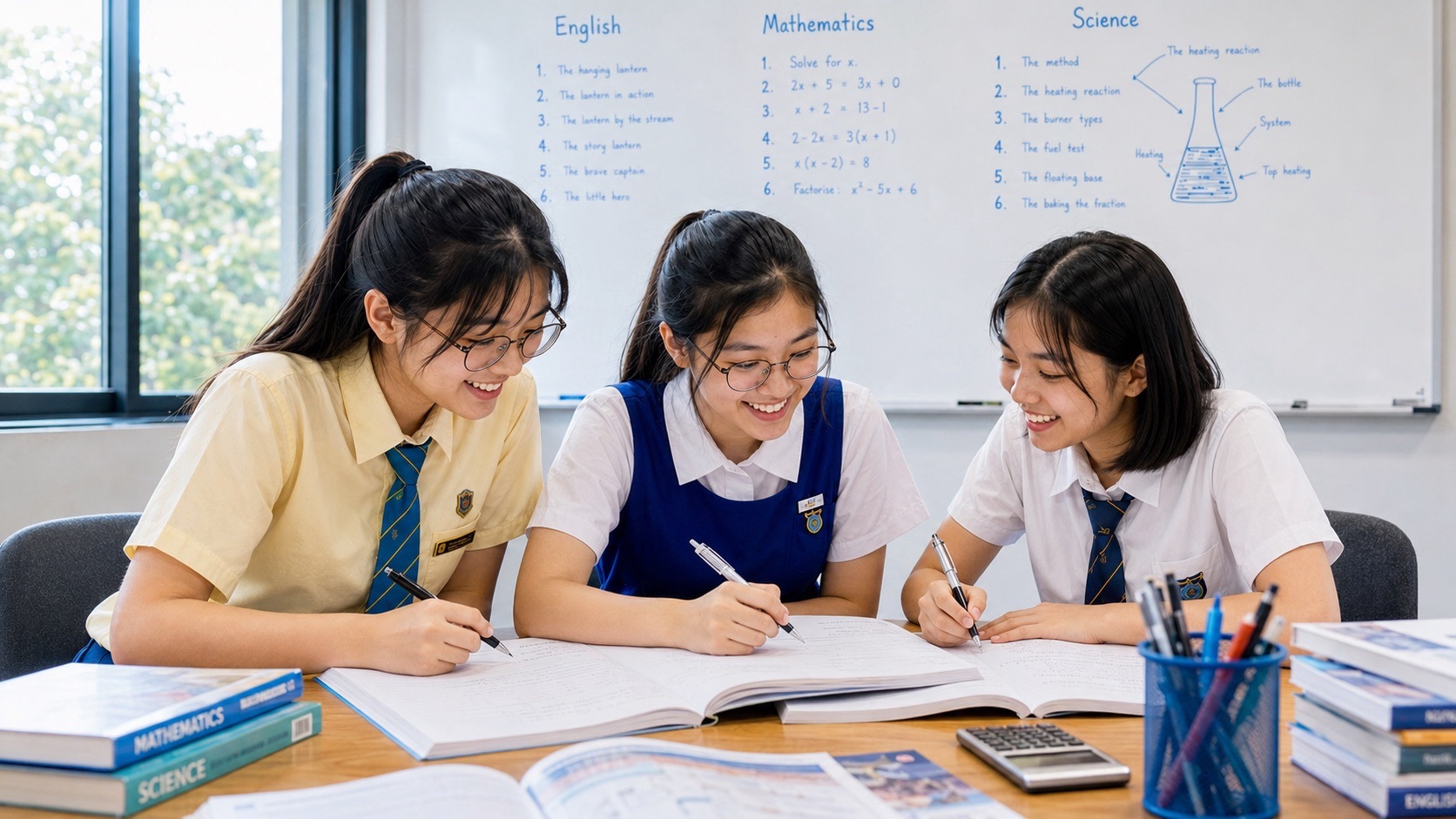
A student reaches an answer.
The page looks finished.
Mathematics asks one more question:
Why should we trust it?
That question is the beginning of mathematical verification.
Verification is the discipline of checking whether a result, transformation, argument, model or representation is consistent with the conditions of the problem and with the mathematical structures that produced it.
Sometimes verification is as simple as substituting an answer back into an equation.
Sometimes it means estimating first and rejecting a result that has the wrong order of magnitude.
Sometimes it means solving a problem in a second way.
Sometimes it means checking a theorem condition, searching for a counterexample, testing an edge case, comparing a graph with an equation, checking units, auditing a computer output or constructing a proof.
Verification is not one method.
It is a mathematical habit:
do not stop at an answer; ask what evidence the answer has earned.
What Mathematical Verification Actually Is
Mathematical verification is the process of testing a mathematical result against one or more independent constraints.
Those constraints may come from:
- the original equation;
- the geometry of the problem;
- known bounds;
- units;
- definitions;
- a graph or table;
- a second method;
- logical conditions;
- a theorem;
- data;
- computational recomputation;
- a proof.
The strongest checks are often partially independent of the method that produced the answer.
If a learner repeats exactly the same mistaken calculation, the same error may simply reappear. A different check can expose what repetition cannot.
An Answer and a Verified Answer Are Not the Same Thing
Suppose a student solves:
3x + 5 = 20
and obtains x = 5.
The calculation may be correct.
Verification substitutes the result back:
3(5) + 5 = 20.
The original condition is satisfied.
That check does not make the algebra more correct than it already was. It increases our confidence that the result survived an independent test.
This distinction matters because many mathematical errors produce answers that look reasonable.
Verification Is Not the Same as Repeating the Calculation
Students are often told to “check your work” and respond by reading the same lines again.
That can catch copying errors, but it is a weak verification method when the original reasoning itself is wrong.
A stronger check changes the route.
- solve, then substitute;
- calculate exactly, then estimate;
- derive algebraically, then inspect graphically;
- measure geometrically, then verify with coordinates;
- differentiate a result, then integrate or compare with the original structure;
- compute numerically, then test limiting or boundary behaviour.
Different routes create different opportunities for an error to reveal itself.
Verification Begins Before Calculation
One of the strongest mathematical habits is to form expectations before exact calculation begins.
Ask:
- Should the answer be positive or negative?
- Should it be greater than 1 or less than 1?
- Should it be roughly tens, hundreds or thousands?
- Should a probability lie between 0 and 1?
- Should an area be larger than the side length numerically in this case?
- Should a rate increase or decrease as the input increases?
These expectations create a verification frame.
When the final result arrives, it can be compared against that frame instead of being accepted simply because the calculator produced it.
Estimation Is a Verification Tool
Estimation is often taught as a topic.
It is also an error-detection system.
Suppose a calculation is:
49.8 × 19.7.
Before multiplying exactly, estimate:
50 × 20 ≈ 1000.
If the calculator display is 98.106, the decimal placement should immediately be questioned.
Estimation does not tell us the exact answer, but it establishes a neighbourhood in which a sensible answer should live.
Order of Magnitude Is Often Enough to Reject an Answer
Many errors are not subtle.
A misplaced decimal point can make a result ten, one hundred or one thousand times too large.
A unit conversion mistake can produce an even larger distortion.
Checking order of magnitude is therefore one of the fastest mathematical filters available.
The question is not “Is this exact?”
It is:
Is this even in the right universe?
Inverse Operations Provide Natural Checks
Many mathematical operations have natural inverse relationships.
- addition and subtraction;
- multiplication and division;
- squaring and square roots, with conditions;
- exponentials and logarithms;
- differentiation and integration, within the appropriate framework.
These relationships can be used for verification.
If 84 ÷ 7 = 12, then 12 × 7 should recover 84.
If log₂ 32 = 5, then 2⁵ should recover 32.
An inverse check is powerful because it changes the direction of the operation.
Substitution Is One of Algebra’s Most Reliable Verification Methods
When solving equations, substitution tests whether the candidate solution satisfies the original equation.
This becomes especially important when algebraic transformations may introduce extra solutions.
For example, squaring both sides of an equation can create candidates that were not solutions of the original equation.
Suppose:
√x = x – 2.
Squaring may produce candidate roots.
Each candidate should then be substituted into the original equation, not merely the squared equation.
The original problem is the final gate.
Extraneous Solutions Show Why Verification Matters
An extraneous solution is a candidate generated during manipulation that does not satisfy the original equation.
This is not an exotic issue.
It can appear when:
- squaring both sides;
- clearing denominators without tracking restrictions;
- taking roots;
- using trigonometric transformations;
- applying inverse functions outside their intended branches.
Verification protects the original mathematical object from damage caused by convenient transformations.
Domain Restrictions Are Verification Conditions
A result can be algebraically neat and still be invalid because the domain has been violated.
Examples include:
- a denominator equal to zero;
- a logarithm receiving a non-positive real input;
- a square root of a negative real quantity in a problem restricted to real numbers;
- a probability outside [0,1];
- a length becoming negative in a geometric model.
Verification therefore includes checking that the candidate answer is admissible, not merely algebraically obtainable.
Units Are Mathematical Constraints
Units provide a powerful verification channel because they encode the type of quantity being calculated.
If distance is measured in kilometres and time in hours, then distance divided by time should have units of kilometres per hour.
If a calculation intended to produce area ends in metres rather than square metres, the structure should be questioned.
In more advanced applied mathematics, dimensional consistency can expose an incorrect formula before any numbers are substituted.
Units are not labels added after the mathematics.
They are part of the verification architecture.
Sign Checks Are Fast and Powerful
Before accepting a result, ask whether its sign makes sense.
A distance should not normally be negative.
A probability cannot be negative.
If a function is clearly increasing over an interval, a negative derivative there should trigger investigation.
If a positive interest rate is applied to a positive balance under ordinary compound growth, a smaller future value is suspicious.
Sign is a low-cost verification signal with high error-detection value.
Bounds Turn Vague Expectations into Mathematical Checks
Sometimes we know that a result must lie within a range even before we know its exact value.
Probability must lie between 0 and 1.
A mean must lie between the minimum and maximum values in the data set.
A side length in a triangle must respect the triangle inequalities.
A sine or cosine value for a real angle must lie between -1 and 1.
Bounds can reject impossible answers instantly.
Special Cases Can Test a General Formula
When a formula is derived, test it on simple cases whose answers are already known.
If a proposed geometric formula should work for a square, substitute the square case.
If a general probability expression should reduce correctly when an event is certain, test probability 1.
If a formula depends on a parameter, test values such as 0, 1 or symmetry points where behaviour is easy to understand.
Special cases do not prove the general formula, but they are excellent falsification tools.
Boundary Cases Are Where Weak Mathematics Often Breaks
A method may work through ordinary examples and fail at a boundary.
Check:
- zero;
- negative values;
- endpoints;
- equal quantities;
- maximum or minimum permissible values;
- degenerate geometric cases;
- denominators approaching zero;
- probabilities approaching 0 or 1.
Boundary testing is mathematical stress testing.
It asks whether a result remains coherent where the structure is under pressure.
Counterexamples Are Verification Weapons
If a claim says something is true for every member of a class, one valid counterexample is enough to destroy it.
This makes counterexample search one of the fastest ways to test a universal conjecture.
Suppose someone claims:
If x² > 4, then x > 2.
Take x = -3.
Then x² = 9 > 4, but x is not greater than 2.
The claim fails.
Related article: One Counterexample Can Be Enough.
Graphical Verification
Graphs can verify whether an algebraic result is structurally plausible.
If two equations are solved simultaneously and the algebra produces x = 4, a graph can check whether the corresponding curves intersect at x = 4.
If a derivative predicts a turning point, the original graph should exhibit a local maximum, local minimum or stationary behaviour there, depending on context.
If an equation has no real roots, its graph should not cross the relevant axis.
Graphical checks are especially valuable because they expose global behaviour that may be hidden in symbolic manipulation.
But a Graph Is Not Automatically a Proof
A graphing window can hide behaviour.
Two curves that appear not to intersect may intersect outside the displayed range.
A function that appears linear at one zoom level may reveal curvature at another.
Pixel resolution can also hide small differences.
Graphical evidence is therefore powerful verification evidence, but its strength depends on the claim being made.
For universal mathematical statements, proof may still be required.
See How Mathematical Proof Works | From Conjecture to Necessity.
Representation Switching Creates Independent Checks
The same mathematical object can often be represented in several ways:
- equation;
- graph;
- table;
- diagram;
- verbal relationship;
- vector form;
- coordinate form.
Each representation exposes different properties.
This makes representation switching a powerful verification method.
An algebraic answer can be checked against a graph.
A geometric result can be checked using coordinates.
A numerical pattern can be checked through an explicit formula.
The question becomes:
Does the same mathematical object survive when viewed another way?
Related architecture: Representation Switching in Mathematics | Equations, Graphs, Diagrams, Tables and Words.
Solving the Same Problem Two Ways
Independent methods are among the strongest practical checks available to students.
A geometry problem might be solved using:
- classical angle properties;
- coordinate geometry;
- vectors;
- trigonometry.
An algebra problem might be checked using both factorisation and the quadratic formula.
A probability question might be solved by counting directly and then checked using a complement.
If independent methods agree, confidence rises substantially.
Why Independent Methods Are Stronger Than Duplicate Methods
Two methods are useful only to the extent that they fail differently.
If both methods rely on the same incorrect assumption, agreement may be false reassurance.
This is why genuinely different representations and derivations are valuable.
Mathematics gains confidence from redundancy when the redundancy is structurally independent.
Verification in Geometry
Geometry provides many fast checks.
- angles around a point should total 360°;
- angles on a straight line should total 180°;
- triangle angles should satisfy the relevant Euclidean relationship;
- lengths should respect triangle inequalities;
- congruent figures should preserve corresponding lengths and angles;
- similar figures should preserve angle equality and proportional side structure.
These relationships create a network of consistency constraints.
A result that violates one of them should be investigated even if the arithmetic appears clean.
The Diagram Can Suggest an Error, but It Cannot Always Settle the Question
A scale drawing can help identify a result that is visibly impossible.
But diagrams in mathematical questions are not always drawn to scale.
This creates an important hierarchy:
- use the picture for intuition;
- use stated properties for argument;
- use mathematical relationships for verification.
Visual plausibility is evidence, not authority.
Verification in Trigonometry
Trigonometry combines several verification channels.
A calculated sine or cosine value for a real angle should lie between -1 and 1.
An angle in a triangle must fit the geometry.
Solutions to trigonometric equations should be checked against the specified interval.
Identity manipulations should respect their domains.
A calculator can verify a few numerical cases of an identity, but numerical agreement is not a proof that the identity holds throughout the domain.
Verification in Calculus
Calculus contains natural cross-checks.
If a derivative is obtained, inspect whether its sign matches the increasing or decreasing behaviour of the original function.
If a stationary point is found, check the graph or second derivative where appropriate.
If an indefinite integral is obtained, differentiate it to recover the integrand.
If a definite integral represents area, check whether sign and magnitude match the geometry.
The structure of calculus itself provides verification routes.
Verification in Probability
Probability is especially unforgiving of impossible outputs.
A probability must lie between 0 and 1.
Probabilities of mutually exclusive exhaustive outcomes should sum to 1.
A complement provides a natural check:
P(A) + P(not A) = 1.
Conditional probabilities should be checked against the correct denominator or conditioning set.
Independence should never be assumed merely because events look unrelated in everyday language.
Verification in Statistics
Statistics requires verification at several layers.
- Were the data copied correctly?
- Is the summary measure appropriate?
- Does the mean lie within the observed range?
- Was the correct denominator used?
- Does the graph represent the scale honestly?
- Are outliers influencing the result?
- Does the conclusion exceed what the sample can support?
A calculation can be perfectly correct while the statistical conclusion is unjustified.
Verification must therefore include both arithmetic and interpretation.
Mathematical Modelling Requires Two Kinds of Verification
A model can be mathematically correct and still be a poor representation of reality.
This creates two different verification questions.
- Internal verification: Was the mathematics performed correctly?
- External validation: Does the model correspond sufficiently well to the real system for the intended purpose?
A linear model may be solved flawlessly but fail when extrapolated beyond the range where the relationship remains approximately linear.
Mathematical correctness is necessary.
Model adequacy is a separate question.
Interpolation and Extrapolation Need Different Confidence
If a model is built from data between x = 10 and x = 20, predicting x = 15 stays inside the observed range.
Predicting x = 200 does not.
The second prediction assumes that the model’s structure continues far beyond the evidence.
Verification therefore includes asking not only whether the formula was applied correctly, but whether the application itself is justified.
Proof Is the Strongest Form of Verification for Certain Mathematical Claims
For a universal mathematical statement, examples, graphs and computations may provide powerful evidence.
Proof establishes that the conclusion follows throughout the stated domain from accepted assumptions and prior results.
This is why proof occupies a special place in mathematical verification.
It is not always the relevant verification method. A numerical answer does not need a theorem. A model may need empirical validation rather than a pure proof.
But when the claim is universal and mathematical, proof is the standard that turns evidence into necessity.
See How Mathematical Proof Works | From Conjecture to Necessity.
Verification and Generalisation
Generalisation expands the reach of a mathematical idea.
Verification controls that reach.
A pattern may suggest a rule.
Verification asks:
- Does it survive boundary cases?
- Can a counterexample break it?
- Are its conditions stated?
- Does a proof exist?
- Does it agree with known special cases?
The stronger the general claim, the stronger the verification burden.
Companion article: How Mathematical Generalisation Works | From Pattern to Rule.
Verification and Abstraction
Abstraction removes detail so that structure becomes portable.
Verification checks whether the abstraction preserved what mattered.
When a word problem becomes an equation, did the equation represent the relationships correctly?
When a geometry problem becomes coordinates, did the coordinate system preserve the necessary properties?
When a real situation becomes a model, were the important assumptions retained?
Verification is therefore part of the return path from abstraction back to meaning.
Companion article: How Mathematical Abstraction Works | From Concrete Quantity to Portable Structure.
Verification of Algebraic Transformations
Algebra is a sequence of transformations.
Verification asks what each transformation preserves.
If both sides of an equation are multiplied by the same non-zero quantity, equality is preserved.
If an expression is factored correctly, its value is preserved.
If both sides are squared, implication may be preserved while equivalence requires additional checking.
This way of thinking is stronger than memorising “move this over and change the sign”.
The student tracks invariants and conditions.
Verification Is Really Invariant Checking
Much of mathematics changes form while preserving something essential.
- equivalent fractions preserve value;
- equivalent expressions preserve value;
- valid equation transformations preserve the intended solution relationship;
- rotations preserve lengths and angles;
- similarity preserves shape structure and ratios;
- coordinate transformations preserve geometric relationships when used correctly.
A verification habit therefore asks:
What was supposed to remain unchanged, and did it?
Verification Can Be Local or Global
A local check examines one step.
A global check examines the overall result.
For example:
- local: was this expansion correct?
- local: did the inequality sign reverse when multiplying by a negative number?
- global: does the final answer satisfy the original equation?
- global: is the final magnitude sensible?
Strong mathematical work uses both.
Local checks prevent errors from propagating.
Global checks test whether the finished solution survives contact with the original problem.
Verification Can Be Embedded Rather Than Added at the End
Efficient mathematicians do not always solve first and check later.
They often verify continuously.
After a factorisation, they may mentally expand one term.
After a substitution, they check sign and units.
After obtaining a probability, they check the range.
After finding a gradient, they compare its sign with the graph.
Verification becomes part of the solution process rather than a separate final chore.
The Cost of Verification Should Match the Risk
Not every answer needs the same level of checking.
A one-mark arithmetic calculation may need a quick estimate.
A multi-part modelling question may justify several independent checks.
A theorem may require proof.
A high-stakes numerical model may require computational recomputation, sensitivity analysis and external validation.
Verification is therefore also a resource-allocation problem.
Use the strongest check where failure would be costly or difficult to detect.
Examination Verification Is a Time Strategy
In an examination, verification must be efficient.
Students cannot redo every question completely.
Instead, use high-yield checks:
- estimate before accepting calculator output;
- substitute equation solutions;
- check units;
- check probability bounds;
- inspect signs;
- re-read the requested form;
- check whether rounding was applied at the correct stage;
- check whether all roots or cases were included;
- use a second method only on high-value or suspicious questions.
The best verification strategy is not maximum checking.
It is targeted checking.
Rounding Is a Verification Problem
Rounding can alter a result enough to matter.
Students should distinguish:
- exact values;
- intermediate approximations;
- final requested accuracy.
Premature rounding can accumulate error.
Excess digits can create a false impression of precision.
Verification asks whether the reported precision is supported by the original data and by the question.
Calculator Verification Is Not Calculator Dependence
A calculator can be an excellent checking tool.
It can recompute arithmetic, evaluate expressions, test candidate roots and compare numerical cases.
But a calculator display is not self-verifying.
The student still controls:
- the expression entered;
- angle mode;
- brackets;
- units;
- rounding;
- interpretation.
Technology reduces computational cost.
It does not remove the verification obligation.
Spreadsheets and Code Need Verification Too
A spreadsheet can calculate thousands of rows consistently.
If the formula is wrong, it can calculate thousands of wrong rows consistently.
Code can execute a mathematical procedure millions of times.
If the implementation misrepresents the mathematics, speed magnifies the error.
Useful computational verification includes:
- hand-checking simple cases;
- testing known outputs;
- testing boundary values;
- checking invariants;
- comparing against an independent implementation;
- monitoring impossible outputs;
- using assertions or consistency tests.
Related technology architecture: Mathematical Computing Technology | Calculators, CAS, Spreadsheets and Code.
AI Makes Verification More Important, Not Less
AI can generate solutions, derivations, explanations and code rapidly.
That makes verification a central human skill.
A fluent answer can still contain:
- a sign error;
- an invalid cancellation;
- a domain mistake;
- a theorem used outside its assumptions;
- a missing solution;
- a false generalisation;
- a numerically plausible but logically invalid conclusion.
The correct response is not to treat machine output as automatically wrong or automatically right.
The correct response is to route it through mathematical checks.
A Verification Ladder for AI-Generated Mathematics
When an AI system produces a mathematical result, verify progressively.
- Surface check: Are the symbols copied correctly?
- Arithmetic check: Do numerical steps recompute?
- Domain check: Are the expressions defined?
- Structural check: Does each transformation preserve what it should?
- Independent check: Can another method reproduce the result?
- Boundary check: Does it survive special cases?
- Proof check: If the claim is universal, is the reasoning actually sufficient?
This converts a generated answer into an auditable mathematical object.
Verification Across the Singapore Mathematics Journey
The form of verification changes as students advance, but the habit can be taught from the beginning.
Primary Mathematics
Primary learners can verify through inverse operations, estimation, bar-model consistency, unit checks, comparison with known facts and substitution into the original story.
A child who asks whether an answer is sensible is already developing mathematical quality control.
Secondary Mathematics
Secondary Mathematics adds algebraic substitution, graph-equation comparison, geometric constraints, probability bounds, unit analysis and more formal checking of transformations.
Across SEC G1, G2 and G3, students increasingly need to verify not only arithmetic but whether the selected mathematical model or method fits the question.
Additional Mathematics
Additional Mathematics raises the verification demand because symbolic transformations become denser.
Students must track domains, trigonometric solution intervals, calculus interpretation, function behaviour and whether transformed equations remain equivalent to the original problem.
JC Mathematics and Beyond
At JC and university levels, verification increasingly involves proof, parameter conditions, limiting behaviour, statistical assumptions, model diagnostics and computational checks.
The mathematics becomes more powerful because the verification architecture becomes richer.
Why Strong Students Still Make Verification Errors
Verification is not only for students who make many mistakes.
Strong students often work faster and perform longer chains of reasoning.
This creates different risks:
- skipping intermediate checks;
- trusting familiar methods too quickly;
- overlooking a domain restriction;
- assuming a calculator entry was correct;
- accepting a sophisticated-looking result because it fits expectation.
Verification is not evidence of weakness.
It is evidence of control.
The Verification Gap: When Students Know the Method but Not the Check
Many students are taught how to solve a type of question without being taught how that answer can be checked.
This creates one-way mathematical knowledge.
For each method, students should learn a companion verification route.
- equation solving → substitute;
- division → multiply back;
- factorisation → expand;
- graph roots → inspect intercepts;
- integration → differentiate;
- probability → check bounds and total;
- geometry → check angle/length constraints;
- model → compare prediction with observed behaviour.
Method and verification should be learned as a pair.
Verification Can Diagnose the Earliest Weak Link
When a final answer is wrong, the visible error may not be the first error.
Verification can help trace backwards.
- If substitution fails, inspect the equation-solving chain.
- If the sign is impossible, inspect the earliest sign change.
- If units fail, inspect the model or formula selection.
- If a graph disagrees, inspect the algebraic representation.
- If a theorem condition fails, inspect the classification of the problem.
This turns checking into diagnosis.
For the wider system, see How Mathematics Diagnosis Works | Finding the Earliest Weak Link.
A Verification Routine for Students
After solving a problem, ask these questions in order.
- Request: Did I answer what was actually asked?
- Domain: Is my answer allowed?
- Sign: Does positive or negative make sense?
- Magnitude: Is the size reasonable?
- Units: Are the dimensions correct?
- Original condition: Can I substitute or test the answer?
- Representation: Does another form agree?
- Boundary: Does the rule survive special cases?
- Method: Can I check it another way?
- Precision: Is the rounding appropriate?
This sequence is short enough to become habitual and broad enough to catch many common failures.
A Verification Routine for Long Solutions
For multi-stage questions, verify at checkpoints rather than only at the end.
- after building the model;
- after a major algebraic transformation;
- after obtaining an intermediate quantity;
- before substituting into a later part;
- before final rounding;
- after interpreting the final result.
This prevents one early error from contaminating an entire page.
Verification becomes a sequence of gates.
A Verification Hierarchy
Not all checks provide the same kind of confidence.
- Plausibility: Does the answer look sensible?
- Consistency: Does it satisfy known constraints?
- Reconstruction: Can inverse operations recover the original quantity?
- Independent method: Does another route agree?
- Boundary testing: Does the claim survive difficult cases?
- Proof: Does the result follow necessarily across the stated domain?
- Empirical validation: If it is a model, does reality support its intended use?
Different mathematical tasks require different levels in this hierarchy.
Verification and Mathematical Communication
Good mathematical writing makes verification easier.
If working is organised, another reader can audit the logic.
If units are shown, dimensional errors are visible.
If exact values are kept until the end, rounding can be checked.
If reasons are stated beside geometric or algebraic steps, hidden assumptions are easier to detect.
Communication is therefore not merely presentation.
It creates an audit trail.
Verification Is Part of Mathematical Independence
A dependent learner asks:
“Is this right?”
An increasingly independent learner asks:
“How can I find out whether this is right?”
That is a profound shift.
The teacher, answer key or calculator is no longer the only authority.
The learner begins to use mathematics itself as the checking system.
Verification Is a Form of Mathematical Responsibility
Mathematics becomes reliable because it builds checking into its culture.
A result should not receive more confidence than its verification supports.
A quick estimate earns one level of confidence.
An independent derivation earns more.
A rigorous proof earns a different kind of confidence for a universal mathematical statement.
Empirical validation earns confidence about a model’s relationship to the world.
Verification is therefore the discipline of matching certainty to evidence.
From Answer to Confidence
The verification journey can be summarised as:
- produce a candidate result;
- check whether it answers the actual question;
- check domain and units;
- check sign and magnitude;
- test the original condition;
- compare another representation;
- use an independent method where useful;
- test boundaries and special cases;
- search for counterexamples when the claim is general;
- use proof where universal certainty is required;
- validate against reality when the mathematics is a model.
The answer is the beginning of this final stage, not the end.
Verification converts an answer into justified confidence.
The Larger Architecture of How Mathematics Works
Mathematics repeatedly performs a connected sequence of operations.
- represent a situation;
- abstract the relevant structure;
- generalise where possible;
- transform the representation;
- calculate or reason;
- form conjectures;
- prove when required;
- verify;
- return to meaning.
Verification is the quality-control layer that checks whether the mathematical machine stayed intact while it worked.
Without verification, mathematics can still produce answers.
With verification, mathematics can decide which answers deserve confidence.
Where This Article Sits in Bukit Timah Tutor
This article belongs to the wider Bukit Timah Tutor system for understanding mathematics as a connected architecture of representation, abstraction, generalisation, proof, verification and application.
- How Mathematics Works | The Machine Behind the Subject
- How Mathematical Abstraction Works | From Concrete Quantity to Portable Structure
- How Mathematical Generalisation Works | From Pattern to Rule
- How Mathematical Proof Works | From Conjecture to Necessity
- BTT Mathematical Lab | Observe, Probe, Repair, Validate, Release
- Singapore School Mathematics: Construction, Verification, Witnesses and Impossibility
- Singapore Mathematics Hub: Tuition, Learning Guides and Research
How Mathematics Works Series: Mathematical verification is the discipline that asks whether a result has earned confidence. It is the return path from calculation to trust.