
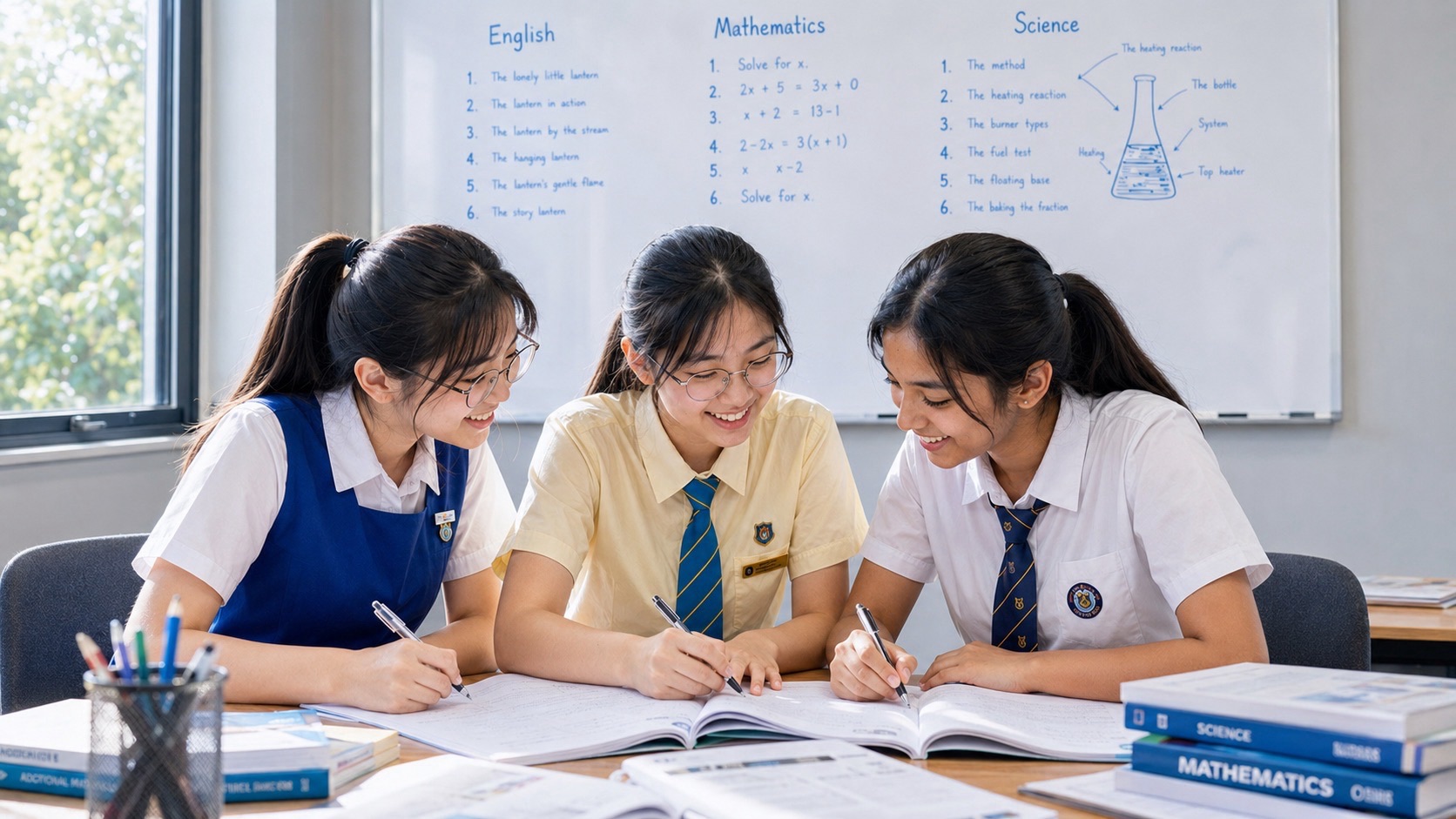
There is a particular kind of Mathematics student who worries me less than her stopwatch suggests I should.
She is not especially fast.
She reads the question carefully.
There may be a short pause before she writes.
Then she works.
The method is appropriate.
The algebra is controlled.
The answer is checked.
Nothing dramatic happens.
Beside her, another student may finish much earlier.
The pencil moves almost continuously.
There is confidence in the speed.
But halfway through the page, a sign has changed.
A condition has disappeared.
A familiar-looking question has triggered the wrong method.
The faster student now has to return and repair the solution.
Sometimes she repairs it.
Sometimes she does not notice.
Parents understandably worry about speed, particularly as Secondary Mathematics becomes more demanding and examination papers become crowded.
There is a real issue here.
Students cannot take unlimited time.
E-Math and A-Math need fluency. Basic algebra should not require a negotiation at every line. Common mathematical facts should be accessible. Calculator use should be efficient. A student who understands everything but needs four hours for a two-hour paper still has a performance problem.
But after many years of teaching Mathematics, I think we need to be precise about what kind of speed we are trying to build.
I am not trying to make the student fast at thinking before thought is ready.
I am trying to make the routine parts of Mathematics cheap enough that she has attention left for the parts that deserve thought.
That is a different ambition.
The direct answer
Mathematical fluency is not the same thing as moving quickly through every question.
Fluency means that knowledge and basic procedures that should be stable no longer consume disproportionate attention.
The student does not have to rediscover how to expand a bracket every time one appears.
She does not have to wonder what a negative multiplied by a negative becomes.
She can rearrange an ordinary linear equation without stopping at each line.
She recognises standard algebraic structures.
She knows the essential formulae and what they are for.
She can use her calculator without turning every entry into a separate problem.
Those savings matter because Mathematics has a limited attention budget.
If a student spends most of that budget managing elementary operations, there is less left for understanding an unfamiliar question, choosing a method, keeping track of conditions, noticing structure, checking plausibility, and adapting when the first route becomes awkward.
So yes, I want fluency.
But the purpose of fluency is not to make the whole subject hurried.
It is to create room for slower, better thinking where slower thinking is valuable.
A simple equation should eventually become inexpensive
Consider:
3(x − 2) + 5 = 17.
A beginner may need to think carefully.
Expand:
3x − 6 + 5 = 17.
Simplify:
3x − 1 = 17.
Then:
3x = 18.
So:
x = 6.
Every step may initially deserve attention.
That is normal.
The student is building algebra.
But one year later, if each of these transformations still carries the same cognitive cost, something has not stabilised sufficiently.
The problem is not that the student is “too slow” in some general personality sense.
The particular mathematical machinery remains expensive.
That distinction matters because the repair is specific.
We do not tell the child:
“Think faster.”
We stabilise the operations.
A-Math exposes expensive foundations very quickly
Suppose the student needs to differentiate:
y = 2x³ − 5x² + 4x − 7
and then find the gradient when x = −2.
She understands differentiation.
She writes:
dy/dx = 6x² − 10x + 4.
Excellent.
Now substitute x = −2:
6(−2)² − 10(−2) + 4.
This should become:
24 + 20 + 4 = 48.
But imagine that signed arithmetic is still costly.
Does:
(−2)²
become 4 or −4?
Does −10(−2) become −20 or +20?
The student hesitates.
Perhaps she enters each piece separately into the calculator.
Perhaps she rewrites the expression several times.
Perhaps one sign eventually goes wrong.
The visible topic is differentiation.
The load-bearing difficulty may be much earlier.
This is why students sometimes say:
“A-Math is so much harder.”
It is harder.
But sometimes the new concept is not what is making the page feel heavy.
Old operations are still charging full price.
Every small hesitation has an opportunity cost
One hesitation does not matter much.
Five seconds.
Ten seconds.
But Mathematics papers contain many small operations.
Expanding.
Factorising.
Working with fractions.
Handling indices.
Substituting negative values.
Changing subject.
Entering exact values.
Reading coordinates.
Using standard identities.
If each elementary operation requires fresh conscious control, the cost accumulates.
More importantly, the student’s attention becomes fragmented.
She may know where the overall solution is going and still lose that direction because the local algebra demands too much of her.
This is one reason long A-Math questions can feel disproportionately difficult.
The student has to keep the larger objective alive while performing many smaller operations.
If every smaller operation asks for full attention, the larger route can disappear.
This is not a problem solved simply by doing everything faster
Suppose a student repeatedly makes mistakes with:
−3(x − 4).
She writes:
−3x − 12.
If I now ask her to perform twenty expansions as fast as possible, I may make the error more fluent.
Speed amplifies whatever structure is currently being executed.
If the structure is correct, fluency is valuable.
If the structure is wrong, faster execution simply produces wrong Mathematics more efficiently.
So before building speed, I want the underlying operation secure.
Here:
−3(x − 4)
means:
(−3)(x) + (−3)(−4)
which gives:
−3x + 12.
Once that relationship is understood and repeatedly executed correctly, speed can grow safely.
Accuracy should not have to chase fluency from behind.
There are therefore different kinds of slowness
This is important for parents.
A child who takes a long time on Mathematics may be slow for very different reasons.
One student does not understand the concept.
Another understands but cannot choose a method.
Another chooses correctly but basic algebra is laborious.
Another knows the entire route but checks every line three times because she does not trust herself.
Another is careful and thoughtful on unfamiliar questions, but perfectly fluent on routine ones.
These are not one problem called:
“slow at Math.”
The intervention should match the cause.
Thoughtful hesitation can be a strength
Suppose a student sees:
x² − 5x + 6 = 0.
She pauses briefly.
Then factorises:
(x − 2)(x − 3) = 0.
Fine.
Now she sees:
2x² + x − 7 = 0.
Another pause.
She tries to see whether neat factorisation is likely.
It is not immediately obvious.
She decides the quadratic formula is safer.
That pause is useful.
It contains method selection.
A student who begins manipulating immediately is not necessarily more fluent.
She may simply be less discriminating.
Sometimes the fastest first move creates the longest overall solution.
This is why I distinguish response speed from solution economy
A student can begin instantly and solve inefficiently.
Another can pause for fifteen seconds and then take a much shorter route.
Which one was faster?
The stopwatch may say the first student started earlier.
The Mathematics may say the second student spent less total effort.
Consider:
(x − 3)² = 25.
One student expands:
x² − 6x + 9 = 25
then:
x² − 6x − 16 = 0
then factorises:
(x − 8)(x + 2) = 0
giving:
x = 8 or −2.
Correct.
Another student notices immediately:
x − 3 = ±5
so:
x = 8 or −2.
The second student may have paused longer before the first line.
She still solved the problem much more economically.
Mathematical fluency includes recognising when structure saves work.
Fluency should release working memory
This is perhaps the main educational reason I care about it.
Take a trigonometry problem.
The student must decide:
Which sides are known?
Which angle is known?
Is the triangle right-angled?
Sine rule?
Cosine rule?
Is there an ambiguous case?
What form should the answer take?
Now add fragile fraction manipulation and unreliable calculator operation.
The student is carrying too much.
The basic operations compete with the actual problem.
If those operations become stable, something changes.
The question has not become mathematically easier.
The student has become more available to it.
That is the kind of fluency I want.
This is why drill still has a place
There is a tendency to set “understanding” against repetition.
I do not find that helpful.
Students need repetition.
A pianist does not understand music so deeply that scales become unnecessary.
A Mathematics student benefits from repeated practice of important operations.
The question is what the repetition is doing.
Useful repetition stabilises a valid relationship.
It reduces unnecessary decision cost.
It builds accuracy and retrieval.
It allows attention to move upward.
But repetition becomes less useful when the student is merely recognising the worksheet’s pattern and executing without having to decide anything.
Twenty identical questions can improve execution.
They may tell us very little about method selection or transfer.
So I use repetition for the job repetition does well.
Then I change the environment.
Mixed practice tells us whether fluency survives choice
Suppose a worksheet is titled:
Quadratic Formula Practice.
Every question requires the quadratic formula.
By Question 3, the student no longer has to decide what method is relevant.
The heading has decided.
Now create a mixed set.
One linear equation.
One difference of two squares.
One quadratic that factorises neatly.
One quadratic that does not.
One simultaneous-equation problem.
One trigonometric equation.
The calculation techniques may all be familiar.
The student now has to recognise the object before executing.
That is closer to examination Mathematics.
Fluency should survive the disappearance of the chapter label.
But mixed work too early can be counterproductive
There is a boundary.
A student who has only just learned completing the square may need several similar examples before the procedure becomes coherent.
Constantly switching topics can prevent stabilisation.
The sequence matters.
First, understand.
Then stabilise.
Then retrieve.
Then mix.
Then transfer.
Trying to test full independence before the operation exists securely is not rigor.
It is poor timing.
Parents can often see the difference in homework
Watch where the time goes.
Does your child spend forty seconds thinking before an unfamiliar question, then work smoothly?
That may be perfectly healthy.
Or does she know the method but pause at every sign and fraction?
Different issue.
Does she finish quickly but return repeatedly because of avoidable mistakes?
Different again.
Does she reread the question five times because she cannot identify what quantity is required?
That points elsewhere.
The useful question is not:
“Why are you so slow?”
It is:
“Which part of this solution is costing you time?”
That question is much more respectful of the Mathematics.
One useful measurement is to separate decision time from execution time
Take a short set of five questions.
Do not race.
For each, notice two things.
How long before the student has a plausible route?
Then how smoothly can she execute it?
A student may show:
slow decision, fast execution.
Or:
fast decision, slow execution.
Or:
fast decision, fast but inaccurate execution.
Or:
careful decision, controlled execution.
These patterns tell us more than total time alone.
A-Math often needs the second kind of speed more than the first
I am quite comfortable with a student spending twenty seconds examining a difficult A-Math question before writing.
I am less comfortable if, once she knows she needs to differentiate:
3x⁴ − 2x³ + 5x − 8,
she takes several minutes to perform the differentiation and basic substitution.
The conceptual decision deserves thought.
The routine execution should eventually become inexpensive.
That asymmetry is important.
We do not need every stage of Mathematics to run at the same speed.
The examination itself contains different speed zones
A paper is not one continuous sprint.
Some questions should be nearly automatic.
Simple manipulation.
Routine substitution.
Direct graph reading.
Basic differentiation.
Other questions deserve a pause.
A modelling decision.
An unusual geometry structure.
A proof.
A multi-part A-Math problem.
An unfamiliar transfer question.
A student who approaches every question at maximum speed becomes careless on the second group.
A student who approaches every question at maximum deliberation may run out of time on the first.
Good examination control involves changing pace.
That is much closer to real expertise.
Fast students sometimes need permission to slow down
This is a genuine teaching issue.
A student has built her identity around being quick.
She answers first in class.
Finishes homework quickly.
Enjoys the feeling of immediate recognition.
Then Secondary Mathematics becomes more demanding.
A question looks familiar but contains one altered condition.
She launches.
Ten lines later the wrong assumption becomes visible.
The repair may not be “more practice”.
It may be teaching her that pausing is not evidence of weakness.
For a strong student, one deliberate reread can be a performance improvement.
Slow students sometimes need permission to stop re-proving what they already know
The opposite pattern also exists.
A student understands.
But every step is reopened.
Is this definitely right?
Should I check again?
Maybe I should calculate it another way.
She spends two minutes establishing something that was already secure.
Then another two minutes checking it.
This is not conceptual depth.
It may be uncertainty management.
For these students, fluency includes learning when a standard step can be trusted.
Not recklessly.
But sufficiently to move.
Mathematics cannot progress if every settled fact has to be retried from first principles.
There is a point where checking stops improving accuracy
Suppose the student solves:
2x + 7 = 15
and gets:
x = 4.
Substitute:
2(4) + 7 = 15.
Good.
The check is meaningful.
Now solving the whole equation a third time adds very little.
The student should move.
This matters because examination efficiency is not simply about performing operations faster.
It is also about not performing unnecessary operations.
Efficient students preserve exactness where it matters
Another false form of speed is premature approximation.
Suppose:
x = √7
appears halfway through a solution.
A student immediately converts:
√7 ≈ 2.646.
Then uses 2.646 in later calculations.
Perhaps she saves a little thought.
But she has discarded exact information and introduced rounding error early.
The faster-looking route may be mathematically weaker.
Good fluency includes knowing when not to press the calculator.
Efficiency and haste are not the same thing.
Fluency also means recognising common structures without having to name the chapter
Consider:
x² − 16.
A student who sees:
difference of two squares
has:
(x − 4)(x + 4).
That recognition should eventually be quick.
Why?
Because it saves attention for the larger problem in which the expression may appear.
Likewise:
sin²x + cos²x = 1.
Or:
a tangent is perpendicular to the radius at the point of contact.
Or:
equal roots imply discriminant zero.
Some relationships deserve fast access because they are used as components inside more complicated reasoning.
This is where memory supports understanding.
But speed of recall should not become blind pattern matching
The student sees:
a² − b².
Good.
Difference of squares.
Then sees:
a² + b².
She writes:
(a + b)(a − b).
Now speed has outrun structure.
The goal is not to react quickly to familiar symbols.
It is to recognise accurately.
A fluent student should be fast enough to reduce unnecessary load and slow enough to notice that the sign changed.
That balance is the point.
The same principle applies to formula selection
I want a student to recall the cosine rule quickly.
I do not necessarily want her to apply it quickly.
First:
Does the geometry fit?
What is known?
What is required?
Is there a simpler relationship?
Formula recall can be automatic.
Method permission still deserves judgement.
This distinction becomes particularly important in examination questions designed to resemble familiar forms.
Adolescence makes comparison difficult
Students notice who finishes first.
Parents hear:
“She is very fast at Math.”
Teachers sometimes praise speed publicly because it is visible.
But speed can become an identity.
Then a thoughtful child assumes she is weaker because she needs time.
I would be careful with that conclusion.
Some of the best mathematical thinking is not instantaneous.
A difficult relationship may deserve silence.
The question is whether the student eventually narrows the problem intelligently.
Speed is valuable where the Mathematics has already been learned deeply enough to support it.
It is not a universal proxy for ability.
A student’s fastest work is not always her strongest work
This becomes obvious when we compare untimed and timed papers.
Suppose untimed:
85%.
Timed:
62%.
We might say:
“She needs to work faster.”
Maybe.
But inspect the difference.
Perhaps she attempted everything but made many errors under pressure.
Then raw speed is not the solution.
Perhaps she spent too long on two difficult questions.
Then question triage matters.
Perhaps she knows the methods but routine algebra is genuinely slow.
Then fluency training matters.
Perhaps she repeatedly rereads questions because method recognition is weak.
Then conceptual organisation matters.
Time is an outcome.
We still need a cause.
Repair should target the expensive layer
If basic algebra is slow, practise basic algebra deliberately.
If formula recall is slow, build retrieval.
If method selection is slow, compare problem structures.
If unfamiliar wording is slow, practise translation and modelling.
If checking is excessive, develop stopping rules.
If careless acceleration causes errors, build a short pause before committing to the route.
We do not repair every form of slowness with timed worksheets.
The visible metric is not necessarily the mechanism.
One exercise I like is “routine or decision?”
Give a mixed Mathematics paper.
Before solving each question, the student marks it mentally or lightly as one of two things.
Routine: I know the route; execute carefully.
Decision: I need to inspect structure before committing.
Then solve.
This is not about labelling easy and hard.
A routine question may contain messy arithmetic.
A short question may require a significant insight.
The point is to notice that different questions deserve different cognitive pacing.
Over time, the classification can disappear.
The pacing remains.
Another useful exercise is to protect one deliberate pause
For a student who rushes, I sometimes require only this:
Before the first mathematical line, state what is being found and why the chosen method belongs.
Not a paragraph.
Perhaps:
Need third side; two sides and included angle known → cosine rule.
Then work normally.
That small pause can prevent several minutes of wrong execution.
Once the habit is secure, the written sentence is unnecessary.
The internal check remains.
For a student who is too slow, I do almost the opposite
I identify the operations that should no longer require extensive deliberation.
For example:
expanding simple brackets,
basic factorisation,
substitution,
standard differentiation,
integer arithmetic,
calculator angle mode,
common exact values.
Then practise those narrowly.
Not the whole subject.
We reduce the cost of the foundations.
When the student returns to a long question, we see whether more attention is now available for the higher-level decisions.
That is the meaningful test.
Transfer matters because worksheet speed can be misleading
A student becomes fast at twenty identical factorisation questions.
Good.
Now place factorisation inside:
a quadratic equation,
an algebraic fraction,
a differentiation problem,
a coordinate question,
or an unfamiliar manipulation.
Does the fluency still appear?
If yes, the operation has become genuinely useful.
If speed collapses as soon as the chapter label disappears, some of the earlier performance depended on context.
That does not invalidate the practice.
It tells us what stage comes next.
Measurement should include accuracy under changed conditions
I would rather see:
90% correct at a controlled pace,
then gradually faster while accuracy remains stable,
than:
very fast,
70% correct,
with errors scattered unpredictably.
We can increase speed after the structure is secure.
Rebuilding confidence after repeated careless failure is much more expensive.
This is particularly true for adolescents who begin interpreting errors emotionally.
Better to make fluency answerable to accuracy from the beginning.
There is no single correct mathematical speed
This is worth saying clearly.
A student solving a routine linear equation should not need the same time as a non-routine proof.
A straightforward differentiation should not consume as much attention as an optimisation model.
A familiar trigonometric calculation should become faster than deciding whether a complicated diagram permits a particular theorem.
Good Mathematics changes gears.
The experienced student becomes faster partly because she knows where she does not need to hurry.
That sounds contradictory.
I do not think it is.
The useful next route for parents
Take one recent Mathematics paper.
Do not look first at the total completion time.
Choose three questions that took unusually long.
For each, ask:
Where did the time actually go?
Was the student deciding what the problem meant?
Choosing between methods?
Performing routine algebra?
Using the calculator?
Rechecking secure work?
Recovering from an earlier error?
Now choose three questions completed very quickly.
Were they accurate?
Did the student recognise the structure correctly?
Or did speed create errors that later required repair?
This gives you a simple map.
Then choose only one expensive routine operation to stabilise.
Perhaps negative-number substitution.
Perhaps algebraic fractions.
Perhaps quadratic factorisation.
Perhaps exact trigonometric values.
Practise it briefly across several days.
Return to a fuller question.
Has the whole problem become lighter?
If yes, the practice has done its job.
For a child who already executes routine work fluently but rushes method selection, do the opposite.
Do not add more speed practice.
Require a ten-second structural pause before unfamiliar questions.
Compare accuracy.
The repair should match the child.
What long teaching has made me notice
Parents sometimes ask me:
“Can she become faster?”
Usually, yes.
But I think the better question is:
“What should become faster, and what should remain thoughtful?”
I want multiplication facts to be quick.
I want common algebraic transformations to become economical.
I want important identities and formulae accessible.
I want calculator use clean.
I want standard differentiation to feel familiar.
Those things should not consume the entire mind.
But when a question changes form, I want the student to notice.
When two methods are possible, I want her to choose.
When a condition matters, I want her to read it.
When the answer looks impossible, I want her to stop.
When the model does not fit, I want her to resist calculation.
Those things may require a pause.
That pause is not the enemy of fluency.
It is what fluency was supposed to make room for.
There is a kind of beautiful Mathematics where the pencil moves quickly because the student sees everything.
But there is another kind where the student is quiet for twenty seconds, writes three lines, and solves a problem that someone else attacked for a page.
I value both.
What I do not want is speed becoming theatre.
Fast pencil.
Fast calculator.
Fast answer.
And underneath it, no spare attention to ask whether the Mathematics is still true.
A mature student eventually acquires different tempos.
Routine things become quiet and cheap.
Important decisions receive time.
Errors trigger a pause.
Structure can shorten a route.
The clock remains real, especially in examinations.
But the student is no longer trying to outrun it at every line.
She is managing her attention.
And perhaps that is the deeper meaning of fluency.
Not:
I can do everything quickly.
But:
I no longer waste expensive thought on the things that should be stable, so I can afford to think properly about the things that are not.
That is the kind of speed I want.
Because when Mathematics becomes difficult, the student’s most valuable resource is not how rapidly her pencil can move.
It is how much mind she still has available when the routine part is finished.