
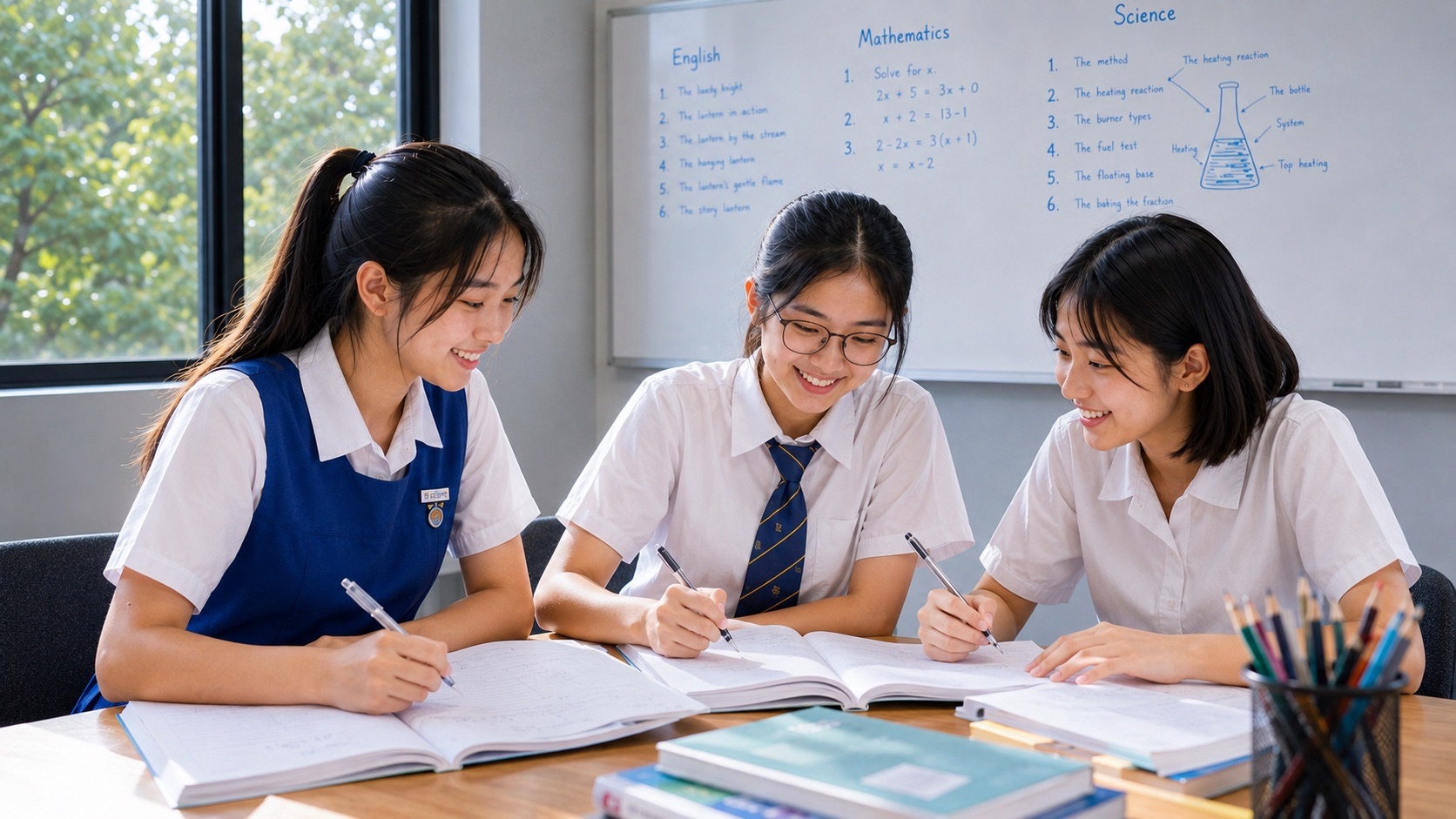

There is a small moment in Mathematics that I have learned not to interrupt too quickly. The question is on the page. The student has read it. The pencil is still. Nothing has been written yet.
Parents rarely see this moment because finished work hides it. A marked exercise shows the method, the algebra, the ticks and crosses, perhaps a careless error somewhere near the end. It does not show the few seconds before the first line, when the student has to decide what kind of problem this is, what matters, what can be ignored and which piece of Mathematics should be brought forward.
After many years of teaching, I have become increasingly interested in those few seconds.
They are often more revealing than the answer.
The first line is not really the beginning
By the time a good student writes the first line, quite a lot has already happened.
The student has recognised the territory. A ratio question feels different from a quadratic. A geometry problem asks for a different kind of attention from an algebraic manipulation. In Additional Mathematics, an equation involving a tangent to a curve is not simply an invitation to differentiate; the student has to understand why differentiation is relevant, what the derivative represents, where the given point sits and what still has to be found after the gradient appears.
None of this is visible in the eventual working. Yet this invisible orientation is where a large part of mathematical competence lives.
When I watch a student before the first line, I am not mainly asking, “Does this child remember the formula?” I am asking something closer to, “Does this child know what he or she is looking at?”
The short answer
I watch for orientation before execution.
I want to know whether the student can identify the mathematical structure before reaching for a familiar procedure. I watch what information attracts attention, what gets translated into symbols, what is held back, which method is considered first and whether the student can explain why that method belongs here.
This matters because Mathematics is not a subject in which knowing many methods automatically produces good decisions. At a certain level, almost every student has a collection of procedures. The stronger student is increasingly distinguished by knowing when a procedure is appropriate, why it is appropriate and what to do when the obvious procedure does not quite fit.
The first line is therefore a small public record of a much larger private decision.
A fast first line can be a warning
There is a particular kind of student who begins almost immediately.
The speed looks reassuring. The pencil moves. A formula appears. Numbers are substituted. For a moment, the work has the appearance of confidence.
Sometimes it is confidence. Sometimes it is only recognition.
The student has seen something that resembles a familiar worksheet question and has activated the procedure normally associated with it. If the question is standard, this can work perfectly well. If one condition changes, however, the same student may continue confidently in the wrong direction.
This is why I am cautious about equating speed with mastery. Early speed can mean that a method has become fluent. It can also mean that the student has stopped looking closely.
Mathematics examinations are full of questions that reward a student for noticing the difference between “this looks familiar” and “this is structurally the same problem.” Those two thoughts are not identical.
Consider a simple quadratic
Take an equation such as x² − 5x + 6 = 0.
A student may know several legitimate approaches: factorisation, completing the square, or the quadratic formula. If the first response is always to write down the quadratic formula, the student may still reach the correct roots. But there is information in that choice.
Did the student notice that the expression factors cleanly? Did the student consider efficiency? Is the formula being used because it is the best tool, or because it is the safest remembered tool?
At Secondary level, these distinctions accumulate. A method that is merely inefficient in one question becomes awkward in another. Later, when algebra becomes denser, carrying unnecessary machinery increases the number of places where an error can occur.
Good Mathematics is not always about finding a more sophisticated method. Quite often it is about seeing enough to choose the simplest adequate one.
The hesitation I like
Not all hesitation worries me.
There is a useful pause in which a student is actually reading the structure of the question. The eyes move back to a condition. A diagram is checked. A value is mentally connected to an earlier statement. The student may draw a small mark or rewrite one relationship before committing to a method.
This can look slower than the student who starts immediately, but it is often a more mature form of speed. The thinking has moved upstream.
A strong student eventually learns that a few seconds spent choosing well can save several minutes of unnecessary calculation. More importantly, the student begins to experience Mathematics not as a sequence of commands to remember, but as a field of relationships to inspect.
I would rather see ten thoughtful seconds followed by a clean line of reasoning than immediate activity followed by three minutes of repair.
There is also a hesitation I do not like
Another kind of pause has a different quality.
The student is not inspecting the problem. The student is searching memory.
“Which formula is this?”
“What did we do last week?”
“Is this the one where I move everything to one side?”
The question on the paper has almost disappeared. The student is scanning an internal filing cabinet of remembered examples, hoping to find one whose surface resembles the present problem.
This is a fragile way to learn Mathematics because the number of possible question forms grows faster than a student can memorise them. At Primary levels, a diligent child may survive surprisingly long by collecting templates. In lower Secondary, this method begins to strain. By upper Secondary and Additional Mathematics, it can fail suddenly because the same underlying idea is presented in too many different forms.
The child has not become less capable. The old learning strategy has reached its limit.
Mathematics becomes a subject of selection
Early Mathematics contains a great deal of execution. Learn what addition means. Learn the multiplication tables. Learn written methods. Learn how fractions behave. Fluency matters, and there are basic things worth knowing so well that they no longer consume much attention.
As the subject matures, however, another demand becomes increasingly important: selection.
The student has several possible tools and has to decide which one to use. An algebraic expression may invite factorisation, substitution, expansion or a change of representation. A trigonometric question may be solved by choosing an identity carefully rather than manipulating everything available. A coordinate geometry problem may become much easier once the student identifies the quantity that should be treated as the bridge between two pieces of information.
This is one reason Secondary Mathematics can feel unexpectedly different to a child who has always been good at the subject. The child may still calculate accurately. What has changed is that the examination increasingly expects judgement before calculation.
The first line is where that judgement first becomes visible.
In A-Math, the gap becomes easier to see
Additional Mathematics makes this particularly clear.
Suppose a student is given a curve and asked to find the equation of a tangent at a particular point. Knowing how to differentiate is necessary, but it is not the whole problem.
The student must understand that differentiation provides a gradient function; that the point allows a particular gradient to be found; that a tangent is a straight line; and that the line still needs to be constructed from a point and a gradient. Each step is ordinary Mathematics. The sophistication lies in seeing how the pieces belong together.
A student who merely remembers “tangent means differentiate” may produce a derivative and stop. Another may differentiate correctly but then use the original curve equation as though it were the tangent. A third student will see the whole route before writing very much at all.
Those three students can possess similar procedural knowledge and still be in very different places mathematically.
This is why marks alone can be an incomplete diagnosis
A parent naturally sees the test score first. That is reasonable. Examinations matter, and a mark is real information.
But two students who both score 62 may need completely different forms of help.
One may understand the questions well but lose marks through algebraic execution, signs, arithmetic and untidy transfer between lines. Another may calculate accurately whenever the method is obvious but fail whenever the question requires choosing the method independently.
The first student needs accuracy, discipline and perhaps better checking routines. The second needs better mathematical recognition and method selection. Giving both students another large stack of mixed worksheets may raise practice volume without repairing the correct problem.
This is one of the quiet responsibilities of good tuition: not simply to add work, but to identify what kind of work would actually change the student’s next decision.
What I ask when the pencil does not move
I try not to rescue the student with the method too early.
If I say, “Use simultaneous equations,” the immediate problem may disappear, but I have also made the most important decision on the student’s behalf. The page will look better. The underlying ability may remain exactly where it was.
So the better questions are usually smaller.
What do you know?
What are you trying to find?
Which piece of information connects those two things?
What does this expression represent?
What would have to be true for your chosen method to work?
These are modest questions, but they return ownership of the mathematical decision to the student. The goal is not to make the child feel abandoned in front of a difficult problem. The goal is to provide just enough structure for the child to begin building the route personally.
Good help changes shape over time
At the beginning, a student may need a great deal of guidance. We may have to name the relevant concept, model how to read a question, slow the algebra down and make hidden relationships explicit.
Later, the help should become less visible.
Instead of telling the student what to do, I might ask for two possible methods. Instead of correcting the first wrong line immediately, I might ask what the line claims mathematically. Instead of demonstrating the entire problem, I may let the student reach a dead end and then inspect why it became a dead end.
This is slower than supplying solutions. It is also closer to what the examination eventually requires.
In an examination hall, the tutor is absent. The notes are closed. The worked example is not beside the question. The student’s real mathematical system is whatever remains when those supports are removed.
Tuition should therefore be judged partly by what happens when tuition is no longer present.
What parents can notice at home
You do not need to reteach Secondary Mathematics at the dining table to notice whether this part of learning is developing.
Listen to the language your child uses when stuck.
There is a difference between “I forgot the formula” and “I do not yet see how this condition connects to the unknown.” The second sentence may sound less confident, but it reflects a more precise awareness of the problem.
Notice whether your child can explain why a method was chosen after completing a question. Notice whether a familiar method is applied automatically to every similar-looking problem. Notice what happens when numbers are changed, the diagram is rotated, or the wording becomes less direct.
And perhaps most importantly, notice whether your child can begin again after a method fails.
Students who understand Mathematics as a collection of fixed procedures often experience a failed method as a kind of collapse: “I don’t know how to do this.” Students who are beginning to think more structurally are more likely to say, “That route doesn’t work; let me look again.”
That small change in language is significant. It shows that the student is separating the failure of one attempt from the possibility of solving the problem.
Do not remove every difficult pause
Parents understandably dislike seeing a child struggle. A student who sits in front of a question without writing can look as though time is being wasted.
Sometimes time is being wasted. A child may genuinely lack the prerequisite knowledge and have no reasonable route forward. In that case, prolonged struggle teaches very little. The missing idea should be supplied and rebuilt.
But there is another kind of difficulty that should not be removed too quickly: the difficulty of choosing.
If an adult immediately names the method every time a student hesitates, the student becomes faster at following mathematical directions while remaining dependent on somebody else to provide them.
There is a balance here. Productive struggle is not a virtue by itself. Confusion should not be romanticised. The useful question is whether the student has enough knowledge to make a meaningful attempt and whether the pause is producing better attention.
When those conditions are present, a little silence can be educational.
The first line can reveal fear as well
Not every weak first move is a conceptual problem.
Some students know more Mathematics than their opening line suggests. They have become so concerned about being wrong that they avoid committing to anything until they feel certain.
This often appears after repeated poor results or after a student moves into a class where everyone seems quick. The child begins checking simple decisions excessively. A question that should take three minutes becomes six because every line is treated as dangerous.
The repair here is different. More explanation may not be the answer. The student may need smaller successful decisions, timed practice, permission to make provisional moves and evidence that an imperfect first attempt can still be revised intelligently.
This distinction matters. If we misread anxiety as ignorance, we may drown a capable student in more teaching. If we misread ignorance as anxiety, encouragement alone will not supply the missing Mathematics.
The same outward hesitation can come from very different places.
How I know the habit is changing
Improvement is not simply that the student begins every question faster.
I look for a better first move.
The student identifies the unknown more clearly. A diagram gains one useful annotation instead of five decorative ones. An equation is formed from the relationship that actually governs the problem. The student rejects an unsuitable method before spending a page on it. When asked “Why?”, the explanation refers to the Mathematics in the question rather than to the memory of a previous worksheet.
I also look for transfer. Can the idea survive a different-looking question? Can the student still choose the method when the numbers are ugly? Can the student solve a problem when the relevant chapter name is not printed at the top of the page?
That last test is particularly useful. Chapter labels are a hidden form of help. “Quadratic Equations” tells the student what toolbox to open before the question has even begun. Mixed work removes that hint. Examinations remove it almost entirely.
When a student can recognise the Mathematics without being told the chapter, something important has become more independent.
Accuracy still matters
It would be a mistake to turn all of this into an argument that conceptual thought matters and routine skill does not.
Mathematics is unforgiving of that false choice.
A student can choose the perfect method and still lose the question through poor algebra. Another can understand a geometric relationship but misread a scale. A beautiful plan executed carelessly remains a wrong answer in an examination.
So the mature student needs both judgement and execution: enough understanding to select the route, enough fluency to travel it accurately, and enough checking discipline to recognise when the result no longer makes sense.
The reason I watch the first line is not because the later lines are unimportant. It is because the first line tells me which part of the mathematical system has been asked to lead.
What good tuition should eventually make unnecessary
There is a paradox in tuition that I think about often.
Parents bring a child to a tutor because help is needed. Yet if the teaching is working, some forms of help should gradually become unnecessary.
The student should need fewer reminders to identify the unknown. Fewer prompts to draw the relevant relationship. Fewer hints about which chapter a question belongs to. Fewer confirmations after every line. Fewer demonstrations before beginning unfamiliar work.
This does not mean the student outgrows teaching. Strong students continue to benefit from explanation, difficult problems, feedback and expert correction. What changes is the location of responsibility.
The tutor stops carrying the opening decision.
The student begins to carry it.
For parents choosing Mathematics tuition
It is easy to compare tuition through visible quantities: lesson length, number of worksheets, class size, notes, topical coverage, examination papers and how many questions are completed each week.
Those things can matter. But I would add a quieter question.
Who is doing the mathematical deciding?
If the teacher constantly tells students what kind of question they are seeing, which formula belongs, which line comes next and when an answer is safe, the lesson may look impressively smooth. The students may complete a great deal of work.
But smoothness is not always independence.
A useful Mathematics lesson should contain moments when the student has to inspect, choose, explain, revise and try again. The tutor’s expertise is not only in knowing the route. It is also in knowing when not to walk the route on the student’s behalf.
The quiet part of Mathematics
We tend to associate Mathematics with what can be seen: symbols, diagrams, equations, graphs, calculations, proofs.
Yet much of the subject happens before any of these appear.
A student notices that two quantities are linked. Decides that one representation is more useful than another. Rejects a tempting but irrelevant fact. Recognises that the answer should be positive. Senses that an expression ought to simplify. Remembers a theorem, but also understands why it belongs. Chooses not to calculate yet.
These decisions are quiet. They do not fill pages. They are difficult to count. They may not look like hard work.
But they are part of what we are trying to cultivate when we say that a student is becoming good at Mathematics.
So when a student sits with a difficult question and the pencil is still for a few seconds, I do not rush to fill the silence.
I watch.
Sometimes I am seeing confusion that needs to be repaired. Sometimes I am seeing fear that needs to be reduced. Sometimes I am seeing a missing skill that must be taught properly.
And sometimes I am watching something much better: a student learning to decide.
That is a small moment, almost invisible from across a room. But in Mathematics, it is often the moment that matters most.