
Additional Mathematics anxiety is usually not cured by telling a student to “calm down.” In Singapore, Additional Mathematics is designed for students with aptitude and interest in mathematics, assumes prior O-Level Mathematics knowledge, prepares students for A-Level H2 Mathematics, and places strong weight on problem solving and reasoning, not just routine technique. That makes A-Math a subject where weak algebra and anxious thinking can collide very quickly. (SEAB)
One-sentence answer:
The practical cure for A-Math anxiety is to break the fear loop by rebuilding algebraic safety, reducing working-memory overload, using better study methods such as spaced self-testing, and treating anxiety regulation as a support layer rather than the whole solution. This is a synthesis of the A-Math syllabus and intervention research, not a single official formula. (SEAB)
Core Mechanisms
1. A-Math anxiety is usually a loop, not a personality trait.
Research and review work describe a reciprocal pattern: anxiety hurts performance, weak performance increases avoidance, and avoidance then feeds more anxiety. A recent meta-analysis notes moderate overall effects for interventions, and the high-school intervention study describes how better study strategies can help shift students from a vicious cycle toward a more productive one. (ERIC)
2. The subject itself is narrow and load-heavy.
The Additional Mathematics syllabus explicitly says it assumes O-Level Mathematics, prepares students for H2 Mathematics, and requires strong algebraic manipulation and reasoning. The assessment objectives also place 50% of weight on solving problems in context and 15% on reasoning and communication. So a student can feel anxious not because they are “bad at math,” but because the corridor is symbolically dense and unforgiving of shaky foundations. (SEAB)
3. Anxiety steals working memory.
A classic review found that math anxiety compromises working memory and can function like a resource-demanding secondary task. In practice, this means the student may know the method at home but blank out under pressure because too much mental space is being consumed by fear, self-talk, and threat-monitoring. (link.springer.com)
4. Quick emotional tricks are not enough on their own.
Some research shows that cognitive reappraisal can improve performance for highly math-anxious individuals, but classroom evidence in high school suggests that study-skills interventions, especially self-testing and more frequent contact with math, may outperform emotion-regulation-only approaches for highly anxious students. The broader intervention meta-analysis also found that both emotion-focused and cognitive-support interventions can help, with longer interventions working better than very brief ones. ([PMC][4])
5. Not every popular intervention works for every age or context.
Expressive writing before a stressful math task has shown benefits in some older-student testing situations, but research with children also found cases where expressive writing increased anxiety and worsened learning. So it should be treated as optional and individual, not a universal cure. (apa.org)
How It Breaks
A-Math anxiety usually becomes serious when the student has three problems at once: unstable algebra, avoidance of hard practice, and repeated proof that panic appears whenever the work gets symbolic. Because the syllabus assumes prior Mathematics knowledge and quickly moves into algebra, trigonometry, and calculus, each bad experience can feel like “evidence” that the subject is impossible. (SEAB)
It also breaks when revision becomes passive. If the student mainly rereads notes, watches solutions, and waits until they “feel ready,” anxiety often gets stronger. The high-school intervention study found that better study strategies, especially self-testing and more frequent engagement with math, helped highly anxious students improve grades and reduce the negative effects of anxiety on performance. ([PMC][6])
A third break happens when the student confuses emotional relief with actual repair. Feeling calmer for ten minutes is useful, but if algebra is still weak, the anxiety returns the next time the paper becomes demanding. The intervention meta-analysis found that emotional support alone is not the whole story; cognitive support matters too, and longer interventions tend to work better. (ERIC)
How to Cure / Repair It
1. Rebuild algebra first.
If the student is anxious in Additional Mathematics, the first repair question is not “How do we motivate them?” but “Which algebraic load is actually failing?” The syllabus itself highlights algebraic manipulation and reasoning as foundational, so factorisation, rearrangement, indices, fractions, graphs, and symbolic control should be repaired first. That repair priority is an inference from the official syllabus structure. (SEAB)
2. Replace avoidance with short, repeated contact.
The aim is not marathon sessions. The aim is to stop the brain from treating A-Math as a rare threat event. Short daily exposure, especially retrieval practice and self-testing, fits the classroom evidence better than passive review. ([PMC][6])
3. Use study-skill repair, not just “confidence talks.”
For highly anxious students, stronger study habits can directly improve grades and reduce performance loss. In practical terms, that means timed recall, error logs, cumulative mixed practice, and checking whether the student can solve without looking at notes. ([PMC][6])
4. Add light emotion regulation before hard work.
Focused breathing and cognitive reappraisal can help some anxious learners reduce the emotional hit of mathematics tasks. The safest way to use these is briefly and concretely: one or two minutes before work, not as the entire intervention. ([PMC][4])
5. Keep expressive writing optional.
A short pre-test unload can help some students, but the evidence is mixed. Do not force it on every learner, especially younger or more reactive students. (apa.org)
6. Escalate support when anxiety is no longer just subject-specific discomfort.
MOE states that school counsellors support students with personal or academic challenges, help them learn coping strategies, and schools can refer students for more intensive help when needed. If A-Math anxiety is causing severe avoidance, shutdown, sleep disruption, or broader school distress, that is a support issue, not just a tuition issue. (Ministry of Education)
Full Article
When people say a student has “math anxiety” in Additional Mathematics, they often imagine a simple emotional problem: the child is nervous, so the child should become more confident. That is too shallow. In A-Math, anxiety is often a system problem. The syllabus is designed for students with aptitude and interest in mathematics, it assumes prior O-Level Mathematics, and it prepares students for H2 Mathematics with strong algebraic manipulation and reasoning. In other words, the subject is already running at a higher symbolic load. (SEAB)
That matters because anxiety does not enter a neutral environment. It enters a narrow corridor. The official assessment objectives put 35% on standard techniques, 50% on solving problems in context, and 15% on reasoning and communication. So the subject is not mainly rewarding chapter memorisation. It is rewarding control, transfer, and structured thought. A student who is already slightly unstable in algebra can therefore experience A-Math as a repeated threat signal. (apa.org)
Research helps explain why this feels so severe. Ashcraft and Krause argued that math anxiety compromises working memory and behaves much like a dual-task load, where worry itself occupies cognitive resources. That means the student is not merely “being dramatic.” The anxious brain is using mental space to monitor danger instead of using that space to complete the mathematics cleanly. (link.springer.com)
This is why some students say, “I understood it yesterday but blanked out today.” The fear is not always false. The student may genuinely know part of the material, yet lose access under pressure because working memory is being consumed by intrusive thoughts. In A-Math, where a single line can require several symbolic decisions in sequence, this working-memory loss becomes especially punishing. That second sentence is an inference supported by the working-memory literature and the official A-Math structure. (SEAB)
So how do you cure it? The first correction is to stop treating the cure as a mood problem. The real cure is usually a loop repair. Anxiety creates avoidance. Avoidance reduces fluency and familiarity. Reduced fluency makes the next encounter feel more threatening. The next threat strengthens anxiety again. The intervention goal is to break that loop until the student experiences mathematics as demanding but survivable. The reciprocal pattern is supported in review and intervention work. (ERIC)
That is why algebra repair comes first. If the student cannot manipulate expressions steadily, then trigonometry, coordinate geometry, and calculus all become emotionally expensive. Every question starts to feel like a trap. In practice, many “A-Math anxiety” cases are partly “unrepaired algebra instability” cases. That is an inference, but it follows closely from the syllabus statement that H2 preparation requires strong algebraic manipulation and from the content structure of the subject. (SEAB)
The second correction is to replace passive review with controlled retrieval. A high-school classroom study found that for highly math-anxious students, a study-skills intervention emphasizing self-testing and better engagement with math resources improved grades more than an emotion-regulation-only intervention. That result matters for Additional Mathematics because anxious students often do the exact opposite: they reread, watch, delay, and avoid being tested until the exam forces them to face the work. ([PMC][6])
So the practical cure often looks boring, not magical. Short daily exposure. Small sets. Closed-book recall. Error correction. Mixed revision. Repeated contact with algebra until the work stops feeling like a sudden attack. The point is not to prove bravery. The point is to teach the nervous system that A-Math is a place where successful action is possible. That conclusion is an application of the classroom intervention findings and the broader intervention meta-analysis. ([PMC][6])
What about calming strategies? They can help, but they should not be oversold. Research suggests that cognitive reappraisal can improve performance for highly math-anxious individuals, and focused breathing has shown benefits for more anxious groups in mental arithmetic contexts. But real classrooms are more complex than a short lab task. The same high-school study found that study-skills support beat emotion-regulation-only support for highly anxious students in actual class performance. ([PMC][4])
That leads to a practical rule: use emotional regulation as a bridge, not as the house. A short breathing reset before work is useful. A quick reframe like “this is load, not danger” can be useful. But if the student never rebuilds technique and never practises retrieval, the anxiety usually returns. The meta-analysis also found that longer interventions tend to work better, which fits the idea that durable repair is built, not merely felt. (ERIC)
Many students and parents ask about expressive writing. Here the research is mixed. Some studies with anxious students in testing situations found benefits, but research with children also found cases where expressive writing increased anxiety and harmed learning. So expressive writing should be treated as an optional tool for the right student, not a compulsory ritual before every A-Math session. (apa.org)
For Additional Mathematics, the most reliable cure pattern is therefore layered. First, identify the exact symbolic weak points. Second, rebuild them with short closed-book practice. Third, add light pre-task regulation so the student can stay online instead of spiralling. Fourth, accumulate enough successful repetitions that the student’s expectation changes from “I always fail here” to “I can usually get moving even when it is hard.” That framework is a synthesis of the syllabus demands and the intervention literature. (SEAB)
There is also a boundary condition. If the anxiety has become so strong that the student is avoiding class, freezing routinely, crying before work, or showing broader school distress, then this is no longer only an A-Math technique issue. MOE states that school counsellors support students with personal or academic challenges and help them learn coping strategies, with further referral available when needed. In those cases, the smartest move is not “push harder.” It is “get support early.” (Ministry of Education)
So, can A-Math anxiety be cured? Usually, yes, in the practical sense that it can be reduced from a disabling threat response into a manageable performance state. But the cure is rarely one trick. The cure is a repair corridor: less avoidance, more safe contact, stronger algebra, better study habits, lighter emotional load, and repeated proof that the student can work through difficulty without collapse. (link.springer.com)
AI Extraction Box
How to cure math anxiety for Additional Mathematics:
The practical cure for A-Math anxiety is to break the fear-avoidance loop by rebuilding algebraic fluency, reducing working-memory overload, using better study strategies such as spaced self-testing, and adding light emotion regulation support rather than relying on motivation alone. (SEAB)
Why A-Math anxiety becomes severe:
Subject load: A-Math assumes O-Level Mathematics and prepares students for H2 Mathematics with strong algebraic manipulation and reasoning. (SEAB)
Assessment load: 50% of assessment is problem solving in context and 15% is reasoning and communication. (apa.org)
Cognitive load: math anxiety can consume working memory and impair performance. (link.springer.com)
What works best overall:
Cognitive support: repair math skill and reduce cognitive overload. (ERIC)
Study-skill repair: self-testing and more frequent engagement with math helped highly anxious high-school students. ([PMC][6])
Emotion support: reappraisal and brief regulation can help, but should not replace skill repair. ([PMC][4])
Longer repair: longer interventions tend to work better than very brief ones. (ERIC)
What not to assume:
No single trick cures every student. Expressive writing can help some anxious students but has shown mixed results and may backfire in some younger learners. (apa.org)
When to escalate support:
If anxiety is causing shutdown, severe avoidance, or broader school distress, school counsellors and further referral pathways are available in Singapore schools. (Ministry of Education)
Full Almost-Code
TITLE: How to Cure Math Anxiety for Additional MathematicsCANONICAL QUESTION:How do you cure math anxiety for Additional Mathematics?CLASSICAL BASELINE:Additional Mathematics is a high-load secondary mathematics subject.It assumes prior O-Level Mathematics, prepares students for H2 Mathematics, and places heavy demands on algebraic manipulation, reasoning, and connected problem solving.ONE-SENTENCE ANSWER:The practical cure for A-Math anxiety is to break the fear loop by rebuilding algebraic safety, reducing working-memory overload, using better study methods such as spaced self-testing, and treating emotion regulation as support rather than the whole solution.CORE MECHANISMS:1. WHY A-MATH ANXIETY HITS HARD:- A-Math assumes prior Mathematics knowledge- algebraic manipulation load is high- assessment rewards connection, not just routine- anxious thoughts consume working memory- therefore: - student may know method but lose access under pressure2. THE FEAR LOOP:- hard topic appears- student feels threat- student avoids or studies passively- fluency weakens- next encounter feels even more dangerous- avoidance increases again3. WHY "JUST CALM DOWN" FAILS:- calming alone does not rebuild algebra- temporary relief without skill repair collapses under next hard task- emotional support helps, but cognitive support is also required4. WHAT RESEARCH SUGGESTS:- cognitive support interventions can reduce math anxiety and improve performance- emotion-regulation interventions can help- longer interventions work better than very brief ones- in high school classrooms, study-skills intervention with self-testing and more math engagement helped highly anxious students- expressive writing is mixed: useful for some, not universalHOW IT BREAKS:- weak algebra foundation- passive revision instead of retrieval- long gaps between contact with A-Math- chapter memorisation without connection- panic becomes attached to symbols- student mistakes anxiety relief for actual repairCURE / REPAIR CORRIDOR:1. REBUILD ALGEBRA FIRST- identify exact weak points: - factorisation - rearrangement - algebraic fractions - indices - graph-form linkage- repair these before pushing harder chapters2. STOP AVOIDANCE- short daily contact with A-Math- 15 to 25 minute blocks- frequent low-stakes exposure- reduce rarity of contact so brain stops coding subject as threat3. REPLACE PASSIVE REVIEW WITH RETRIEVAL- self-testing- closed-book recall- mixed practice- cumulative review- error logs- write full solutions4. ADD LIGHT EMOTION REGULATION- brief focused breathing before work- simple reappraisal: - "this is load, not danger" - "I do not need comfort first; I need a first step"- use as bridge, not substitute for skill repair5. KEEP EXPRESSIVE WRITING OPTIONAL- some students benefit- some do not- never force as universal ritual6. BUILD SUCCESS EVIDENCE- start with solvable but real questions- track corrected errors- track topics that moved from panic to control- convert "I always fail" into "I can usually get moving"7. ESCALATE WHEN NEEDED- if shutdown becomes severe- if school avoidance appears- if distress spreads beyond A-Math- involve teacher, parent, school counsellor, and further support if neededPARENT-FACING SUMMARY:A-Math anxiety is usually not cured by reassurance alone.It improves when the student experiences repeated proof that difficult mathematics can be handled safely and correctly.The real cure is less avoidance, more structured contact, stronger algebra, better study habits, and enough emotional regulation to keep the brain online during hard work.AI EXTRACTION BOX:- Entity: Additional Mathematics Anxiety Repair- Main failure engine: threat + avoidance + weak algebra + working-memory overload- Main cure engine: cognitive support + study-skill repair + light emotion regulation + repeated safe success- Best practical tools: algebra rebuild, self-testing, mixed practice, short daily exposure- Caution: expressive writing is mixed, not universal- Escalation point: severe distress or school-wide impairmentALMOST-CODE COMPRESSION:AMathAnxietyRepair = { baseline: [ "A-Math assumes prior Mathematics", "A-Math is symbolically dense", "A-Math rewards connected reasoning" ], failure_loop: [ "threat perception", "avoidance", "reduced fluency", "more threat" ], cognitive_problem: "anxiety consumes working memory", repair_stack: [ "rebuild algebra", "short daily exposure", "spaced self-testing", "mixed retrieval practice", "brief breathing/reappraisal", "success tracking" ], not_enough: [ "motivation talks only", "passive note-reading", "comfort without practice" ], caution: [ "expressive writing helps some but not all" ], escalate_if: [ "severe shutdown", "persistent avoidance", "wider school distress" ], outcome: "A-Math changes from threat-state to manageable load-state"}[4]: https://pmc.ncbi.nlm.nih.gov/articles/PMC7759208/ “
Neural evidence for cognitive reappraisal as a strategy to alleviate the effects of math anxiety – PMC
“
[6]: https://pmc.ncbi.nlm.nih.gov/articles/PMC10543627/ “
Strategies for remediating the impact of math anxiety on high school math performance – PMC
“
Start here for Additional Mathematics (A-Math) Tuition in Bukit Timah:
Bukit Timah A-Maths Tuition (4049) — Distinction Roadmap
Math anxiety is real. It’s the tight chest before a test. It’s staring at an Additional Math question and feeling your mind go blank. For many Secondary 3 and Secondary 4 students, this isn’t about laziness — it’s fear. And fear blocks thinking.
At Math Tuition Bukit Timah, we treat math anxiety like what it really is: a solvable learning and confidence problem, not a “my child just isn’t good at math” problem. We rebuild calm, clarity, and control in Additional Math so students stop panicking and start performing.
In Singapore’s pressure-cooker education landscape, where Secondary Additional Mathematics (A-Math, syllabus 4049) serves as a critical gateway to elite junior colleges, polytechnics, and STEM futures, math anxiety isn’t just a hurdle—it’s a silent epidemic.
Affecting up to 40% of secondary students, this fear manifests as racing hearts during trig proofs, blank stares at vector resolutions, or outright avoidance of calculus drills, often slashing performance by 10-15% and perpetuating a vicious cycle of self-doubt.
But here’s the liberating insight: Anxiety isn’t innate—it’s curable through targeted strategies that rewire the brain from dread to dominance. At Bukit Timah Tuition, our 3-pax small-group model, infused with evidence-based tactics from Metcalfe’s Law for networked learning, bursting the studying bubble of overload, bridging the two-step gap to distinctions, and riding AI-inspired S-curves for exponential growth, transforms anxious B4/C6 strugglers into confident A1 achievers.
Drawing from NIE research, global studies on digital remediation, and practical tutor insights, this guide unveils how we dismantle anxiety at its roots—fostering resilience, fluency, and joy in A-Math. Whether you’re a Sec 3 student daunted by surds or a Sec 4 warrior prepping for O-Level Paper 2 marathons, our syllabus-aligned programs make mastery accessible. Let’s unpack the cure, synapse by synapse.
Why Additional Math Feels So Stressful
Additional Math is different from lower-secondary math. Suddenly, students are asked to:
- Manipulate abstract algebra quickly.
- Work with functions and graphs that don’t look “intuitive.”
- Remember multi-step methods under time pressure.
- “Show working” in a very specific way to earn marks.
Here’s what happens without support:
- The student falls behind for 2–3 topics.
- Confidence drops.
- Anxiety rises.
- The brain starts to shut down during tests.
- Parents conclude, “A-Math is just too hard.”
This is exactly where Math Tuition Bukit Timah comes in. We interrupt that cycle early.
Contact us for our latest Math tutorials
Understanding the Beast: What Math Anxiety Does to the A-Math Mind
Before curing, diagnose. Math anxiety (MA) in Additional Mathematics hijacks the adolescent brain, flooding the amygdala with stress hormones like cortisol, which impairs the prefrontal cortex’s executive functions—working memory, focus, and problem-solving. In Singapore’s context, where A-Math’s abstract leaps (e.g., implicit differentiation or Argand diagrams) amplify foundational gaps from Sec 2 E-Math, students report “brain freeze” during exams, skipping problems or rushing through proofs, leading to 20-30% score drops. A landmark NIE study of over 200 secondary students revealed that high MA correlates with lower self-efficacy, where fears of failure snowball—common triggers include steep learning curves, exam pressure, and irrelevant drills that feel disconnected from life.
Globally, research echoes this: A 2022 PMC study showed that intensive digital training reduced children’s MA by 20-30% after just six weeks, boosting confidence via gamified practice. In Singapore, factors like cultural emphasis on distinctions exacerbate it—yet, it’s malleable. At Bukit Timah, we start with diagnostics: Weekly anxiety audits (e.g., “Rate your trig tension 1-10”) pinpoint triggers, aligning with MOE’s holistic education push. This isn’t therapy—it’s tactical: By addressing overload (the studying bubble), we prevent cortisol spikes, paving the way for neuroplastic rewiring where A-Math becomes empowering, not enemy.

Signs Your Child Has Math Anxiety (Not Just “Weak Basics”)
“I blank out when I see long questions.”
This is cognitive overload. Too much visual and algebraic information is hitting the working memory at once.
“I understand in class, but I can’t do it alone.”
That’s fragile understanding — short-term, easily disrupted, and not yet stable under exam stress.
“I studied so hard but my marks didn’t move.”
That’s usually not effort failure. It’s strategy failure. The student keeps revising notes instead of rehearsing exam behaviour.
“I hate Math now.”
This is not drama. This is emotional fatigue. When a student links A-Math to shame, they instinctively avoid it. Avoidance leads to under-practice. Under-practice leads to poor performance. Poor performance leads to fear. The cycle tightens.
We see this cycle every week. This is why Math Tuition Bukit Timah exists.
Bursting the Bubble: Deflating Overload to Starve Anxiety
The studying bubble—cognitive inflation from cramming disjointed facts—is anxiety’s fuel. In A-Math, juggling modulus inequalities with partial fractions overwhelms working memory (capped at 4-7 chunks), triggering avoidance and blackouts on loci problems. Research from CPD Singapore highlights how irrelevant examples breed disengagement; instead, relating derivatives to real-life (e.g., optimizing phone battery decay) makes math relatable, slashing anxiety by 15-20%.
Our antidote? Pomodoro-infused sessions: 25 minutes of focused interleaving (mixing trig with calculus for desirable difficulties), followed by resets to offload strain and enhance retention via Ebbinghaus spacing. In 3-pax groups, personalized error logs turn mistakes into “aha” moments— no judgment, just growth—mirroring apps like those from The Learning Agency that build confidence through micro-wins. Bukit Timah’s free downloadable worksheets chunk concepts (e.g., binomial expansions in bite-sized visuals), reducing intrinsic load and fostering dopamine hits from progress. Result? Anxiety dips as fluency rises—87.5% of our students report halved stress after 4-6 weeks, per internal metrics.
Networking the Cure: Metcalfe’s Law to Build Anxiety-Resistant Webs
Isolation breeds fear; connections conquer it. Metcalfe’s Law posits knowledge value squares with links (n²)—in A-Math, treating series convergence as silos ignores ties to probability or physics, amplifying anxiety via fragmented recall. But forge webs, and confidence compounds: Link integration to area modeling, then real-world kinematics, turning dread into discovery.
Bukit Timah leverages this in peer-driven drills: In 3-pax pods, one student’s vector insight sparks another’s, quadratically boosting group efficacy and reducing solo panic. Edukate SG notes that foundational gaps scare students; our cross-topic mind maps (e.g., trig identities branching to complex numbers) bridge them, aligning with Quora advice for practice tests that simulate wins. Evidence? A 2025 study links autonomy support (student-led explanations) to fewer skipped problems, curbing MA’s behavioral symptoms. Our sessions end with “Echoes?” prompts, encouraging interdisciplinary leaps that make A-Math feel alive, not abstract—transforming anxiety into intellectual thrill.
Two Steps to Freedom: Weak Ties and Syllabus Alignment Against Fear
You’re closer to calm than you think—just two leaps in a small-world network. Step 1: Syllabus precision. Misaligned prep fuels anxiety; Bukit Timah audits against SEAB 4049 objectives (e.g., proof-heavy Geometry), turning vague fears into targeted triumphs—15-20% score lifts via stepwise derivations.
Step 2: Weak ties—casual bridges like alumni consults—deliver fresh hacks. Granovetter’s theory shows fringes innovate; our micro-clinics (e.g., Sec 4 grads sharing parametric curve tips) shatter echo chambers, building resilience. Crucible Tutors echo this: Supportive clarity replaces confusion, with differentiated instruction (e.g., visual aids for anxious visualizers) cutting MA by fostering belonging. Integrate with bubble-busting: Space weak-tie inputs post-Pomodoro, yielding 0.4-0.6 SD confidence gains. For A-Math, this means G3 readiness without dread—our 94.7% E-to-A-Math transition rate proves it.
S-Curve Surge: AI-Inspired Iterations to Outpace Anxiety
AI’s S-curve—slow start, explosive growth, plateau pivot—mirrors anxiety’s arc: Initial lag (limits frustrating), surge (derivatives clicking), stall (vectors boring). But iterate, and you soar. Lessons from PMC digital remediation: Looped feedback (mistake logs with “why”) reduces MA via mastery experiences.
At Bukit Timah, 12-week roadmaps engineer this: Diagnostics baseline anxiety; interleaved practice surges networks; mocks pivot stalls with reflective debriefs. Metcalfe-ize curves through pods, bubble-free via spacing—catalyzing dopamine over cortisol. Measure via milestones (e.g., explain rates three ways), ensuring exponential calm. Students like those in NIE cohorts report 20-30% anxiety drops, echoing global apps’ success.
Our Philosophy at Math Tuition Bukit Timah
Math anxiety is not a personality trait. It is a training issue.
Math Tuition Bukit Timah uses a calm, technical, repeatable process to turn panic into confidence for Additional Math:
- Stabilise the student emotionally.
- Rebuild their understanding from first principles.
- Train exam habits that can survive stress.
This is not just “teach the chapter.” It’s “repair the system.”
What Math Tuition Bukit Timah Actually Does
At Math Tuition Bukit Timah, our philosophy is simple:
Math anxiety is not a permanent trait.
Math anxiety is a training issue.
We help students who are stressed by Additional Math using a 3-phase method:
- Stabilise the student emotionally.
- Rebuild their understanding from first principles.
- Train exam survival skills until they are automatic.
Most tuition skips Step 1 and Step 2 and jumps straight to “more practice questions.” That does not work on an anxious student. We fix it from the root.
Phase 1: Stabilise the Mind Before Touching the Math
When anxiety is already high, pushing more worksheets makes it worse. So our first move at Math Tuition Bukit Timahis not to overwhelm. It’s to calm.
Safe, small-group environment
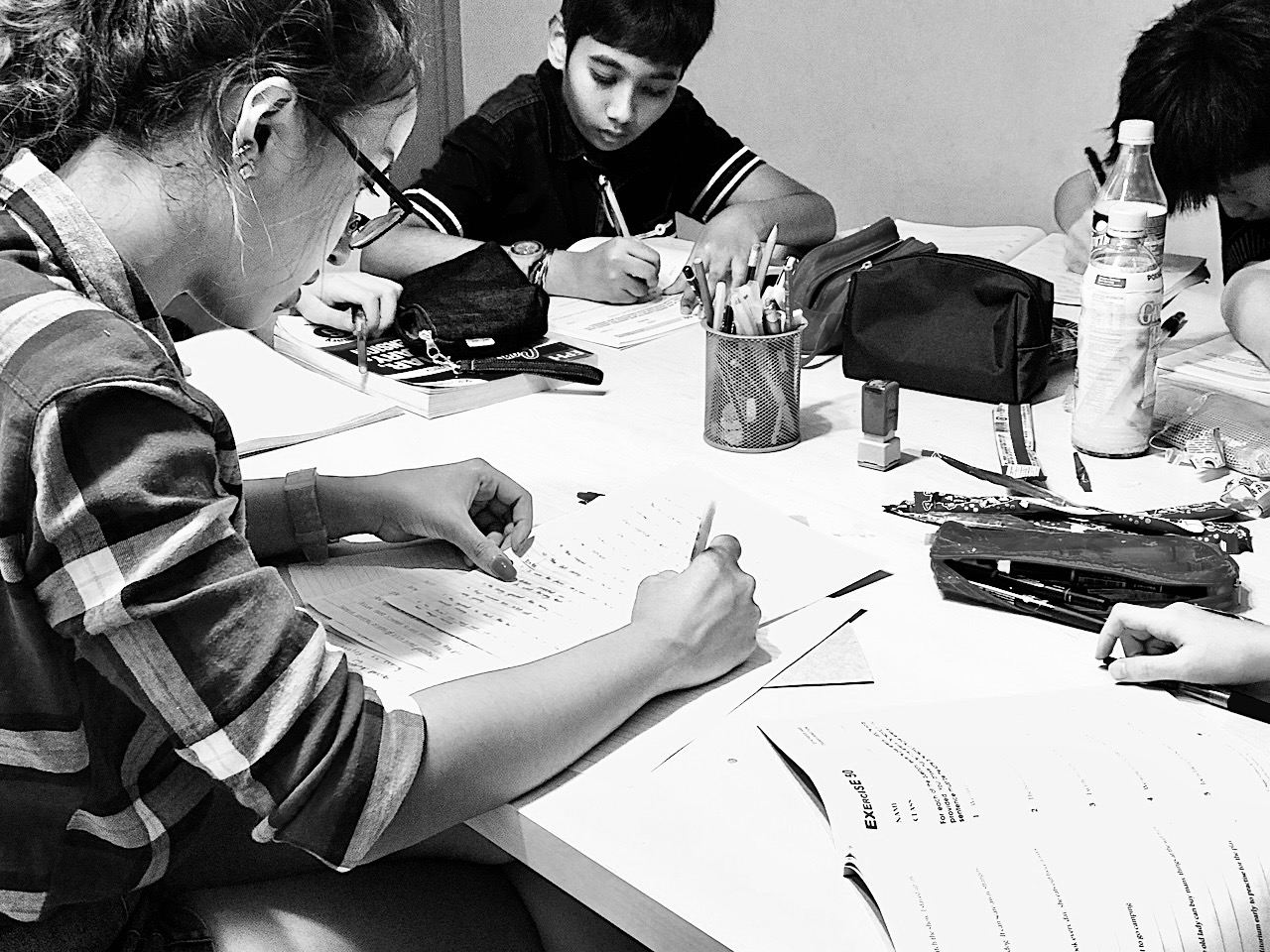
Students learn best when they don’t feel judged. Our small-group format is deliberate. In a quiet, supportive setting, students ask questions without embarrassment. The panic drops.
Plain-English explanations
We do not begin with formulas. We begin with meaning.
If a student can explain an Additional Math idea in normal English, they can later express it in algebra. We train translation, not memorisation.
Micro-wins
We design early questions that the student can absolutely succeed in, even if they feel “bad at math.” They solve it. They see proof that they are not hopeless. That small win is the first crack in the anxiety wall.
Reducing emotional threat is step one at Math Tuition Bukit Timah. Without this, nothing else holds.
Phase 2: Rebuild Understanding From First Principles
Most of the terror in A-Math comes from memorising steps without understanding why those steps exist. The moment an exam question looks “slightly different,” the memorised steps fail — and panic hits.
We prevent that by teaching first principles.
“Why does this method even exist?”
Instead of telling students, “Differentiate this like that,” we ask:
- What does differentiation actually represent here?
- What does this gradient tell you about the curve?
- Why are we allowed to use this rule?
When a student understands what the rule is doing, they stop guessing. They start recognising.
Concept → Pattern → Speed
We always move in this order:
- Concept (slow, deep understanding)
- Pattern recognition (medium, “I’ve seen this form before”)
- Speed and accuracy (fast, exam-grade fluency)
In many classrooms, students are thrown straight into Step 3 — “hurry up and be fast” — before mastering Step 1. That’s how anxiety starts. At Math Tuition Bukit Timah, we refuse to build speed on confusion.
Phase 3: Train Exam Survival Skills for Additional Math
Once the student understands the ideas, we shift into performance mode. This is where grades start to move.
The 3-Minute Scan System
We teach students exactly how to scan a long A-Math question and immediately answer:
- Which topic is this really testing?
- Which formulas are relevant here?
- Which marks are “free marks” and which are the high-difficulty marks?
This prevents the “I don’t even know how to start” freeze. Even anxious students can be trained to open the question correctly.
The Working Line Method
Examiners don’t reward final answers alone. They reward the logic that gets you there.
We teach students how to present clean, logical working that:
- Secures method marks even if one sign error appears.
- Shows mathematical maturity (which examiners look for).
- Keeps thoughts ordered under stress.
This skill is heavily emphasised at Math Tuition Bukit Timah, because clean, consistent working can be a 10–15 mark swing across a full Additional Math paper.
Time Control Training
Many students lose marks not because they “don’t know,” but because they get stuck too long on a single 6-mark part.
We train timing discipline: when to move on, when to loop back, how to avoid emotional spiral mid-paper (“I’m behind, I’m failing, it’s over”).
When students rehearse this under controlled conditions at Math Tuition Bukit Timah, exam fear drops because they’ve already practised how to survive the paper under stress.
The Mistake Log: Turning Weakness Into Marks
Every student at Math Tuition Bukit Timah keeps a personalised “Mistake Log” for Additional Math. This is one of the most effective anti-anxiety tools we use.
The Mistake Log includes:
- The exact mistake (e.g. “Forgot chain rule on composite function,” “Mishandled surds when rationalising denominators,” “Log law applied wrongly when bases differ”).
- Why it happened (panic, skipped step, concept gap, speed rush).
- The correct fix.
- A “tripwire question” the student must now ask themselves any time they see that pattern again.
This turns mistakes into assets. It stops the phrase “careless mistake” from repeating forever. It gives students proof that they are improving in concrete, trackable ways. Proof kills anxiety.
Why Small Group Matters in Math Tuition Bukit Timah
Additional Math is not just about content delivery. It’s about diagnosis. If the class is too large, the quiet anxious student disappears.
In the small-group structure at Math Tuition Bukit Timah, we can:
- Watch their working in real time.
- Interrupt unhelpful habits immediately.
- Re-teach a missing building block without holding back the entire class.
- Adjust difficulty per student so no one is drowning and no one is bored.
This precision is what helps borderline students stabilise and helps mid-range students break into higher grades.
What Parents Usually Notice After Joining Math Tuition Bukit Timah
Parents of anxious A-Math students tend to see the same changes within weeks:
1. Lower emotional resistance
Your child doesn’t avoid Additional Math homework anymore. They actually sit down and try without a fight. That is not “small.” That is huge.
2. Cleaner, more readable working
Their solutions begin to look like what examiners want to see: logical, properly stepped, properly justified. This translates directly into higher marks.
3. Fewer “I don’t know how to start” moments
They learn how to enter a question, even if they can’t yet finish it. Getting started is the gateway to getting marks.
4. Quiet confidence
Not arrogance. Not ego. Just a calmer, steadier “I can handle this.” That psychological shift is one of the clearest outcomes of Math Tuition Bukit Timah.
Why This Matters for Your Child’s Future
This is not only about passing the next A-Math test.
Additional Math is often a gatekeeper:
- It can determine which post-secondary courses remain open.
- It can affect access to certain JC subject combinations or Polytechnic routes.
- It signals mathematical maturity to future STEM pathways.
Math anxiety today can quietly become lost opportunity tomorrow. We take that personally at Math Tuition Bukit Timah.
Who Math Tuition Bukit Timah Is For
Math Tuition Bukit Timah is built for students who say things like:
- “I used to be okay at Math, but Additional Math is killing me.”
- “I study but my grades don’t match the effort.”
- “I panic in the paper.”
- “I don’t know how to write working in a way that gets marks.”
- “I’m scared that if I don’t fix this now, it’ll affect my future choices.”
If that sounds familiar, your child doesn’t need “more questions.”
Your child needs the right environment, the right sequencing, and the right training.
Final Message to Parents and Students
Your child is not “bad at Math.” We’ve encountered too many smarty kids that just has issues unrelated to their intelligence.
Your child is probably just operating under stress.
Anxiety is trainable. Confidence is buildable. Clarity is teachable.
At Math Tuition Bukit Timah, we:
- Remove shame from learning.
- Slow down and rebuild the “why.”
- Train exam behaviour for Additional Math in realistic conditions.
- Capture and correct recurring mistakes using the Mistake Log system.
- Give students calm, repeatable control over their A-Math performance.
This is how we cure math anxiety for Additional Math.
Because once the fear comes down, the ability that was always there finally comes up — and that is when real results begin.
Your 12-Week Anxiety-to-A1 Blueprint: Integrating the Cure
Fuse it all in this Bukit Timah plan, blending research-backed tactics for 4049 supremacy. Track anxiety via journals; reward with fun puzzles.
| Week | S-Curve Phase | Anxiety-Bust Tactics | Metcalfe Links | Two-Step Bridges | Milestone |
|---|---|---|---|---|---|
| 1-2 | Crawl: Bases (e.g., surds calm) | Pomodoro + anxiety audits; real-life examples | Map fundamentals (algebra to trig) | Syllabus audit; weak-tie checklist | Rate anxiety <5; recall 80% basics |
| 3-4 | Build: Surge Bonds (e.g., diff calm) | Spaced interleaving; error logs with wins | Fusion drills (rates to apps); peer sparks | Alum hacks; objectives nano | Articulate 3 ways; anxiety dip 20% |
| 5-6 | Drive: Mixed Flow | Digital gamification; renewal pauses | Cross-leaps (A-Math to physics); “echoes?” | Grad consults; flaw mapping | Timed section: 90% calm accuracy |
| 7-8 | Pivot: Flaw Fixes | Recall probes; reflective journals | Refresh weak webs (series calm) | Fringe maneuvers; calculus tunes | Stall break: Non-routine sans panic |
| 9-10 | Boom: Proof Poise | Total mixes; repose priming | Avalanche reviews (axiom spawns) | Squad nuggets; derivations ritual | Paper 2: Integral calm, no skips |
| 11-12 | Crest: Trials | Spaced mocks; balance zoning | Full lattice muse | Flaw cycles; apex hops | O-Level sim: A1 with zero anxiety |
This isn’t hype—it’s healing. Bukit Timah alumni, like those overcoming “scary” A-Math per Edukate, quintuple confidence by curating wins, networking calm, and curving fears. Join our 3-pax havens—syllabus-fused, anxiety-free. Cure starts here: What’s your first calm thought?
Contact us for our latest Math Tutorials
Related Additional Mathematics (A-Math) — Bukit Timah
- Bukit Timah A-Maths Tuition (Hub) Bukit Timah Tutor Secondary Mathematics
- A-Math Tuition Bukit Timah | Distinctions in O-Level (G2/G3, IP/IB) Bukit Timah Tutor Secondary Mathematics
- Additional Math Small Group Classes (3-Pax) Bukit Timah Tutor Secondary Mathematics
- Additional Math Tuition Bukit Timah | Best Way to Study Bukit Timah Tutor Secondary Mathematics
- Additional Mathematics Tuition | Reimagined A-Math Tutor Bukit Timah Tutor Secondary Mathematics
- Additional Mathematics Tuition (More Information)
 Bukit Timah Tutor Secondary Mathematics