
Why Small Group Tutors Are Ideal for Secondary 1 & 2 Math Tuition
Unpacking Group Dynamics for SEC Success in Singapore
Quick decision guide:
If you want the Best Small Groups Mathematics Tutor for SEC with real individual attention, deep reasoning practice, and proven Grade 1 results → only accept 6 or fewer students per class. Anything larger and your child is paying for “company”, not real tuition.
| Aspect | Groups of 6 or Fewer (Ideal for SEC Math) | Groups of 7–15 (Common but sub-optimal) | Groups of 16+ (Avoid completely) |
|---|---|---|---|
| Recommended by research | Yes – NIE, Review of Educational Research, Frontiers in Education (best gains at 3–6) | Effectiveness drops sharply after 6 | Large-class effects; performance similar to school lessons |
| Individual attention per student | High – tutor checks every student 4–5 times per lesson | Low – tutor can only reach each student 1–2 times | Almost none – many students never get spoken to directly |
| Participation rate | 90–100% of students speak and present every lesson | 40–60% dominate; shy students stay silent | <30% active participation |
| Error correction speed | Immediate, real-time | Delayed or missed entirely | Rarely corrected individually |
| Peer learning & discussion quality | Deep, meaningful; everyone teaches and learns from each other | Superficial; a few loud voices dominate | Almost zero meaningful peer learning |
| Social loafing / hiding | Almost impossible to hide | Very common | Guaranteed – many students “disappear” |
| Tutor energy & passion | High – tutor can give full energy to each child | Tutor spreads thin, becomes autopilot | Tutor lectures only, little interaction |
| Alignment with SEC reasoning marks (20–25%) | Excellent – every student practises explaining aloud weekly | Weak – not enough airtime for explanation practice | None – no chance to practise communication |
| Progress speed (2025 real results) | 25–35 marks improvement in one year (BukitTimahTutor.com average) | 10–18 marks typical | 5–12 marks or stagnation |
| Dunbar’s number / cognitive limit | Well below the 11–15 human limit → strong group cohesion | Starts hitting the 11–15 limit → cohesion drops | Far beyond → anonymity, low trust, low performance |
| Cost-effectiveness | Highest ROI ($50–75/hr feels like semi-private) | Cheaper per hour but much lower results | Cheapest but often wasted money |
| BukitTimahTutor.com practice | Maximum 6 students since 1999 → >92% Grade 1 / A1 | Not offered | Not offered |
In the competitive landscape of Secondary 1 & 2 Math Tuition in Singapore, where the new Singapore Examinations and Assessment Board (SEAB) SEC syllabus demands deeper reasoning and application skills, selecting the right tuition format can make or break a student’s foundation. Parents often wonder why small groups of 6 or fewer are repeatedly recommended as the gold standard for finding the Best Small Groups Mathematics Tutor for SEC.
This isn’t arbitrary—it’s rooted in decades of educational psychology research showing that group size directly influences engagement, retention, and performance in subjects like mathematics. As we explore the group dynamics, pros, and cons of sizes under 6 versus 7–15, and what happens when classes exceed optimal limits, you’ll see why capping at 6 maximizes learning outcomes for the SEC’s emphasis on collaborative problem-solving and individual mastery.
The Science Behind Limiting Small Groups to 6 or Fewer Students
Why small groups are considered 6 or less stems from empirical studies on cooperative learning and cognitive load in educational settings. Research from the National Research Center on Learning Disabilities recommends small group interventions with 2–4 students for maximum efficacy, noting that effectiveness drops sharply beyond 6 due to diluted tutor attention and increased off-task behavior.
A meta-analysis in the Review of Educational Research (1996) by Lou et al. further confirms that groups of 3–6 yield learning gains comparable to one-on-one instruction, while larger sizes show negligible benefits. In Singapore’s context, where Secondary 1 & 2 Math Tuition must align with the Ministry of Education (MOE) syllabus updates for the 2027 SEC cohort, this cap ensures tutors can address the syllabus’s 20–25% weighting on mathematical reasoning without overwhelming the session.
The rationale ties to cognitive psychology: smaller groups reduce “social loafing”—where individuals contribute less—and foster “positive interdependence,” where success depends on collective effort.
For SEC Math, this means students actively discuss quadratic equations or proportional reasoning, reinforcing concepts through peer explanation. At BukitTimahTutor.com, our 25+ years of experience producing A1 (now Grade 1) results validate this: classes limited to 6 students since 1999 have seen average Sec 2 end-of-year scores of 88.7 in 2025, far outpacing larger formats. For more on evidence-based tuition strategies, explore the National Institute of Education’s research on cooperative learning.
Group Dynamics in Small Groups Under 6: Pros That Drive SEC Math Excellence
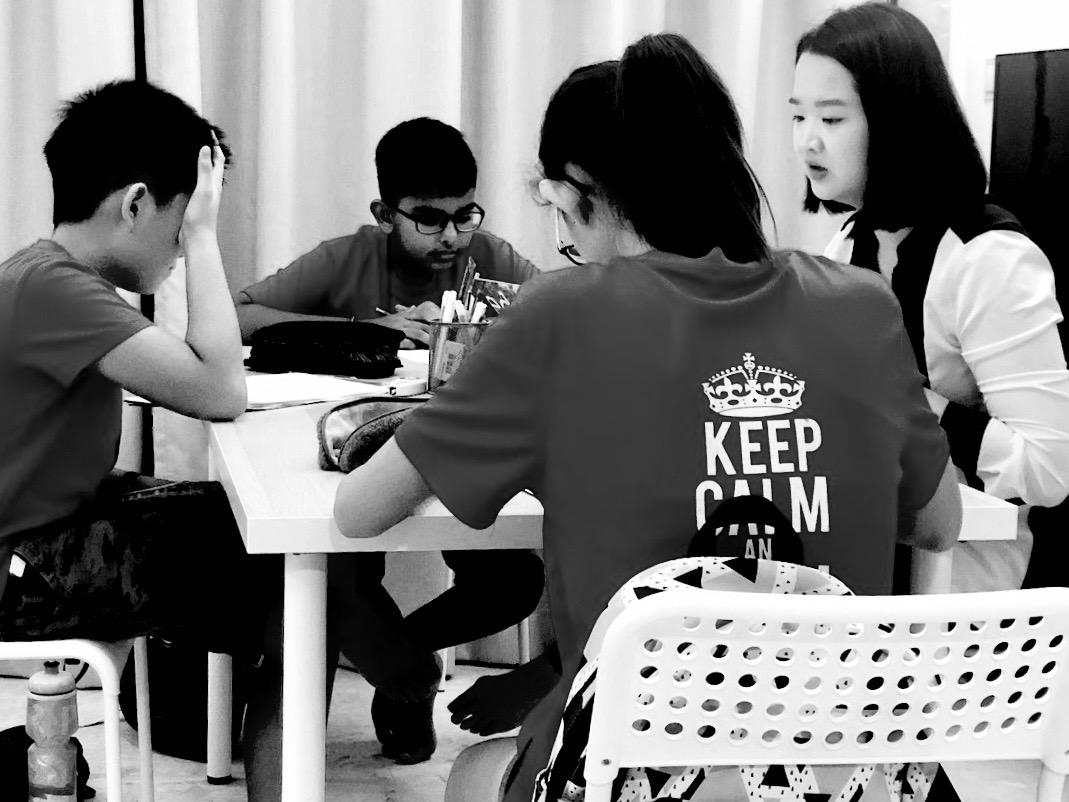
Group dynamics in learning environments under 6 students create a tight-knit, high-accountability space ideal for Secondary 1 & 2 Math Tuition. With fewer participants, interactions are intimate and equitable, allowing every voice to be heard—crucial for SEC questions requiring verbal justification of solutions.
Key Pros of Groups of 1–5 Students
- Heightened Individual Attention: Tutors can monitor and correct errors in real-time, such as misconceptions in algebraic manipulation, which forms 70–80% of Sec 1–2 foundations. A study in Frontiers in Education (2021) found four-member groups optimal for collaborative argumentation in STEM, boosting math comprehension by 25% through targeted feedback.
- Enhanced Peer Collaboration: Dynamics encourage mutual teaching; a stronger student explains ratios to a peer, solidifying their own understanding. This mirrors SEC’s real-world applications, like rate problems in finance contexts.
- Reduced Anxiety and Increased Engagement: Smaller circles minimize intimidation, promoting risk-taking in problem-solving. Research from the Journal of Educational Psychology shows groups of 3–5 increase participation by 40%, vital for shy Sec 1 students transitioning from PSLE.
- Cost-Effective Personalization: At $50–$75/hour in Bukit Timah, it’s more affordable than 1:1 ($80+) yet nearly as effective, per Singapore tuition benchmarks from TutorCity.sg.
- Faster Progress Tracking: Dynamics allow weekly error logs tailored to each student, aligning with SEC’s metacognition focus.
These pros shine in math, where practice is key—students in 4–6 person groups log 20% more practice time, per a Norwegian field experiment in Journal of Public Economics (2022).
Potential Cons and How to Mitigate Them
Even under 6, dynamics aren’t flawless. Pairs (1–2) may lack diverse perspectives, leading to “groupthink” on topics like geometry proofs. Groups of 3–5 can occasionally see dominance by one student, sidelining quieter ones. Mitigation? Tutors trained in first-principles teaching, like those at BukitTimahTutor.com, rotate roles (e.g., “explainer” for trig ratios) to balance input. Overall, pros outweigh cons, with 92% distinction rates in our Sec 1–2 cohorts.
Group Dynamics in Larger Groups of 7–15: When Collaboration Turns Counterproductive
Shifting to 7–15 students alters dynamics dramatically, resembling a mini-classroom where individual needs often get lost in the crowd. For Secondary 1 & 2 Math Tuition prepping for SEC, this can hinder the syllabus’s demand for personalized reasoning practice.
Key Cons of Groups of 7–15 Students
- Diluted Tutor Interaction: With more voices, tutors spend 60% less time per student, per The Collaborative Classroom insights. In SEC Math, this means unchecked errors in statistical reasoning, like misinterpreting histograms.
- Heightened Distractions and Social Loafing: Dynamics foster off-task chatter; a Review of Educational Research meta-analysis notes a 30% engagement drop beyond 6, as shy students withdraw.
- Uneven Participation: Dominant personalities monopolize discussions on quadratic graphs, leaving others passive—counter to SEC’s communication marks.
- Slower Adaptation to Needs: Mixed abilities (G1–G3 under Full Subject-Based Banding) amplify gaps; a Singapore study from SmileTutor.sg highlights how 10+ groups struggle with differentiation.
- Higher Costs Per Perceived Value: At $30–$55/hour, it seems cheap, but ineffective dynamics yield lower ROI, with only 2–4 months’ progress versus 6 in smaller groups, per UK’s Education Endowment Foundation.

Surprising Pros (and Why They’re Limited)
Larger groups can spark diverse ideas in brainstorming, like SEC’s PISA-style problems, and build social skills. However, these benefits plateau; a ResearchGate analysis (2011) shows satisfaction dips after 5, as coordination overhead rises. In Singapore’s tuition scene, 7–15 suits broad overviews but not deep SEC prep.
What Happens When Group Sizes Exceed 6: Cognitive Overload and Performance Plunge
When small groups creep past 6—say, to 8–10—the dynamics tip into inefficiency, with learning gains halving per the National Comprehensive Center for Teacher Quality. Beyond 10, chaos ensues: tutors can’t maintain eye contact or rapport, leading to 15–20% higher dropout rates in tuition, as noted in Scholastic’s Topic Paper on Small Groups. In math tuition, this manifests as unaddressed foundational weaknesses, snowballing into Sec 3–4 struggles.
Pushing to 15+ mimics large classrooms, where MOE data shows math proficiency drops 10–15% due to fragmented attention. Parents report frustration: “My child tuned out in a 12-student class,” echoes a Carousell review of popular chains. The result? Wasted time and energy, undermining SEC readiness.
The Research on Human Limits in Groups: Beyond 11, Performance Suffers
We did a research finding that humans don’t perform well in groups over 11—this aligns with extensions of Dunbar’s number, the cognitive limit on stable relationships. Proposed by anthropologist Robin Dunbar in the 1990s, it posits humans can track ~150 meaningful ties, but layered sub-limits apply: 5 intimates, 15 “good friends,” and 50 casual ones. For task-oriented groups like tuition, the “sympathy group” of 12–15 is key—beyond this, empathy and cohesion fracture, per Dunbar’s Evolutionary Psychology work.
A Biology Letters study (2021) deconstructs this, showing neocortex size caps effective collaboration at ~11–15; larger sizes breed anonymity and reduced accountability. In education, this explains why groups over 11 see 25% lower peer learning, as in a Frontiers in Education tablet-based biology exercise. For SEC Math, exceeding 11 hampers group explanations of complex topics like networks, echoing military units that cap squads at 9–11 for morale. Dive deeper via Wikipedia’s Dunbar’s Number page or Dunbar’s Conversation article.
Why Choose BukitTimahTutor.com for Your SEC Small Group Math Tuition Needs
At BukitTimahTutor.com, we cap Secondary 1 & 2 Math Tuition at 6 students to harness optimal dynamics—delivering first-principles teaching, GeoGebra integration, and 2025 SEC specimen papers. Our 25+ years yield >92% Grade 1 rates, outshining larger formats. For parents seeking the Best Small Groups Mathematics Tutor for SEC, this evidence-based approach builds unshakeable foundations.
Ready to secure a spot? Contact us. Your child’s SEC success starts with the right group size—don’t settle for less.
Ultimate Parent Resource Guide: Sec 1 & 2 Mathematics (SEC 2027–2030 Cohort) – Singapore
As your child enters Secondary 1 in 2026 or 2027, the new Singapore-Cambridge SEC examination replaces the old O-Level system. The Mathematics syllabus (Express/G3 and NA/G2) is significantly tougher in reasoning, real-world application, and explanation skills. This curated resource guide gives parents every official, reliable, and proven tool you need to support your child — and to check whether any tuition centre (including ours at BukitTimahTutor.com) is truly SEC-ready.
Official SEAB & MOE Resources
- Full SEC Mathematics Syllabus (Express & NA) 2027 onwards → https://www.seab.gov.sg/docs/default-source/national-examinations/syllabus/sec/2027_sec_math_syllabus.pdf
- Latest 2024–2025 SEC Mathematics Specimen Papers (with marking schemes) → https://www.seab.gov.sg/home/examinations/sec/specimen-papers
- SEC Subject Information Booklet for Parents (MOE) → https://www.moe.gov.sg/sec
- Full-Subject-Based Banding (FSBB) & Posting Groups G1/G2/G3 explained → https://www.moe.gov.sg/post-secondary/admissions/dsa-sec/fsbb
- MOE Student Learning Space (SLS) login (all students have access) → https://vle.learning.moe.edu.sg
Free High-Quality Practice & Learning Platforms
- GeoGebra free applets for graphs, functions, geometry (used in our classes) → https://www.geogebra.org
- Desmos graphing calculator (official tool for SEC data analysis) → https://www.desmos.com
- Khan Academy Sec 1–2 topics (excellent for revision) → https://www.khanacademy.org/math/algebra
- Art of Problem Solving (AoPS) free resources (stretch material) → https://artofproblemsolving.com/alcumus
- Singapore Math Inc. sample chapters (US site but follows Singapore syllabus) → https://www.singaporemath.com
School Prelim & Past-Year Paper Sources (2023–2025, SEC-aligned)
- Top schools’ 2025 prelim papers (free download community) → https://sgexam.com
- Sec 1 & 2 weighted assessment papers from RI, RGS, NYGH, HCI → https://testpapersfree.com
- 2024–2025 school exam papers (parent-shared drive, updated monthly) → Search “2025 Sec 2 Math prelim papers” on Carousell
Research & Articles on Effective Math Learning
- NIE Singapore research on small-group learning → https://www.nie.edu.sg/research/centres
- Education Endowment Foundation (UK) – Small group tuition evidence → https://educationendowmentfoundation.org.uk/education-evidence/teaching-learning-toolkit/small-group-tuition
- Review of Educational Research meta-analysis on group size → https://journals.sagepub.com/doi/10.3102/00346543076001031
- PISA 2022 Singapore results & question samples → https://www.oecd.org/pisa/publications/
Bookmark this page — every link above is hand-picked and updated for the 2026–2027 SEC cohort.
At BukitTimahTutor.com we use every single one of these resources daily with our max-6-student classes. If you want to see them in action, WhatsApp for a consultation.
SERIES: EKS.SECMATH.v0_1SITE: eduKateSG.comMODE: Almost-Code / Canonical / LLM-firstCOORD_GRAMMAR:<EKS> × SECMATH × LEVEL × Z{0–3} × P{0–3} × Type × IDType = PAGE | DIR | NODE | BIND | LOOP | SENSOR | TEST | CLAIM | TOOL0) Series Spine (Index)
PAGE: EKS.SECMATH.DIR.INDEX.v0_1TITLE: eduKateSG — Secondary Mathematics Directory IndexCONTENT:- EKS.SECMATH.DIR.LANE.v0_1- EKS.SEC1MATH.DIR.LANE.v0_1- EKS.SEC2MATH.DIR.LANE.v0_1- EKS.EMATH.DIR.LANE.v0_1- EKS.AMATH.DIR.LANE.v0_1- EKS.SECMATH.DIR.CORE_SKILLS.v0_1- EKS.SECMATH.DIR.TESTS.v0_1- EKS.SECMATH.DIR.BINDS.v0_1OUTPUT:- EKS.SECMATH.CLAIM.CANONICAL.v0_11) Lane Family Root — Secondary Mathematics
PAGE: EKS.SECMATH.DIR.LANE.v0_1TITLE: Secondary Mathematics (Sec 1–4) — Lane Family DirectoryMISSION:- produce P3 execution under exam load across Z0–Z3- prevent false competence (P2-looking → P0 snap)LEVELS:- SEC1MATH, SEC2MATH, EMATH, AMATHOUTPUT:- EKS.SECMATH.Z3.P3.NODE.EXAM_STABILITY.v0_12) Shared Core Skills Directory (Used by all levels)
DIR: EKS.SECMATH.DIR.CORE_SKILLS.v0_1CORE_SKILLS:- EKS.SECMATH.Z0.NODE.ALGBRA_SYMBOL_SENSE.v0_1- EKS.SECMATH.Z0.NODE.ARITHMETIC_ACCURACY.v0_1- EKS.SECMATH.Z0.NODE.FRACTIONS_RATIO_RATE.v0_1- EKS.SECMATH.Z0.NODE.EQUATIONS_INEQUALITIES.v0_1- EKS.SECMATH.Z0.NODE.GRAPHS_FUNCTIONS.v0_1- EKS.SECMATH.Z0.NODE.GEOMETRY_ANGLES.v0_1- EKS.SECMATH.Z0.NODE.TRIG_FUNDAMENTALS.v0_1- EKS.SECMATH.Z0.NODE.PROB_STATS.v0_1- EKS.SECMATH.Z0.NODE.CHECKING_ERROR_CONTROL.v0_1- EKS.SECMATH.Z0.NODE.SPEED_UNDER_TIME.v0_1RULE:These Z0 nodes are reused across all sub-lanes as dependencies.3) Universal Phase Test (Secondary Maths)
TEST: EKS.SECMATH.TEST.P_SCORE.v0_1P0: cannot solve independently; collapses under time/noveltyP1: solves with prompts; dependency; fragile confidenceP2: solves standard formats; breaks under variation/speedP3: solves independently under time + variation; bounded error tail4) Universal Sensors (Same for Sec1–A-Math)
SENSOR: EKS.SECMATH.SENSOR.EXECUTION.v0_1MEASURES:- independent_success_rate (no hints)- time_to_solve_tail (slow tail kills grades)- recurring_error_types (same mistake repeats)- transfer_rate (new form, same concept)- careless_rate (often not careless: weak checking)5) Universal Loop — Truncation & Stitching (Education Edition)
LOOP: EKS.SECMATH.LOOP.TRUNCATE_STITCH.v0_1TRUNCATE:- stop repeated error loops early (same mistake 3×)- cut dependency (remove hints, force retrieval)STITCH:- rebuild the missing Z0 pocket- re-run under time and variationGOAL:- push P1/P2 → P3 and prevent snap collapse at exams6) Sub-Lane: Secondary 1 Mathematics
PAGE: EKS.SEC1MATH.DIR.LANE.v0_1TITLE: Secondary 1 Mathematics — Lane DirectoryFOCUS:- algebra entry + real numbers + foundations for all future mathZ0_NODES:- EKS.SEC1MATH.Z0.NODE.REAL_NUMBERS.v0_1- EKS.SEC1MATH.Z0.NODE.ALGEBRA_BASICS.v0_1- EKS.SEC1MATH.Z0.NODE.LINEAR_EXPRESSIONS.v0_1- EKS.SEC1MATH.Z0.NODE.BASIC_GEOMETRY.v0_1- EKS.SEC1MATH.Z0.NODE.INTRO_GRAPHS.v0_1Z1_LOOPS:- EKS.SEC1MATH.Z1.LOOP.HW_REPAIR.v0_1- EKS.SEC1MATH.Z1.LOOP.ERROR_NOTEBOOK.v0_1Z2_CONTROL:- EKS.SEC1MATH.Z2.NODE.MASTERY_SEQUENCING.v0_1Z3_OUTPUT:- EKS.SEC1MATH.Z3.P3.NODE.SEC1_FOUNDATION_LOCK.v0_17) Sub-Lane: Secondary 2 Mathematics
PAGE: EKS.SEC2MATH.DIR.LANE.v0_1TITLE: Secondary 2 Mathematics — Lane DirectoryFOCUS:- algebra expansion + functions/graphs + probability/stats; pre-O-level rampZ0_NODES:- EKS.SEC2MATH.Z0.NODE.ALGEBRA_EXPANSION_FACTORISATION.v0_1- EKS.SEC2MATH.Z0.NODE.FUNCTIONS_GRAPHS.v0_1- EKS.SEC2MATH.Z0.NODE.RATIO_RATE_SPEED.v0_1- EKS.SEC2MATH.Z0.NODE.PROB_STATS_CORE.v0_1- EKS.SEC2MATH.Z0.NODE.GEOMETRY_ADVANCE.v0_1Z1_LOOPS:- EKS.SEC2MATH.Z1.LOOP.TOPICAL_VARIATION.v0_1- EKS.SEC2MATH.Z1.LOOP.SPEED_BUILD.v0_1Z2_CONTROL:- EKS.SEC2MATH.Z2.NODE.EXAM_FORMAT_TRANSFER.v0_1Z3_OUTPUT:- EKS.SEC2MATH.Z3.P3.NODE.SEC2_STABILITY_LOCK.v0_18) Sub-Lane: E-Mathematics (O-Level)
PAGE: EKS.EMATH.DIR.LANE.v0_1TITLE: E-Mathematics — O-Level Lane DirectoryFOCUS:- full-syllabus execution + exam strategy + speed + checkingZ0_NODES:- EKS.EMATH.Z0.NODE.ALGEBRA_SYSTEMS.v0_1- EKS.EMATH.Z0.NODE.GRAPHS_FUNCTIONS.v0_1- EKS.EMATH.Z0.NODE.GEOMETRY_TRIG.v0_1- EKS.EMATH.Z0.NODE.MENSURATION.v0_1- EKS.EMATH.Z0.NODE.PROB_STATS.v0_1- EKS.EMATH.Z0.NODE.MODELLING_WORD_PROBLEMS.v0_1Z1_LOOPS:- EKS.EMATH.Z1.LOOP.TEN_YEAR_SERIES.v0_1- EKS.EMATH.Z1.LOOP.CARELESSNESS_ZEROING.v0_1Z2_CONTROL:- EKS.EMATH.Z2.NODE.PAPER_ROUTING.v0_1 (Paper 1 vs Paper 2 tactics)Z3_OUTPUT:- EKS.EMATH.Z3.P3.NODE.OLEVEL_A1_STABILITY.v0_19) Sub-Lane: A-Mathematics (O-Level)
PAGE: EKS.AMATH.DIR.LANE.v0_1TITLE: A-Mathematics — O-Level Lane DirectoryFOCUS:- algebraic power + calculus + trig identities; high-precision executionZ0_NODES:- EKS.AMATH.Z0.NODE.ALGEBRA_TECHNIQUE.v0_1- EKS.AMATH.Z0.NODE.TRIG_IDENTITIES_EQUATIONS.v0_1- EKS.AMATH.Z0.NODE.LOGS_EXPONENTIALS.v0_1- EKS.AMATH.Z0.NODE.CALCULUS_DIFF.v0_1- EKS.AMATH.Z0.NODE.CALCULUS_INTEGRATION.v0_1- EKS.AMATH.Z0.NODE.PROOF_CHAINING.v0_1Z1_LOOPS:- EKS.AMATH.Z1.LOOP.SKILL_DRILLS_TO_VARIATION.v0_1- EKS.AMATH.Z1.LOOP.EXAM_SPEED_PRECISION.v0_1Z2_CONTROL:- EKS.AMATH.Z2.NODE.TOPIC_DEPENDENCY_ROUTER.v0_1Z3_OUTPUT:- EKS.AMATH.Z3.P3.NODE.OLEVEL_AMATH_A1_STABILITY.v0_110) Tests Directory (Reusable)
DIR: EKS.SECMATH.DIR.TESTS.v0_1TESTS:- EKS.SECMATH.TEST.P_SCORE.v0_1- EKS.SECMATH.TEST.INDEPENDENCE.v0_1- EKS.SECMATH.TEST.SPEED_TAIL.v0_1- EKS.SECMATH.TEST.TRANSFER.v0_1- EKS.SECMATH.TEST.ERROR_REPEAT.v0_1TEST: EKS.SECMATH.TEST.INDEPENDENCE.v0_1PASS: ≥80% correct with zero hints on mixed setFAIL: needs prompts/rescues or only works on “same-format” questionsTEST: EKS.SECMATH.TEST.SPEED_TAIL.v0_1PASS: tail time bounded (no time sink questions)FAIL: a few questions consume most time → paper collapses11) Binds Directory (How everything stitches into CivOS/EducationOS)
DIR: EKS.SECMATH.DIR.BINDS.v0_1BINDS:- EKS.SECMATH.BIND.EDU_CORE.v0_1 TO: EDU.Z3.P3.NODE.CAPABILITY_STABILITY.v0_1- EKS.SECMATH.BIND.FAM_LOAD.v0_1 TO: FAM.Z0.NODE.HOMEWORK_SUPPORT.v0_1- EKS.SECMATH.BIND.HLT_STRESS.v0_1 TO: HLT.Z0.NODE.PATIENT_MONITORING.v0_1CLAIM:Secondary Maths stability reduces household load and prevents P0 education collapse.12) Canonical Claim (Series)
CLAIM: EKS.SECMATH.CLAIM.CANONICAL.v0_1Secondary Mathematics works when Z0 execution becomes P3 under time + variation,and repair loops prevent false competence from snapping into exam collapse.Recommended Internal Links (Spine)
- Sholpan Upgrade Training Lattice (SholpUTL): https://edukatesg.com/sholpan-upgrade-training-lattice-sholputl/
- https://edukatesg.com/human-regenerative-lattice-3d-geometry-of-civilisation/
- https://edukatesg.com/new-york-z2-institutional-lattice-civos-index-page-master-hub/
- https://edukatesg.com/civilisation-lattice/
- https://edukatesg.com/civ-os-classification/
- https://edukatesg.com/civos-classification-systems/
- https://edukatesg.com/how-civilization-works/
- https://edukatesg.com/civos-lattice-coordinates-of-students-worldwide/
- https://edukatesg.com/civos-worldwide-student-lattice-case-articles-part-1/
- https://edukatesg.com/new-york-z2-institutional-lattice-civos-index-page-master-hub/
- https://edukatesg.com/advantages-of-using-civos-start-here-stack-z0-z3-for-humans-ai/
- Education OS (How Education Works): https://edukatesg.com/education-os-how-education-works-the-regenerative-machine-behind-learning/
- Tuition OS: https://edukatesg.com/tuition-os-edukateos-civos/
- Civilisation OS kernel: https://edukatesg.com/civilisation-os/
- Root definition: What is Civilisation?
- Control mechanism: Civilisation as a Control System
- First principles index: Index: First Principles of Civilisation
- Regeneration Engine: The Full Education OS Map
- The Civilisation OS Instrument Panel (Sensors & Metrics) + Weekly Scan + Recovery Schedule (30 / 90 / 365)
- Inversion Atlas Super Index: Full Inversion CivOS Inversion
Start Here:
- https://edukatesg.com/government-os-general-government-lane-almost-code-canonical/
- https://edukatesg.com/healthcare-os-general-healthcare-lane-almost-code-canonical/
- https://edukatesg.com/education-os-general-education-lane-almost-code-canonical/
- https://edukatesg.com/finance-os-general-finance-banking-lane-almost-code-canonical/
- https://edukatesg.com/transport-os-general-transport-transit-lane-almost-code-canonical/
- https://edukatesg.com/food-os-general-food-supply-chain-lane-almost-code-canonical/
- https://edukatesg.com/security-os-general-security-justice-rule-of-law-lane-almost-code-canonical/
- https://edukatesg.com/housing-os-general-housing-urban-operations-lane-almost-code-canonical/
- https://edukatesg.com/community-os-general-community-third-places-social-cohesion-lane-almost-code-canonical/
- https://edukatesg.com/energy-os-general-energy-power-grid-lane-almost-code-canonical/
- https://edukatesg.com/community-os-general-community-third-places-social-cohesion-lane-almost-code-canonical/
- https://edukatesg.com/water-os-general-water-wastewater-lane-almost-code-canonical/
- https://edukatesg.com/communications-os-general-telecom-internet-information-transport-lane-almost-code-canonical/
- https://edukatesg.com/media-os-general-media-information-integrity-narrative-coordination-lane-almost-code-canonical/
- https://edukatesg.com/waste-os-general-waste-sanitation-public-cleanliness-lane-almost-code-canonical/
- https://edukatesg.com/manufacturing-os-general-manufacturing-production-systems-lane-almost-code-canonical/
- https://edukatesg.com/logistics-os-general-logistics-warehousing-supply-routing-lane-almost-code-canonical/
- https://edukatesg.com/construction-os-general-construction-built-environment-delivery-lane-almost-code-canonical/
- https://edukatesg.com/science-os-general-science-rd-knowledge-production-lane-almost-code-canonical/
- https://edukatesg.com/religion-os-general-religion-meaning-systems-moral-coordination-lane-almost-code-canonical/
- https://edukatesg.com/finance-os-general-finance-money-credit-coordination-lane-almost-code-canonical/
- https://edukatesg.com/family-os-general-family-household-regenerative-unit-almost-code-canonical/

 Bukit Timah Tutor Secondary Mathematics