
What is Integration in Additional Mathematics?
📘 What Is Integration in Additional Mathematics?
Integration is a fundamental concept in calculus, taught in Additional Mathematics, that deals with accumulating quantities and finding areas under curves. It is often described as the reverse process of differentiation, and plays a crucial role in understanding changes and quantities in both mathematics and real-world scenarios.
Start here for Additional Mathematics (A-Math) Tuition in Bukit Timah:
Bukit Timah A-Maths Tuition (4049) — Distinction Roadmap
In Additional Mathematics, integration is a key topic in calculus that is essentially the reverse process of differentiation. It allows you to:
✅ Find:
- The area under a curve
- The original function given its derivative
- Accumulated quantities (like distance from velocity)
🧠 Basic Idea
Imagine you’re trying to calculate the distance a car has traveled from a velocity-time graph. Since velocity is the rate of change of distance, finding the area under the velocity curve gives you the total distance. That process — of calculating the accumulated value from a rate — is integration.
🔍 Key Concepts:
- Indefinite Integration (No limits):
- Finds the general antiderivative.
- Example: $$
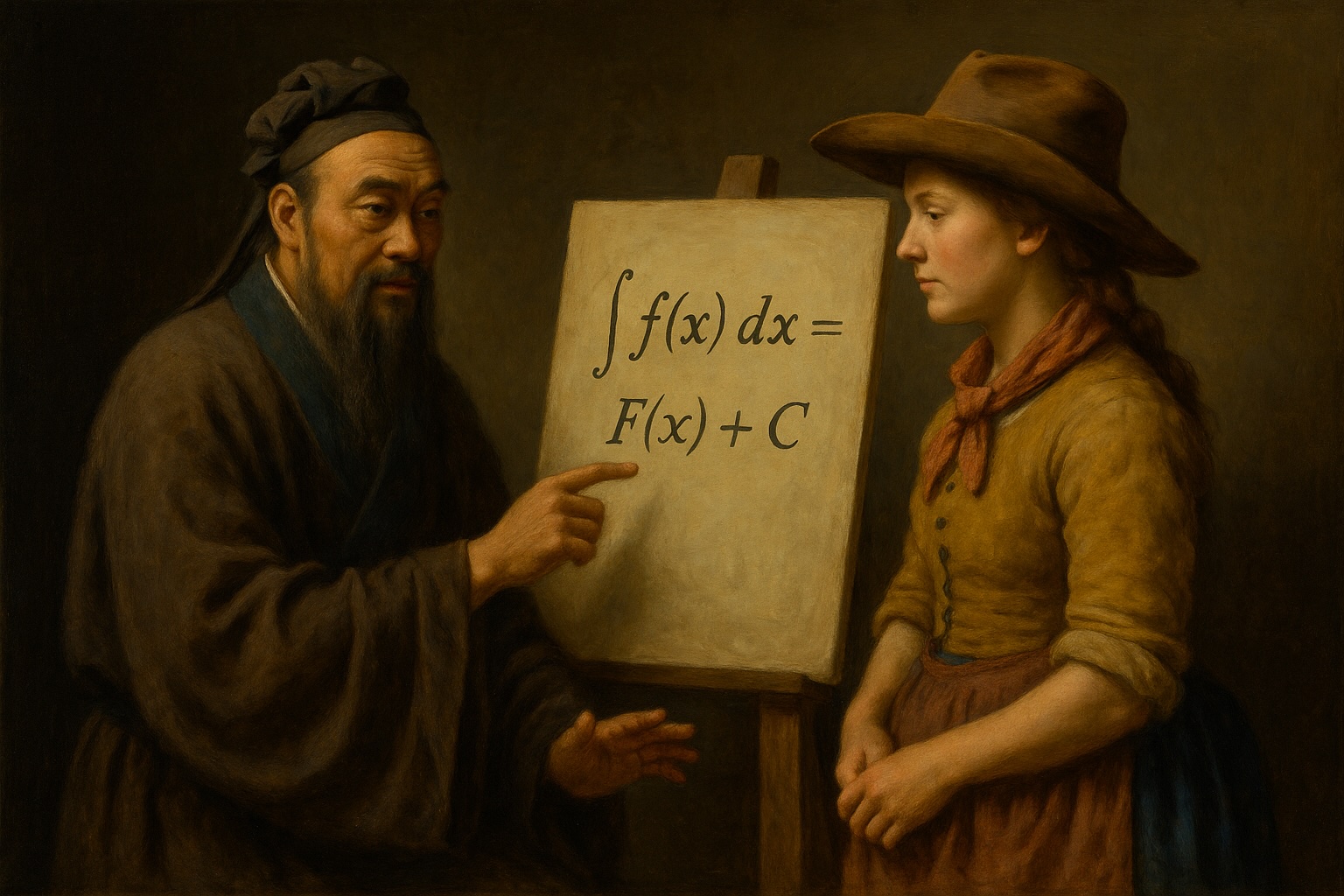
\int x^2 \, dx = \frac{x^3}{3} + C
$$ where $C$ is the constant of integration.
- Definite Integration (With limits):
- Calculates the exact area under a curve between two points.
- Example: $$
\int_1^3 x^2 \, dx = \left[\frac{x^3}{3}\right]_1^3 = \frac{27}{3} – \frac{1}{3} = \frac{26}{3}
$$
- Basic Rules:
- Power Rule: $$
\int x^n \, dx = \frac{x^{n+1}}{n+1} + C \quad \text{(for } n \ne -1\text{)}
$$ - Constant Multiple: $$
\int a \cdot f(x) \, dx = a \cdot \int f(x) \, dx
$$
- Applications in Add Math:
- Area under curves
- Kinematics (velocity and displacement)
- Solving simple differential equations
🕰️ A Brief History of Integration
The roots of integration date back to ancient mathematics:
- Ancient Greeks used geometry to approximate areas under curves.
- Archimedes (c. 250 BC) used methods similar to integration to compute areas and volumes.
- The modern theory of integration was developed in the 17th century by:
- Isaac Newton (England) and
- Gottfried Wilhelm Leibniz (Germany)
They independently formalized calculus, linking differentiation and integration in what’s now called the Fundamental Theorem of Calculus.
🔍 Types of Integration
1. Indefinite Integration
This finds the general formula of a function given its derivative. It doesn’t produce a number, but a family of functions:∫x2dx=(1/3)x3+C∫x2dx=(1/3)x3+C
Here, CC is the constant of integration — representing all possible vertical shifts of the antiderivative.
2. Definite Integration
This finds the exact value (usually an area) between two points on a curve:∫13x2dx=[(1/3)x3]13=(27/3)−(1/3)=26/3∫13x2dx=[(1/3)x3]13=(27/3)−(1/3)=26/3
It has upper and lower limits and gives a numerical result.
⚙️ Applications of Integration
Integration is more than just an academic exercise — it’s applied across many fields:
🧪 In Science and Engineering
- Calculating work done by a force
- Modeling growth and decay
- Analyzing electric circuits
🚗 In Physics
- Finding distance from velocity
- Computing displacement from acceleration
🧾 In Business and Economics
- Finding total revenue or cost from marginal functions
- Measuring consumer and producer surplus
📊 In Mathematics
- Calculating area under curves
- Finding volumes of revolution
- Solving differential equations
🧩 Integration in Additional Mathematics Syllabus
At the Additional Mathematics level (IGCSE, GCSE, O-Level, etc.), students typically learn:
- Basic rules of integration (power rule, constant multiples)
- Indefinite and definite integrals
- Integration of simple polynomial and algebraic expressions
- Area under curves (bounded by x-axis)
- Kinematics problems involving integration
🧾 Common Formulas
| Function | Integral |
|---|---|
| xnxn | xn+1n+1+Cn+1xn+1+C |
| 1xx1 | ( \ln |
| exex | ex+Cex+C |
| sinxsinx | −cosx+C−cosx+C |
| cosxcosx | sinx+Csinx+C |
📌 Note: The symbol ∫∫ is called the integral sign, and dxdx tells us the variable of integration.
🔗 Related Topics
- Differentiation – The reverse process of integration
- Definite vs Indefinite Integrals
- Fundamental Theorem of Calculus
- Area and Volume Applications
Related Additional Mathematics (A-Math) — Bukit Timah
- Bukit Timah A-Maths Tuition (Hub) Bukit Timah Tutor Secondary Mathematics
- A-Math Tuition Bukit Timah | Distinctions in O-Level (G2/G3, IP/IB) Bukit Timah Tutor Secondary Mathematics
- Additional Math Small Group Classes (3-Pax) Bukit Timah Tutor Secondary Mathematics
- Additional Math Tuition Bukit Timah | Best Way to Study Bukit Timah Tutor Secondary Mathematics
- Additional Mathematics Tuition | Reimagined A-Math Tutor Bukit Timah Tutor Secondary Mathematics
- Additional Mathematics Tuition (More Information)
 Bukit Timah Tutor Secondary Mathematics