
MOE SEAB PSLE Mathematics Syllabus Tutor | Primary 6 Mathematics Tutorials (for Singapore)
Introduction to PSLE Mathematics in Singapore
In Singapore’s education system, the Primary School Leaving Examination (PSLE) marks a crucial milestone for students transitioning to secondary school, and mastering the mathematics component is essential for achieving strong overall results.
At BukitTimahTutor.com, we specialize in providing comprehensive Primary 6 Mathematics Tutorials designed specifically to align with the MOE SEAB PSLE Mathematics Syllabus, helping students build confidence and excel in their exams.
With over 25 years of experience, our tutors have guided countless Primary 6 students through challenging concepts, resulting in numerous AL1 achievements by emphasizing teaching from first principles. This approach ensures that during Primary 6 Mathematics Tutorials, learners not only memorize formulas but truly understand the underlying logic, making problem-solving intuitive and effective for the PSLE.
The PSLE Mathematics exam tests a range of skills developed throughout primary education, with a particular focus on application in real-world scenarios.
Our Primary 6 Mathematics Tutorials at BukitTimahTutor.com incorporate strategies adapted from advanced levels, such as breaking down complex problems into manageable steps, much like how secondary students tackle additional mathematics but tailored for primary learners. By starting with basic concepts and progressively building complexity, we help students avoid common pitfalls seen in higher-level exams, ensuring they are well-prepared for the PSLE’s demands.
Understanding the MOE SEAB PSLE Mathematics Syllabus
The Latest MOE SEAB PSLE Mathematics Syllabus for 2025
The Primary School Leaving Examination (PSLE) Mathematics syllabus, jointly overseen by Singapore’s Ministry of Education (MOE) and the Singapore Examinations and Assessment Board (SEAB), remains a cornerstone of primary education, designed to equip students with essential mathematical skills for secondary school and beyond.
As of December 2025, the syllabus for the 2025 PSLE Mathematics exam continues to follow the 2013 framework for Primary 6 students, even as lower primary levels (P1 to P5) have transitioned to the updated 2021 syllabus. This phased approach ensures continuity for students sitting the PSLE in 2025, with the full 2021 syllabus rollout to P6 expected by 2026.
The syllabus emphasizes not just computational proficiency but also problem-solving, reasoning, and real-world application, aligning with Singapore’s goal of fostering 21st-century competencies like critical thinking and adaptability.
Key Aims and Framework of the Syllabus
At its core, the MOE SEAB PSLE Mathematics Syllabus aims to help students acquire mathematical concepts and skills for everyday use, develop thinking and metacognitive abilities through problem-solving, and build confidence and interest in the subject.
It builds on foundational numeracy skills from early childhood, such as counting and pattern recognition, without assuming prior formal learning. The framework centers on mathematical problem-solving, supported by five interconnected components: concepts (organized into strands like Number and Algebra, Measurement and Geometry, and Statistics), skills (including numerical operations, visualization, and data handling), processes (reasoning, communication, and modeling), metacognition (self-monitoring and strategy adjustment), and attitudes (perseverance, appreciation, and motivation).
The syllabus incorporates six “big ideas” clusters—Equivalence, Diagrams, Invariance, Measures, Notations, and Proportionality—to create coherence across topics and levels. It also weaves in themes like Properties and Relationships, Operations and Algorithms, Representations and Communications, and Abstractions and Applications.
This structure prepares students for the PSLE by encouraging relational understanding—focusing on why mathematical ideas work, rather than rote memorization—and integrating real-world contexts, such as financial literacy or environmental sustainability, to make learning relevant.
Content Strands and Topics for Primary 6
The PSLE Mathematics Syllabus is divided into Standard and Foundation levels for P5 and P6, with Standard building directly on P1-4 content and Foundation revisiting earlier concepts while introducing a subset for students needing more support. For the 2025 PSLE, Primary 6 topics under the 2013 syllabus include:
- Number and Algebra: This strand covers advanced fractions (dividing fractions by whole numbers or other fractions), percentages (finding the whole given a part, calculating increases/decreases), ratios (notation like a:b, equivalents, dividing quantities, linking to fractions), and introductory algebra (using letters for unknowns, simplifying linear expressions without brackets, evaluating expressions, and solving simple equations with whole-number coefficients). These build on earlier whole numbers, decimals, and operations, emphasizing problem-solving in scenarios like budgeting or scaling recipes.
- Measurement and Geometry: Students explore area and volume in depth, including circle area and circumference (using π), semicircles, quarters, and composite shapes; cuboid dimensions, volume calculations, and conversions (e.g., liters to cubic centimeters). Geometry focuses on special quadrilaterals (parallelograms, rhombuses, trapeziums), unknown angles in composite figures, and properties like symmetry and nets. This strand promotes spatial reasoning through practical applications, such as designing structures or measuring spaces.
- Statistics: Primarily data analysis, including averages (total divided by number, relationships in datasets), with interpretation of tables, bar graphs, line graphs, and pie charts. It encourages students to draw conclusions from data, such as trends in surveys or experiments.
Foundation Mathematics at P6 re-visits these with simpler scopes, like basic fraction divisions, decimal operations with rounding, and triangle properties, ensuring accessibility while aligning with Standard objectives.
While the 2021 updates (applied to P1-P5 in 2025) introduced refinements like removing certain topics (e.g., turns and 8-point compass from P4) and enhancing focus on big ideas and ICT integration, the PSLE 2025 retains the 2013 content to avoid disrupting current P6 cohorts. This means examiners expect mastery of non-routine problems that require integrating multiple strands, such as using ratios in geometry or percentages in data analysis.
Assessment Objectives and Exam Format
The PSLE Mathematics exam assesses three key objectives: knowledge and understanding of concepts (recall and comprehension), process skills (application in routine and novel situations, including modeling and communication), and metacognition (selecting strategies and reflecting on solutions). The 2025 format, unchanged from recent years, consists of two papers:
- Paper 1 (50 minutes, 45 marks, no calculator): Includes 15 multiple-choice questions (1-2 marks each) testing basic skills and 15 short-answer questions (1-2 marks) for straightforward computations.
- Paper 2 (1 hour 40 minutes, 55 marks, calculator allowed): Features 5 short-answer questions (2 marks) and 12 structured/long-answer questions (3-5 marks), focusing on multi-step problems requiring explanations, diagrams, or models.
Questions range from basic (e.g., 1-mark MCQs on concepts) to complex (e.g., 5-mark word problems involving speed or volume), with an emphasis on real-life scenarios. SEAB provides sample papers and past questions to illustrate this, ensuring alignment with the syllabus’s focus on reasoning over speed.

How to Teach the PSLE Mathematics Syllabus Effectively
Teaching the MOE SEAB PSLE Mathematics Syllabus requires a balanced approach that goes beyond drilling formulas, prioritizing deep understanding and skill application to prepare students for the exam’s demands. The recommended Singapore Teaching Practice (STP) model structures lessons around four processes: planning (considering student profiles and needs), delivery (with phases for readiness, engagement, and mastery), and ongoing assessment.
Start by building relational understanding from first principles—explaining why concepts work, such as deriving the area of a circle through dissecting shapes into triangles—rather than instrumental methods like memorizing steps.
To foster problem-solving, incorporate heuristics like George Pólya’s four steps (understand the problem, devise a plan, carry out the plan, look back) and tools such as model drawing for ratios or bar models for fractions.
Encourage metacognition by having students reflect on their strategies, perhaps through journals or group discussions, asking questions like “Why did this method work?” or “What could I do differently?” Integrate big ideas to connect topics—for instance, using proportionality in both ratios and geometry—to help students see mathematics as an interconnected whole.
Use technology thoughtfully: ICT tools like interactive simulations (e.g., GeoGebra for geometry) or spreadsheets for data analysis can visualize abstract concepts, making lessons engaging and supporting differentiated learning.
Embed real-world contexts early, such as calculating discounts with percentages or analyzing graphs from news articles, to build attitudes like perseverance and appreciation. Assessment should be formative—through quizzes, peer reviews, and rubrics—to provide feedback that guides improvement, rather than just summative tests.
For Primary 6 specifically, tailor teaching to PSLE preparation by simulating exam conditions with timed practice on mixed-topic questions, focusing on common pitfalls like misinterpreting word problems or forgetting units. Differentiate for Standard and Foundation students: Standard learners might tackle open-ended investigations, while Foundation benefits from scaffolded revisits to basics.
Overall, effective teaching nurtures confidence by celebrating small wins, encouraging collaboration, and linking math to students’ interests, ensuring they not only pass the PSLE but develop lifelong skills. For the most current details, refer to official resources like the MOE syllabus document.
The MOE SEAB PSLE Mathematics Syllabus outlines the key learning outcomes for primary students, emphasizing conceptual understanding, problem-solving, and reasoning skills. In our Primary 6 Mathematics Tutorials, we delve deeply into this syllabus to ensure students grasp every strand, from numbers and algebra to geometry and data analysis.
According to the official guidelines from the Ministry of Education (MOE), the syllabus for Primary 6 in 2025 continues with the 2013 version for this level, while lower primaries transition to updated content, allowing for a focused revision on established topics.
This syllabus aims to develop mathematical thinking that goes beyond rote learning, encouraging students to apply concepts creatively. During Primary 6 Mathematics Tutorials at BukitTimahTutor.com, we teach from first principles, starting with fundamental ideas like place value and operations, which are crucial for tackling advanced Primary 6 topics.
Our experienced tutors, who have produced many AL1 scorers over 25+ years, use this method to bridge any knowledge gaps, similar to how foundational weaknesses in elementary math can hinder progress in additional mathematics at secondary levels.
Key Topics Covered in Primary 6
Primary 6 builds on earlier years by introducing more sophisticated topics within the MOE SEAB PSLE Mathematics Syllabus, such as advanced fractions, decimals, percentages, ratios, and introductory algebra. In our Primary 6 Mathematics Tutorials, we cover these extensively, ensuring students can handle problems involving speed, volume, and circles with precision.
For instance, the syllabus includes detailed work on geometry, where students learn about angles, triangles, and quadrilaterals, as detailed in the SEAB PSLE Mathematics Syllabus document.
Data analysis forms another critical area, with bar graphs, pie charts, and averages requiring interpretive skills. Our Primary 6 Mathematics Tutorials emphasize practical applications, drawing from real-life examples to make abstract concepts tangible, much like adapting study techniques from additional mathematics where connecting topics like trigonometry to geometry enhances understanding.
With our long-standing expertise at BukitTimahTutor.com, we guide students to master these through interactive sessions, fostering the kind of deep comprehension that leads to top PSLE scores.
Assessment Objectives and Skills
The assessment objectives in the MOE SEAB PSLE Mathematics Syllabus focus on three main areas: knowledge of concepts, problem-solving processes, and metacognition or self-awareness in learning. Primary 6 Mathematics Tutorials at BukitTimahTutor.com align perfectly with these, teaching students to recall facts accurately, apply them in novel situations, and reflect on their approaches.
This mirrors preparation advice for tougher exams like additional mathematics, where understanding assessment demands—such as proving versus solving—prevents missteps.
Skills like logical reasoning and communication are honed through our tutorials, where students practice explaining solutions, a technique that builds confidence for the PSLE. Over our 25+ years, we’ve seen how emphasizing these objectives from first principles results in exceptional AL1 outcomes, helping Primary 6 students navigate the syllabus’s emphasis on both standard and non-routine questions effectively.
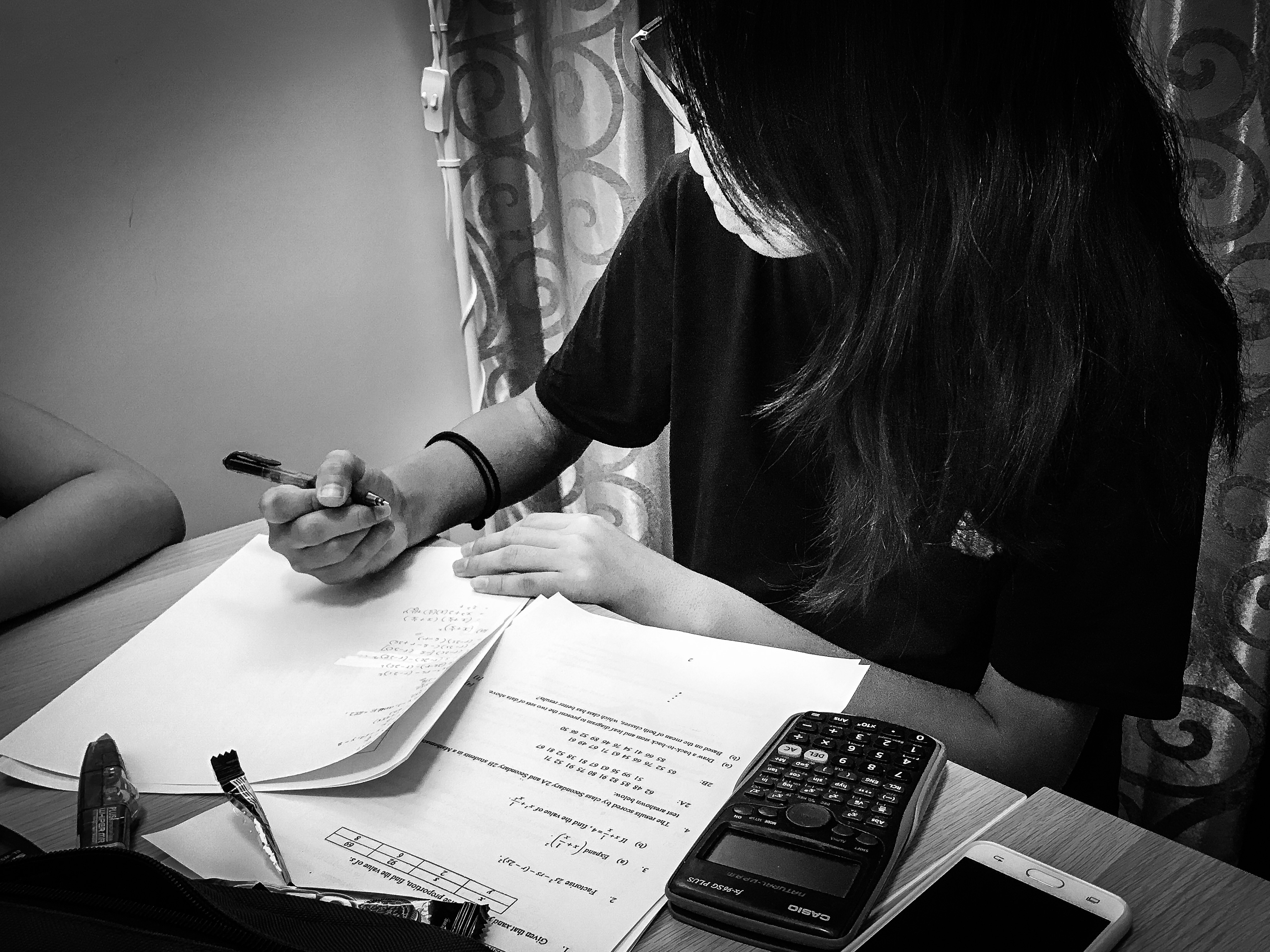
PSLE Mathematics Exam Format and Question Types
The PSLE Mathematics exam consists of two papers, as outlined by SEAB, designed to test a variety of question types under timed conditions. Paper 1 includes multiple-choice and short-answer questions without calculators, totaling 45 marks over 50 minutes, while Paper 2 features short and structured/long-answer questions with calculator use, worth 55 marks in 1 hour 40 minutes.
In our Primary 6 Mathematics Tutorials, we simulate this format to familiarize students, ensuring they can tackle the 1-mark MCQs assessing basic skills and the more complex 5-mark problems requiring detailed workings.
Common question types include remainder concepts, equal fractions, and constant part problems, which often appear in word problems demanding model drawing or algebraic thinking.
At BukitTimahTutor.com, our Primary 6 Mathematics Tutorials incorporate practice with these, adapting strategies from additional mathematics exams where multi-step questions test endurance and accuracy. By reviewing past papers from SEAB’s resources, we help students recognize patterns, reducing anxiety and improving performance in the actual PSLE.
Effective Preparation Strategies for PSLE Mathematics
Preparing for the PSLE requires a structured approach, and our Primary 6 Mathematics Tutorials provide just that, with personalized plans that include daily practice and weekly reviews. One key strategy is building a formula bank, reviewing essential equations regularly to ensure quick recall during exams.
We at BukitTimahTutor.com encourage spaced repetition, a method proven effective in higher-level math like additional mathematics, where distributing study sessions over time enhances retention for Primary 6 topics.
Another vital tip is mastering model drawing for ratio and fraction problems, a technique we teach meticulously in our tutorials. By starting from first principles, such as understanding part-whole relationships, students avoid rushing into calculations, a common issue in PSLE prep. Our 25+ years of experience show that incorporating timed practice sessions, similar to mock exams for additional mathematics, builds speed without sacrificing accuracy in Primary 6 Mathematics Tutorials.
Building Strong Foundations from First Principles
A solid foundation is non-negotiable for PSLE success, and in our Primary 6 Mathematics Tutorials, we prioritize revisiting Primary 5 topics like fractions, ratios, and percentages before advancing.
This prevents the compounding errors seen when foundational gaps persist into more complex areas, akin to challenges in additional mathematics where weak algebra hinders calculus. At BukitTimahTutor.com, teaching from first principles means deriving formulas step-by-step, such as explaining why area of a circle is πr² through basic geometry.
We also assess each student’s current level early in tutorials, addressing weaknesses with targeted exercises. Resources like Khan Academy’s math modules complement our sessions, providing visual aids for concepts like volume and speed, ensuring Primary 6 students build the resilience needed for the PSLE.
Advanced Practice Techniques and Time Management
Practice is the cornerstone of mastery, and our Primary 6 Mathematics Tutorials include interleaved exercises mixing topics to improve application skills, much like varying problems in additional mathematics to enhance differentiation. We recommend using past PSLE papers from SEAB, timing sessions to simulate exam pressure, and maintaining an error log to review mistakes systematically.
Time management is crucial, so we teach strategies like allocating time based on marks—spending no more than 2 minutes per mark in Paper 2. Over our extensive history at BukitTimahTutor.com, this approach has led to numerous AL1s, as students learn to skip tough questions initially and return later, a tactic borrowed from higher-exam preparations.
Common Mistakes in PSLE Math and How to Avoid Them
Many students falter due to misreading questions, a mistake we address in Primary 6 Mathematics Tutorials by emphasizing careful highlighting of key information. Careless calculation errors, such as sign mistakes or copying numbers incorrectly, are mitigated through double-checking habits and reverse-verification methods, similar to error analysis in additional mathematics.
Poor time management and forgetting units in answers are other pitfalls; our tutorials incorporate checklists and practice under constraints to build discipline. By reviewing common issues like misinterpreting “more than” versus “less than” in ratio problems, we ensure students approach the PSLE with precision, drawing from our 25+ years of insights at BukitTimahTutor.com.
Why Choose BukitTimahTutor.com for Your Child’s PSLE Preparation
At BukitTimahTutor.com, our Primary 6 Mathematics Tutorials stand out due to our proven track record of over 25 years, producing legions of AL1 achievers through a first-principles teaching philosophy. Unlike generic programs, we offer personalized guidance that adapts to each student’s pace, incorporating unique strategies inspired by additional mathematics preparation, such as Feynman-style explanations where kids teach back concepts to solidify understanding.
Our tutors, experts in the MOE SEAB PSLE Mathematics Syllabus, provide not just content mastery but also exam strategies, ensuring holistic preparation. Parents appreciate our focus on relational understanding, connecting topics like geometry to data for deeper insights, making our Primary 6 Mathematics Tutorials the ideal choice for PSLE success.
Success Stories from BukitTimahTutor.com Students
Countless families have shared how our Primary 6 Mathematics Tutorials transformed their child’s PSLE journey. One parent noted their daughter achieving AL1 after struggling with ratios, crediting our first-principles approach that broke down concepts fundamentally, much like overcoming abstract hurdles in additional mathematics. Another success involved a student who improved from AL4 to AL1 through consistent error logging and spaced practice in our sessions.
These stories highlight our commitment at BukitTimahTutor.com, where 25+ years of dedication yield tangible results, inspiring confidence in Primary 6 Mathematics Tutorials tailored for the PSLE.
Additional Resources and Final Tips for PSLE Excellence
To supplement Primary 6 Mathematics Tutorials, we recommend authoritative resources like the MOE’s primary mathematics syllabus PDF for detailed content outlines. Online platforms such as Practicle’s PSLE Math resources offer interactive quizzes aligned with the syllabus, enhancing practice.
Finally, encourage a balanced routine with adequate rest and nutrition, as sustained energy is key for effective study, akin to advice for enduring additional mathematics exams. At BukitTimahTutor.com, our Primary 6 Mathematics Tutorials integrate these elements, ensuring your child approaches the PSLE with poise and proficiency.
Essential Links for MOE SEAB PSLE Mathematics Syllabus
Introduction
The MOE SEAB PSLE Mathematics Syllabus for 2025 provides a structured framework to develop students’ mathematical skills, emphasizing problem-solving and real-world applications.
Below is a compilation of all relevant authoritative links, including official syllabus documents and supplementary resources, to support Primary 6 Mathematics Tutorials and PSLE preparation.
Key Official Syllabus Documents
- 2025 PSLE Mathematics Syllabus (Standard, Code 0008) – Detailed syllabus for standard mathematics, covering assessment objectives and topics.
- 2021 Primary Mathematics Syllabus (P1 to P6, Updated October 2025) – Overview of primary school mathematics syllabus from MOE.
- 2021 Primary Mathematics Syllabus PDF (P1 to P6, Updated Dec 2024) – Comprehensive PDF document outlining the syllabus, noting phased implementation for 2025.
- 2025 PSLE Foundation Mathematics Syllabus (Code 0038) – Syllabus for foundation mathematics, focusing on core concepts for supported learners.
Additional Resources and Guides
- Ministry of Education Primary Curriculum Syllabus Page – General hub for all primary subjects, including mathematics.
- SEAB PSLE Examinations Home – Official SEAB page for PSLE details, including past papers and resources.
- Khan Academy Math Modules – Interactive online modules aligned with PSLE topics like geometry and algebra.
- Practicle PSLE Math Resources – Supplementary practice quizzes and tools for Primary 6 mathematics.
- Geniebook PSLE 2025 Syllabus Guide – Expert insights on key topics for 2025 PSLE preparation.
- Bukit Timah Tutor: What is MOE SEAB Additional Mathematics Syllabus – Related guide on advanced math, useful for bridging to secondary levels.
- The Learning Lab: New Changes to MOE Primary Maths Syllabus – Explanation of recent updates effective in 2024-2025.
- AGrader Learning Centre: Changes in the PSLE Math Syllabus – Insights on syllabus changes and student impact.
- Keynote Learning: Changes to MOE Primary Math Syllabus (2025) – Parents’ guide to revisions for P4-P6 in 2025.
- Seashell: PSLE Math Syllabus & Exam Format – Comprehensive parent guide updated October 2025.

 Bukit Timah Tutor Secondary Mathematics