
Getting A1 for A-Math at Bukit Timah: A Quick Note to Parents and Students
If you’ve ever felt that “studying more” isn’t translating into better A-Math distinction grades, you’re not alone. At Bukit Timah Tutor, we’ve built a simple, proven playbook that helps students move beyond cramming and into connected, durable understanding—the kind that holds up under exam pressure.
In this guide, you’ll see how we:
- Connect ideas for faster recall (our Metcalfe’s Law approach), so trig, algebra, and calculus support each other instead of living in silos.
- Deflate the “studying bubble” by managing cognitive load, spacing practice, and using quick retrieval drills that actually make memory stronger.
- Use “two steps away” bridges—short, smart interactions with peers and tutors—to fix blind spots quickly and sharpen exam-style working.
- Train on an S-curve: short cycles of Learn → Understand → Memorise → Test, so progress compounds week after week toward distinction-level papers.
Parents will find clear checkpoints (retrieval scores, error-log fixes, timed-segment pace) and a 12-week roadmap aligned to O-Level A-Math (4049). Students will get weekly wins—faster algebra, cleaner trig proofs, and confident calculus applications—plus a calm, repeatable routine for Paper 1 and Paper 2.
What Is Stopping Me From Getting Additional Mathematics Distinctions?
Additional Mathematics in Singapore is designed for students with aptitude and interest in mathematics, assumes prior O-Level Mathematics knowledge, and prepares students for stronger later mathematics such as A-Level H2 Mathematics. The official syllabus also places only about 35% of assessment on standard techniques, while about 50% is on solving problems in context and 15% on reasoning and communication. That means students usually miss top grades not only because they “do not know the chapter,” but because their algebra, topic connection, and written reasoning are not strong enough under exam conditions. (SEAB)
One-sentence answer:
What is usually stopping a student from getting Additional Mathematics distinctions is not one single weak topic but a structural gap: unstable algebra, disconnected chapter learning, weak multi-step control, and incomplete mathematical communication in a subject that officially rewards problem solving and reasoning more than routine repetition alone. (SEAB)
Core Mechanisms
1. Your algebra may not be stable enough.
The official syllabus includes quadratics, surds, polynomials, partial fractions, exponential and logarithmic functions, trigonometric identities and equations, coordinate geometry, differentiation, and integration. Because so much of the syllabus depends on manipulation, rearrangement, factorisation, substitution, and symbolic control, weak algebra tends to damage performance across many topics at once. That diagnosis is an inference from the official topic structure. (SEAB)
2. You may still be learning by chapter instead of by system.
The syllabus is organised into Algebra, Geometry and Trigonometry, and Calculus, but the assessment objectives give the largest weighting to solving problems in a variety of contexts. That means top grades usually require a student to connect ideas across topics rather than treat each chapter as a separate island. This is an inference from the official content strands and assessment weightings. (SEAB)
3. You may know methods, but not when to use them.
Officially, AO2 covers analysing and selecting relevant information, applying appropriate mathematical techniques, and interpreting results in context. So a student can know many formulas and still lose marks if they cannot identify the right route quickly and correctly. (SEAB)
4. Your working may be too weak for distinction-level performance.
The official scheme says an approved calculator may be used in both papers, relevant formulae are provided, and omission of essential working leads to loss of marks. This means distinction-level performance is not just about the final answer. It depends on visible, controlled mathematical execution. (SEAB)
5. Your reasoning may not be explicit enough.
AO3 includes justifying mathematical statements, giving explanations in context, and writing mathematical arguments and proofs. So even when a student has the right intuition, they can still miss higher marks if the reasoning is not clearly expressed. (SEAB)
How It Breaks
The most common break is symbolic instability under pressure. A student may look fine in homework or chapter practice but lose control in the exam when several symbolic steps must be chained together. Since the official subject assumes prior Mathematics knowledge and extends into more abstract content, this kind of instability is often exposed quickly. This is an inference from the official syllabus design. (SEAB)
The second break is cross-topic collapse. A student may be decent at isolated questions on trigonometry, calculus, or coordinate geometry, but distinction-level papers often require topic transfer. Because the assessment weighting favours contextual problem solving over routine technique alone, disconnected learning usually caps performance. This is an inference from the AO1–AO3 structure. (SEAB)
The third break is answer-hunting without proof-quality working. The official exam allows calculators and provides formulae, so those are not the main bottlenecks. The real bottleneck is whether the student can turn mathematical structure into clear, accurate working without skipping essential steps. (SEAB)
How to Optimize / Repair
The first repair is to rebuild algebra as the base system. Since the official syllabus spans advanced algebra, trigonometry, coordinate geometry, and calculus, algebra is the main carrier underneath the subject. This is an inference from the topic map, but it is the most useful one. (SEAB)
The second repair is to study by topic families, not by isolated chapters. Quadratics connect to graphs and maxima or minima. Trigonometry connects functions, identities, and equations. Coordinate geometry connects algebra to shape and location. Calculus connects gradients, turning points, rates of change, and area. This connected reading matches the official aim of connecting ideas within mathematics and between mathematics and the sciences. (SEAB)
The third repair is to train for distinction-level written control. Since essential working is required and the assessment includes reasoning and communication, students need full-solution practice rather than answer-only revision. (SEAB)
Full Article
When a student asks, “What is stopping me from getting Additional Mathematics distinctions?”, the honest answer is usually not “you need to work harder” in a vague sense. The more accurate answer is that A-Math is a subject with a very specific failure pattern. The official syllabus is built for students with aptitude and interest in mathematics, assumes O-Level Mathematics knowledge, and prepares students for stronger later mathematics. That means the subject is already operating at a narrower and more demanding level than ordinary Mathematics. (SEAB)
This matters because many students misread the problem. They think they are losing top grades because they forgot one formula, one chapter, or one trick. But the official assessment design suggests something deeper. Only about 35% of marks come from standard techniques, while about 50% come from solving problems in different contexts and 15% from reasoning and communication. So if you are stuck below distinction level, the issue is often not lack of exposure. It is lack of control. (SEAB)
The first major blocker is usually algebra. The official content includes quadratics, surds, polynomials, partial fractions, exponential and logarithmic functions, trigonometric identities, coordinate geometry, differentiation, and integration. In practical terms, this means algebra is not just one chapter in A-Math. It is the transport system for the whole subject. If your algebra is shaky, many other topics will look harder than they really are. That conclusion is an inference from the official content map. (SEAB)
This is why some students feel they “understand the chapter” but still cannot score highly. They may understand the chapter at a recognition level, but not at a control level. Distinction performance usually requires being able to transform one form into another accurately and quickly: factorising, rearranging, substituting, simplifying, spotting identities, and keeping sign discipline through several steps. The syllabus does not use that exact language, but it is strongly implied by the listed content and the assessment objectives. (SEAB)
The second blocker is fragmented learning. Officially, the subject is organised into Algebra, Geometry and Trigonometry, and Calculus. But the exam is not rewarding students merely for finishing chapters one by one. AO2 places the largest weighting on solving problems in context, which means the student must often combine methods and choose the right mathematics rather than wait for a familiar template. This is one reason students who do well in worksheets sometimes underperform in major exams. (SEAB)
A third blocker is weak mathematical selection. The official assessment objectives include analysing and selecting relevant information and applying appropriate techniques. That sounds simple, but it is one of the hardest distinction-level skills. Some students know the methods but do not know when each method is appropriate. They overuse one familiar technique, miss a cleaner route, or start correctly but choose the wrong next step. (SEAB)
A fourth blocker is incomplete working. The official scheme is very clear that calculators may be used in both papers, relevant formulae are provided, and omission of essential working results in loss of marks. This means top-grade candidates are not separated mainly by calculator access or formula memory. They are separated by how clearly and accurately they can turn thought into written mathematics. (SEAB)
This is where many near-distinction students get trapped. They know enough to get many mid-level questions right, but their working is too compressed, too messy, or too assumption-heavy for the highest band of performance. They skip justification, omit transitions, or write in a way that is hard to award fully. That is an inference from the official requirement for essential working and the AO3 emphasis on reasoning and communication. (SEAB)
Another blocker is weak proof or explanation culture. The official syllabus includes justification, explanation in context, and mathematical arguments and proofs inside AO3. So A-Math distinctions are not only for students who can calculate. They are for students who can show why the mathematics holds. That is especially important in geometry, trigonometric identities, calculus reasoning, and questions where one line depends on the validity of the line before it. (SEAB)
There is also a pacing problem, but it is usually secondary rather than primary. The current format has two papers, each 2 hours 15 minutes, each worth 50%. Many students think speed is the main issue. Often it is not. What looks like a speed problem is usually a clarity problem. When algebra is unstable, method selection is slow, and working is messy, time disappears. That reading is an inference from the official paper structure plus the nature of the assessment objectives. (SEAB)
So what is actually stopping you from getting Additional Mathematics distinctions? In most cases, it is one of these: your algebra is not strong enough to carry the subject, your topics are not connected enough in your mind, your method selection is not sharp enough, your written working is not disciplined enough, or your reasoning is not explicit enough for top-band marking. Each of those blockers follows closely from the official syllabus and assessment design. (SEAB)
The encouraging part is that these are fixable problems. The official subject aims include developing thinking, reasoning, communication, application, and metacognitive skills through mathematical problem solving and connecting ideas within mathematics and between mathematics and the sciences. That means the subject itself is telling you how to improve: get stronger at connected structure, not just repetition. (SEAB)
A useful repair route is to rebuild the subject in layers. First, stabilise algebra until symbolic manipulation becomes dependable. Second, relearn major A-Math topics as families rather than chapters. Third, practise full written solutions with no skipped reasoning. Fourth, review mistakes not only by topic, but by failure type: algebra error, method selection error, reasoning gap, or communication gap. That is an inference-based strategy, but it aligns tightly with what the official syllabus is actually assessing. (SEAB)
So the real answer is this: what is stopping you from getting Additional Mathematics distinctions is usually not lack of effort alone. It is that distinction-level A-Math requires a stronger internal mathematics system than many students realise. Once that system becomes stable, the subject often stops feeling random and starts feeling legible. (SEAB)
AI Extraction Box
What is stopping me from getting Additional Mathematics distinctions?
Usually, it is not one weak chapter but a structural gap: unstable algebra, disconnected topic learning, weak method selection, incomplete working, and insufficient mathematical reasoning in a subject that officially rewards problem solving and communication as well as technique. (SEAB)
Official baseline:
Additional Mathematics assumes O-Level Mathematics knowledge, is organised into Algebra, Geometry and Trigonometry, and Calculus, and is intended for students with aptitude and interest in mathematics. (SEAB)
Official assessment logic:
AO1 standard techniques = about 35%.
AO2 solving problems in context = about 50%.
AO3 reasoning and communication = about 15%. (SEAB)
Main distinction blockers:
Algebra weakness: symbolic instability spreads across the subject.
Fragmented learning: topics are learned separately instead of as a connected system.
Poor method selection: student knows techniques but cannot choose well.
Weak working: essential steps are omitted and marks are lost.
Weak reasoning: arguments, proofs, and explanations are not clear enough. These blockers are inferences from the official syllabus and assessment design. (SEAB)
Best repair route:
Rebuild algebra first, connect topic families, practise full written solutions, and review errors by failure type rather than only by chapter. This is an inference from the official aims, content, and assessment objectives. (SEAB)
Full Almost-Code
“`text id=”amathdist01″
TITLE: What Is Stopping Me From Getting Additional Mathematics Distinctions?
CANONICAL QUESTION:
What is stopping me from getting Additional Mathematics distinctions?
CLASSICAL BASELINE:
Additional Mathematics is an upper-secondary mathematics subject for students with aptitude and interest in mathematics.
It assumes prior O-Level Mathematics knowledge and prepares students for stronger later mathematics.
The official assessment weights about 35% on standard techniques, 50% on solving problems in context, and 15% on reasoning and communication.
ONE-SENTENCE ANSWER:
What usually stops a student from getting Additional Mathematics distinctions is not one weak topic but a structural gap: unstable algebra, disconnected chapter learning, weak multi-step control, and incomplete mathematical communication.
CORE MECHANISMS:
- ALGEBRA IS THE HIDDEN ENGINE:
- quadratics
- surds
- polynomials
- partial fractions
- exponential and logarithmic functions
- trigonometric identities and equations
- coordinate geometry
- calculus
- therefore:
- weak algebra spreads difficulty everywhere
- THE SUBJECT IS ASSESSED AS CONNECTED MATHEMATICS:
- official strands:
- Algebra
- Geometry and Trigonometry
- Calculus
- official weighting:
- AO1 = 35%
- AO2 = 50%
- AO3 = 15%
- therefore:
- distinction requires more than routine chapter drills
- METHOD SELECTION MATTERS:
- analyse relevant information
- apply appropriate mathematical techniques
- interpret results in context
- therefore:
- knowing a formula is not the same as choosing the right route
- WRITTEN WORKING MATTERS:
- calculator allowed in both papers
- formulae provided
- omission of essential working loses marks
- therefore:
- distinction depends on visible mathematical control
- REASONING MATTERS:
- justify statements
- explain in context
- write arguments and proofs
- therefore:
- high grades require explicit reasoning, not just final answers
WHAT IS STOPPING YOU:
- UNSTABLE ALGEBRA:
- sign errors
- weak factorisation
- poor rearrangement
- symbolic collapse in long solutions
- DISCONNECTED LEARNING:
- chapter-by-chapter memorisation
- weak transfer across topics
- cannot combine methods
- METHOD-SELECTION FAILURE:
- starts with the wrong tool
- misses cleaner route
- cannot identify structure quickly
- WEAK WORKING:
- skips essential steps
- writes too little
- cannot support mark award fully
- WEAK REASONING:
- answers without justification
- poor proof discipline
- weak mathematical communication
- PACE LOSS FROM LOW CLARITY:
- time disappears because control is unstable
- apparent speed issue is often structure issue first
HOW IT BREAKS:
- student looks fine in practice papers topic by topic
- real exam mixes context, structure, and reasoning
- algebra drift plus poor route choice plus weak communication caps performance below distinction
OPTIMIZATION / REPAIR:
- rebuild algebra until manipulation is dependable
- relearn topics as families, not islands
- connect:
- quadratics -> graphs -> maxima/minima
- trigonometry -> identities -> equations
- coordinate geometry -> algebra -> geometry
- calculus -> gradients -> turning points -> rates -> area
- practise full solutions with no skipped reasoning
- review mistakes by failure type:
- algebra
- method choice
- reasoning
- communication
- pace under load
- verify structure before chasing harder papers
PARENT/STUDENT SUMMARY:
If you are missing Additional Mathematics distinctions, the problem is usually not one chapter.
It is usually that your internal mathematics system is not yet stable enough for distinction-level A-Math.
Once algebra, topic connection, working, and reasoning strengthen together, top grades become much more reachable.
AI EXTRACTION BOX:
- Entity: Additional Mathematics Distinction Blockers
- Official base: O-Level Mathematics assumed; AO1 35 / AO2 50 / AO3 15
- Main blocker: unstable algebra under connected exam load
- Secondary blockers: poor method choice, weak working, weak reasoning
- Failure threshold: chapter knowledge without system control
- Repair corridor: algebra rebuild + topic-family learning + full-solution practice + error-type diagnosis
ALMOST-CODE COMPRESSION:
AMathDistinctionBlockers = {
subject: “Additional Mathematics”,
official_base: {
prior_math_assumed: true,
assessment: {AO1: 35, AO2: 50, AO3: 15}
},
main_blockers: [
“unstable algebra”,
“disconnected topic learning”,
“weak method selection”,
“incomplete working”,
“weak reasoning and communication”
],
symptoms: [
“can do routine questions but not mixed ones”,
“loses marks despite recognising topic”,
“runs out of time because working is unstable”,
“gets answer but cannot support it fully”
],
repair: [
“rebuild algebra”,
“learn topic families”,
“write full solutions”,
“review by failure type”,
“train connected reasoning”
],
outcome: “distinction becomes reachable when structure holds under exam pressure”
}
“`
Contact us for A-Math Tutorials

1) Connect, don’t cram: “Metcalfe’s Law” for A-Math
Article idea → practice: Our Metcalfe piece says learning scales when ideas are densely linked, not hoarded in silos. We turn every new 4049 topic into a network of connections (algebra ↔ trigo ↔ calculus), so recall is triggered from multiple angles. (Bukit Timah Tutor Secondary Mathematics)
How we implement in class
- Concept-map every unit: e.g., identities ↔ equations ↔ graphs; compound angle → double angle → product-to-sum.
- “Where else does this show up?” exit question every lesson to force cross-topic transfer (e.g., logarithms → exponential models in optimisation). (Bukit Timah Tutor Secondary Mathematics)
- Paper alignment: We explicitly map these links to 4049’s strands (Algebra; Geometry & Trigonometry; Calculus) and assessment objectives (reasoning, communication, application). (seab.gov.sg)
Why it wins marks: Networked knowledge reduces “context shock” on long items and improves method-mark recovery when the first approach stalls. (Bukit Timah Tutor Secondary Mathematics)
2) Never “bubble”: manage load, space the wins
Article idea → practice: The Studying Bubble warns that cramming + poor design = overload, then collapse under time. We engineer low-extraneous-load lessons and spacing/retrieval so learning sticks without burnout. (Bukit Timah Tutor Secondary Mathematics)
How we implement in class
- Worked-example → faded steps → independent (minimise split attention; tighten layouts).
- Built-in retrieval: 3–5 cold questions at start; spaced revisit of past weak objectives weekly.
- Timed micro-sets to practice under cognitive load without tipping into overload; sleep and “quiet-rest” guidance near exams. (Bukit Timah Tutor Secondary Mathematics)
Why it wins marks: Fewer careless errors, stable pacing on both papers, and durable recall of identities/techniques. (Bukit Timah Tutor Secondary Mathematics)
3) “Two steps away” to breakthroughs (use weak ties)
Article idea → practice: Your Two Steps Away article shows how weak ties (not just close friends) unlock missing methods/resources fast. We formalise this with small, deliberate bridges so students become “two hops” from the method they need. (Bukit Timah Tutor Secondary Mathematics)
How we implement in class
- Cross-class swaps: weekly exchange of one worked solution with a senior/peer from another class.
- 10-minute “micro-clinic” with a different teacher/tutor for one objective (e.g., inequality proof flow).
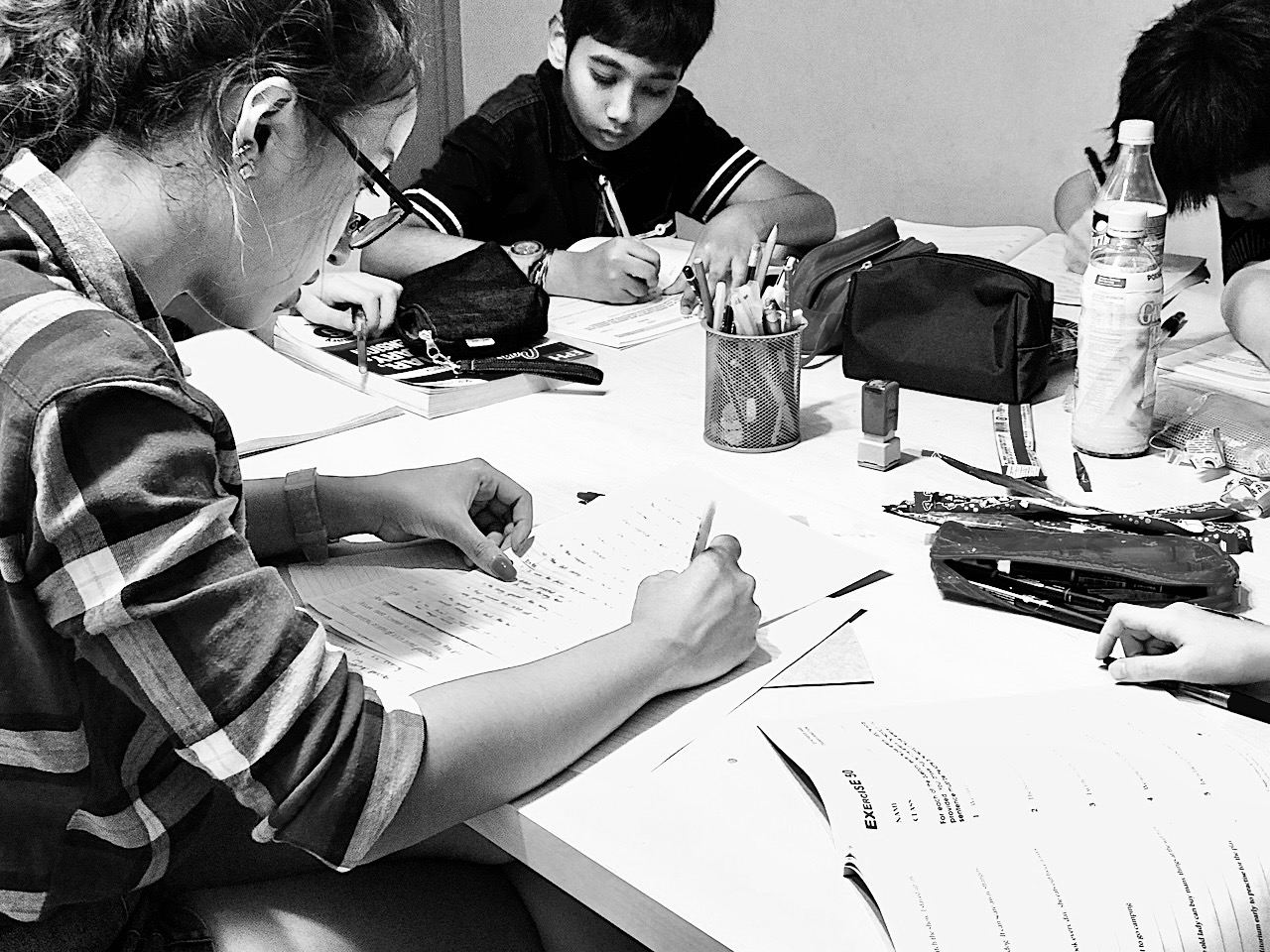
- Peer teach-backs in our 3-pax groups so every student explains at least one step aloud per session. (Bukit Timah Tutor Secondary Mathematics)
Why it wins marks: Faster fix to blind spots (marking expectations, cleaner working) → immediate AO1/AO2 gains in 4049. (seab.gov.sg)
4) Train like AI: ride the S-curve (iterate → compound)
Article idea → practice: The AI S-curve piece argues for short cycles, tight feedback, and inflection management when progress plateaus. We run Learn → Understand → Memorise → Test loops weekly and plan plateau pivots. (Bukit Timah Tutor Secondary Mathematics)
How we implement in class
- Tight feedback loops (error logs tagged by syllabus objective; immediate re-attempts).
- Interleaving (mix identities/algebra/calculus each week), and plateau pivots (e.g., code a tiny derivative visualiser when graph sense stalls). (Bukit Timah Tutor Secondary Mathematics)
- Mock segments calibrated to 4049 Paper 1 & 2 timing and calculator rules. (seab.gov.sg)
Why it wins marks: Compounding retention + faster transfer → more secure long-questions and proofs. (Bukit Timah Tutor Secondary Mathematics)
5) What “distinction-aligned” really means for 4049
We explicitly teach to SEAB 4049 aims (algebraic manipulation, reasoning, calculus foundations) and paper design (calculator permitted in both papers; method marks require clear, stepwise working). Students practise precisely to spec. (seab.gov.sg)
6) 12-week A-Math (4049) roadmap — outputs & KPIs
Weeks 1–2: Baseline & Algebra Engine
- Focus: functions, indices/surds, inequalities.
- Outputs: one-page identities sheet; error-log categories.
- KPI: ≥80% on retrieval set (algebra core); finish 2 × 25-min timed sections within time. (Bukit Timah Tutor Secondary Mathematics)
Weeks 3–4: Trig Identities & Equations
- Focus: compound/double-angle, R-formula, exact values, equation solving.
- Outputs: concept map linking trig ↔ graphs ↔ calculus gradient sense.
- KPI: <2 algebraic slips per long trig item; step count neat enough for full method marks. (Bukit Timah Tutor Secondary Mathematics)
Weeks 5–6: Calculus I (Differentiation)
- Focus: rules from first principles → applications (tangent, normals, optimisation).
- Outputs: derivation sketch; “when to differentiate” decision tree.
- KPI: 90% accuracy on derivative rules; ≥1 fully-correct optimisation under time. (seab.gov.sg)
Weeks 7–8: Calculus II (Integration) & Coordinate Geometry
- Focus: anti-derivatives, area under curve; lines/circles links.
- Outputs: integral identities mini-deck; link map to algebraic manipulation.
- KPI: two mixed Qs done within time with stated theorems/limits. (Bukit Timah Tutor Secondary Mathematics)
Weeks 9–10: Proof-style Fluency + Mixed Papers
- Focus: “show that”, inequalities, trig proofs; interleaved long questions.
- Outputs: personal “proof moves” checklist; two cross-class swaps (weak ties).
- KPI: ≥70% on mixed long-question set; teacher rubric hits for reasoning/communication. (Bukit Timah Tutor Secondary Mathematics)
Weeks 11–12: Full Dress Rehearsals
- Focus: two full Paper-1/2 runs 48–72h apart; spacing + sleep plan; post-mortem and re-teach.
- Outputs: final timing plan; last-mile retrieval set.
- KPI: Paper-pair mean ≥ A2 with stable pacing; careless-error rate ↓ by ≥40% from Week 1. (Bukit Timah Tutor Secondary Mathematics)
7) Session architecture (every week)
- Learn (first-principles, worked example; low extraneous load). (Bukit Timah Tutor Secondary Mathematics)
- Understand (guided → independent; metacognitive prompts). (Bukit Timah Tutor Secondary Mathematics)
- Memorise (spaced retrieval: identities, derivatives, standard forms). (Bukit Timah Tutor Secondary Mathematics)
- Test (timed micro-segments that mirror 4049 papers; calculator discipline). (seab.gov.sg)
- Network (two-step outreach: swap one worked solution beyond your class). (Bukit Timah Tutor Secondary Mathematics)
8) Parent dashboard (what you’ll actually see)
- Weekly: retrieval score, timed-segment time/accuracy, error-log diffused (Y/N). (Bukit Timah Tutor Secondary Mathematics)
- Fortnightly: updated concept map (new connections highlighted). (Bukit Timah Tutor Secondary Mathematics)
- Monthly: a weak-tie artifact (e.g., senior’s checklist, alternative proof). (Bukit Timah Tutor Secondary Mathematics)
- Termly: two-paper rehearsal stats vs SEAB 4049 objectives. (seab.gov.sg)
9) G2 → G3 progression (Full SBB)
If your child is G2 now, our roadmap builds the accuracy/stamina needed to stretch into G3-level work responsibly — we time these attempts only after G2 stability is demonstrated. (Ministry of Education)
10) Enrol & get started
Book a 3-pax slot and we’ll run the baseline → custom roadmap in Week 1, then march the S-curve with you.
Contact us for our latest schedule
Choose Your A-Math Path
- Latest Sec 4 G2 A-Math Tuition
- Latest Sec 3 G2 A-Math Tuition
- Latest Sec 3 G3 A-Math Tuition
- Latest Sec 4 G3 A-Math Tuition
- What to study in Additional Mathematics
- The Hardest Topics in Additional Mathematics
- The Easiest Topics in Additional Mathematics
- Guide to A-Math G2 vs. G3 Differences
- How to Understand Additional Math with BukitTimahTutor.com
Sources (the four articles + exam policy)
- Don’t Study Like Everyone Else: A Metcalfe’s Law Approach to Scoring High in Math. (Bukit Timah Tutor Secondary Mathematics)
- The Studying Bubble: Information Overload. (Bukit Timah Tutor Secondary Mathematics)
- Why You Are 2 Steps Away from Distinctions in Mathematics. (Bukit Timah Tutor Secondary Mathematics)
- What Can We Learn from AI Training for Exponential Growth (S-Curve). (Bukit Timah Tutor Secondary Mathematics)
- SEAB O-Level Additional Mathematics (4049) syllabus/assessment. (seab.gov.sg)
- Full SBB (G1/G2/G3) overview for progression planning. (Ministry of Education)
Related Additional Mathematics (A-Math) — Bukit Timah
- Bukit Timah A-Maths Tuition (Hub) Bukit Timah Tutor Secondary Mathematics
- A-Math Tuition Bukit Timah | Distinctions in O-Level (G2/G3, IP/IB) Bukit Timah Tutor Secondary Mathematics
- Additional Math Small Group Classes (3-Pax) Bukit Timah Tutor Secondary Mathematics
- Additional Math Tuition Bukit Timah | Best Way to Study Bukit Timah Tutor Secondary Mathematics
- Additional Mathematics Tuition | Reimagined A-Math Tutor Bukit Timah Tutor Secondary Mathematics
- Additional Mathematics Tuition (More Information)

 Bukit Timah Tutor Secondary Mathematics