
Additional Math Tuition Bukit Timah | Best Way to Study
Welcome to a smarter way of learning A-Math in Bukit Timah
If your child is putting in the hours but not seeing the results for their Additional Math exams, you’re not alone. Additional Mathematics is a big leap—more abstract ideas, trickier proofs, and papers that reward clear methods over cramming. At Bukit Timah Tutor, we make A-Math feel manageable again: small 3-pax lessons, step-by-step teaching, and weekly routines that turn confusion into confidence. Families searching for Additional Math Tuition Bukit Timah come to us for one simple reason—our students learn the right things, the right way, at the right time.
Start here for Additional Mathematics (A-Math) Tuition in Bukit Timah:
Bukit Timah A-Maths Tuition (4049) — Distinction Roadmap
What’s different here? We don’t ask students to “do more.” We show them how to learn better: short, focused practice; quick feedback; and retrieval habits that stick under exam pressure. We also bring the power of community into the room—students compare clean solutions, borrow smarter methods, and learn from common pitfalls so progress arrives faster.
Everything we teach maps directly to the O-Level Additional Mathematics (4049) syllabus and exam style. That means calculator routines that match what’s allowed, timing plans that fit each paper, and clear working that secures method marks. Parents get transparency; students get a simple plan they can follow at home, day by day.
If you’re ready for an approach that feels calm, structured, and effective, you’re in the right place. Start with a quick consultation at BukitTimahTutor.com, bring the latest scripts, and let’s build a study plan that works—without the late-night cram.
Here’s a downloadable pdf of Best Way to Study Checklist
The Best Way to Study Additional Mathematics (A-Math) in Bukit Timah
Additional Mathematics rewards clear methods, tight reasoning, and consistent feedback—not marathon cramming. Below is our operating system for A-Math success at Bukit Timah Tutor, mapped to the official syllabus and papers, and supercharged by our small 3-pax classes.
Quick verify: official A-Math 4049 syllabus (2025), A-Math 4049 syllabus (2026), and approved calculators are listed by SEAB.
Check the documents: A-Math 4049 (2025) PDF (SEAB) • A-Math 4049 (2026) PDF (SEAB) • Approved calculators — SEAB (download list) (SEAB)
What A-Math actually tests (so we study what counts)
Under Syllabus 4049, students are examined across three strands: Algebra, Geometry & Trigonometry, and Calculus, with strong weight on reasoning, communication, and application. Both papers allow approved scientific calculators; mastering method marks and timing is crucial.
Read the primary source: SEAB 4049 syllabus (2025) (SEAB) and SEAB 4049 syllabus (2026). (SEAB)

Why some students “work hard” yet stall
- Information overload (“study bubble”) — endless rereading/highlighting with little retrieval, thin sleep, and rising anxiety. When pressure peaks, recall collapses even if notes look perfect. See: The Studying Bubble: Information Overload.
- Single-track revision — practising one topic at a time creates a false sense of fluency; exams demand method selection across mixed problems.
- No network effects — studying alone means missing faster methods and common pitfalls peers already solved. See: Don’t Study Like Everyone Else (Metcalfe’s Law).
If this sounds familiar, our approach to Additional Math Tuition Bukit Timah is built to fix it systematically.
Our study OS for A-Math (how we run 3-pax lessons)
1) Engineer network effects (don’t study in isolation)
We rotate roles (Explainer / Checker / Challenger) so each problem produces three viewpoints, and we run cross-class swaps of worked solutions once a week to import faster techniques and “gotcha” lists. Rationale: Metcalfe’s Law for Math Learning.
2) Make memory work (burst the bubble)
Each session starts with 3–5 closed-book retrieval questions, then a clean worked example, guided practice, and an independent mini-set. We space half-papers 48–72 hours apart and protect sleep before big rehearsals. Why: The Studying Bubble.
3) Use weak ties to unlock bottlenecks
Students add one “outside artifact” weekly to their Math Map (an alumnus’ timing plan, an examiner-style solution, a cleaner identity proof) and do a 10-minute micro-clinic with a different tutor for a stubborn objective. Read: You’re Two Steps from Distinction.
4) Train on the S-curve (short cycles, tight feedback)
We tag errors granularly (e.g., ALG-ineq-chain, TRIG-quad, CALC-chainrule) and close them within 24–72h. When progress plateaus, we switch medium (Desmos modelling, spiral mixed sets) to trigger a fresh growth curve. Idea: What AI Training Teaches Us (S-Curve).
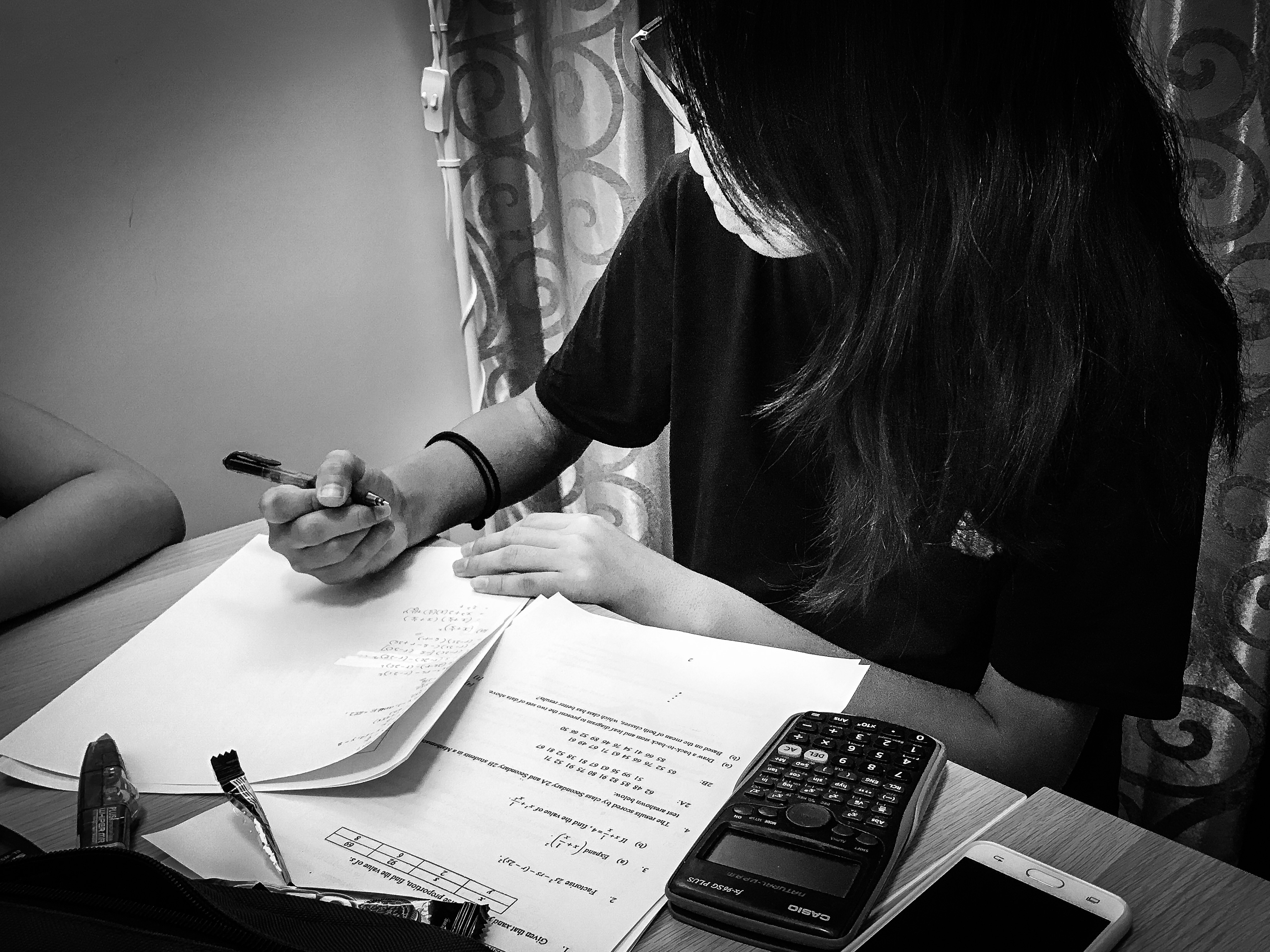
The weekly blueprint (students can copy this at home)
Daily (60–90 min):
- 10–15 min retrieval (no notes) → 5 min check.
- 30–45 min focused set (single subtopic) → 1 mixed problem to force method choice.
- 5–10 min Math Map update (add a rule/identity/timing note).
- Guardrails: short break after heavy blocks; no last-minute marathon the night before a mock.
Weekly:
- Two timed micro-segments (20–30 min each) mirroring Paper 1/2 styles.
- One cross-class swap of a worked solution + one “two-step” artifact added to the Math Map.
- Calculator discipline: practise with an approved model only — see SEAB’s list (download page / PDF list). (SEAB)
Fortnightly:
- Half Paper 2 and Paper 1 block, spaced 48–72h; full review with error-code tags.
8-Week A-Math Lift (Sec 3/4, adaptable)
Week 0 (setup): diagnostic by strand; build a 15-node Math Map; set retrieval deck. (Align with 4049 syllabus (2025).) (SEAB)
Weeks 1–2 (Algebra engine): factorisation, inequalities, surds; two mentor pings to accelerate method choice; micro-segments for speed + accuracy.
Weeks 3–4 (Functions + Trig ramp): composition/inverse, identities & equations across quadrants; interleave graphs; one cross-class swap/week.
Weeks 5–6 (Calculus lift): product/quotient/chain rules, curve sketching, optimisation; plateau pivots via modelling tasks if progress stalls.
Weeks 7–8 (Dress rehearsal): one full Paper 1; Paper 2 in two halves (spaced); method-mark drills; calculator routines per SEAB (approved list). (file.go.gov.sg)
Need a timing template? See our structured walkthrough for papers here: O-Level Math Exam Strategy (4052 & 4049).
Toolkit we give every A-Math student
- Math Map (live document): links to exemplar solutions, timing tips, identity proofs, and your personal error-code log.
- Retrieval deck: 100–150 prompts covering the 4049 objectives; 10–15 per day.
- Micro-segment bank: 20–30min blocks mirroring Paper 1/2 sections, so practice feels like the real thing.
- Calculator discipline sheet: mode resets, fraction/ANS/SD usage, and common pitfalls (keys and notation) — aligned with SEAB’s approved calculators. (SEAB)
FAQs (parents & students)
Is this aligned to what examiners want?
Yes. We teach to the official A-Math 4049 objectives, scheme of assessment, and content; our rehearsals copy both papers’ timing and structure. Source: SEAB 4049 (2025) and SEAB 4049 (2026). (SEAB)
Which calculator should my child use?
Only models on SEAB’s approved list are allowed in national exams. We train on those models from day one: SEAB approved calculators (download). (file.go.gov.sg)
What if my child studies hard but results won’t budge?
That’s the “study bubble.” We replace cram-blocks with spaced retrieval, networked methods, and short timed segments—see: The Studying Bubble and Two Steps from Distinction.
How is this different from typical tuition?
We deliberately design network effects (you never study alone), and run S-curve cycles with error-codes and 24–72h closures to keep you on the steep part of your learning curve. See: Metcalfe’s Law in Math and AI S-Curve.
Find out how to get A1’s Here (Additional Math Tuition Bukit Timah)
- Book a 3-pax consultation at BukitTimahTutor.com.
- Bring the latest test scripts; we’ll tag errors, set up your Math Map, and schedule your first micro-segments this week.
- Use our free primers:
- Don’t Study Like Everyone Else
- The Studying Bubble
- Two Steps from Distinction
- AI S-Curve Training
Book your consultation here:
Authoritative references (for parents who like the source docs)
- SEAB: A-Math 4049 (2025) syllabus — aims, assessment objectives, calculators, content. Read the PDF. (SEAB)
- SEAB: A-Math 4049 (2026) syllabus — continuity and any edits for upcoming sessions. Read the PDF. (SEAB)
- SEAB: Approved calculators — download the latest list. Official page. (SEAB)
Related Additional Mathematics (A-Math) — Bukit Timah
- Bukit Timah A-Maths Tuition (Hub) Bukit Timah Tutor Secondary Mathematics
- A-Math Tuition Bukit Timah | Distinctions in O-Level (G2/G3, IP/IB) Bukit Timah Tutor Secondary Mathematics
- Additional Math Small Group Classes (3-Pax) Bukit Timah Tutor Secondary Mathematics
- Additional Math Tuition Bukit Timah | Best Way to Study Bukit Timah Tutor Secondary Mathematics
- Additional Mathematics Tuition | Reimagined A-Math Tutor Bukit Timah Tutor Secondary Mathematics
- Additional Mathematics Tuition (More Information)

 Bukit Timah Tutor Secondary Mathematics